
The Anthropocene is a geological term describing the period in which humankind has fundamentally altered the Earth’s global systems – in fact, the period in which cultural evolution began, and still continues, up until the moment of the end. The end-event is an imaginary point on the timeline where an apocalypse will occur, in the most literal sense of the word: after the revelation, or more precisely after the veil is lifted from the future. That is to say, the very “-calypsis” is nothing more than the forward gaze along the timeline into the unknown, and implicitly, when we imagine the apocalypse, we assume that we live in a problematic present that could lead to an even more problematic future. All that is left to us is to “take ourselves in hand” and improve it. This is the essence of the “philosophy of technology,” which assumes that we live in an “Age of Reckoning”.
This term was coined by Prof. David L. Rodland, a geologist at Muskingum University in Ohio. As a geologist, none is better suited to testify that the Earth is accustomed to cycles of life and death, to “historical resets”, that is, cosmic events in which the world is destroyed and rebuilt. This is the nature of the world, and it is not unlikely that we too will reach such a point. And the reason it is not unlikely is because, from the very birth of culture itself, the seed of calamity sprouted — and that seed of calamity is none other than the uncontrolled release of carbon dioxide and other gases into the atmosphere, creating a greenhouse effect. This was born from the spark of life — literally — fire. Fire, before it even worked its charms upon the human race and set cultural evolution in motion, was already a double-edged sword.
Fire is at once a force of life and of death. Through it, we can understand how the same spark that drove consciousness and technology is also the one that today threatens to make us witnesses to the apocalypse of the “Age of Reckoning.”
Fire was humanity’s first technology, but also its first religious symbol. The moment our ancestors learned to control fire, it became a clear sign of divine power. It warmed, protected, enabled cooking, and transformed the human body and society. At the very same time, it was dangerous, consuming, and threatening. From this tension was born the religious duality: fire as a divine gift and fire as a cursed menace. Fire appears in nearly every mythology as a sacred element, and fire cults existed as early as prehistory.
With the transition to permanent settlements, fire became part of the social-ritual center. On the one hand, it served as a component in sacrificial rites, while on the other, it served in war. What they shared was fire’s control over social order. As we move forward through history, we see fire taking a more central place in human technology, coming to dominate every aspect of life. It suffices to realize that steam energy is fire, electricity is fire — every dimension that allows us to overcome time and space is, in essence, fire.
The stage between the discovery and mastery of fire, its use in shaping landscapes and hunting, and the agricultural revolution, Rodland links to the discovery of alcohol, which led to the development of agriculture and religion — itself a fire metaphor. Beyond the obvious fact that alcohol is a flammable liquid, it warms the body, and in some cases produces even a sensation of burning. If fire liberated humankind physically, alcohol liberated it spiritually. Alcohol consumes the previous consciousness and creates a new state of mind, and therefore it can be seen as an “inner fire”, akin to the outer fire that cooks food or forges metal. Naturally, alcohol is also dual-faced, capable of bringing about loss of control, violence, and ruin.
The analogy does not end at the symbolic level but is expressed also at the chemical level. Fire causes combustion. Flammable materials, when reaching the state of combustion, release energy in the form of heat and light. This happens in the physical world, when carbon-based organic matter oxidizes and becomes carbon dioxide, water, and heat. The same happens in the microcosm of the body: cellular respiration oxidizes glucose, thereby releasing energy to our body, but also emitting carbon dioxide. Perhaps this is why the soul is sometimes equated with fire — because this is what actually happens in the body. The same applies to the drinking of alcohol. When we consume it, ethanol reacts with oxygen. When it reaches the liver, it is oxidized there: ethanol turns into acetaldehyde, then into acetic acid, which integrates into the body’s energy system. This is a biochemical process “parallel” to combustion, but carried out under enzymatic and far more delicate control. Yet still, it is combustion.
In any case, Rodland demonstrates how technological progress leads to the emission of greenhouse gases, and thus inevitably brings us to a reckoning — a call to act with sustainability. We have the choice to obey this principle and thereby stabilize the world and bring about a paradise on Earth, or to fail, and fulfill the vision of the Day of Judgment. This, in essence, is the heart of eschatology: confronting the question of sustainability, and at the same time, the question of hubris. Rodland illustrates this through two fire-symbols that embody fire’s duality: the dragon and the phoenix.
The dragon embodies the destructive side of fire. It sits upon its hoard and breathes flames, symbolizing greed, hoarding, and obsession with power. In the modern context this is the fire of heavy industry, fossil fuels, nuclear weapons, or unrestrained artificial intelligence. It is the technological power that generates immense force but scorches the ground beneath our feet. The dragon signifies the possibility that in the Age of Reckoning, we will fail in our task — instead of harnessing fire for life, we will allow it to consume us.
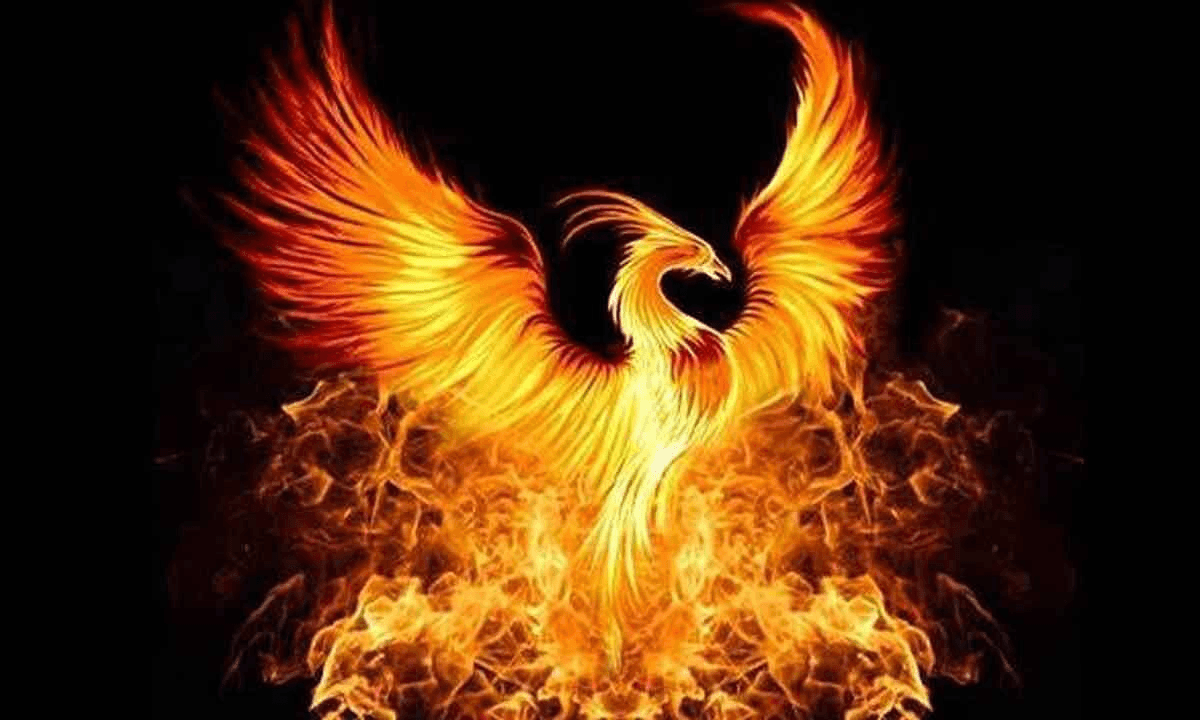
By contrast, the phoenix offers a different reading of fire. It too burns in the flames, but from the ashes it rises anew. Here fire is not greed, but transformation. It consumes the old to make way for the new, representing rebirth, healing, and creation. The phoenix symbolizes the human choice to turn the Anthropocene crisis into an opportunity — to use energy, technology, and knowledge to renew our world rather than destroy it.
We can also note that in various mythologies these two creatures both appear. That is: the fearsome dragon symbolizing the chaos that must be overcome, and the great bird symbolizing wisdom, healing, and renewal. In Judaism: Leviathan and Ziz Shaddai; in Zoroastrianism: Zahhak and the Simurgh; in Egypt: Apophis and Bennu — and so on.
Rodland, David L. “What’s Past Is Prologue: The Dragon, the Phoenix, and the Golden Spike”. In Planet Work: Rethinking Labor and Leisure in the Anthropocene, edited by Ryan Hediger, pp. 35–50. Lewisburg, PA: Bucknell University Press, 2022.
הצטרפו לרשימת התפוצה שלנו
כתיבת תגובה