
-
Electronic Choreia
In antiquity, dance was perceived as a deep cosmic, philosophical, and ritual mechanism. It was not seen at all as leisure, and although it was understood as an aesthetic art, this was aesthetics in the Platonic sense, as the telos of perfection, because dance was the symbol of perfection and of order. When people danced, they sought to connect to the order and restore it – order in the sense of coping with chaotic reality, and order also in the sense of social order, hierarchy, and conformity.
In choreography, everyone has a role; it matters where person A stands in the sequence and where B stands, and the fact that everyone moves in a synchronized way is not only because that is considered a “good” dance, but because this very thing exemplifies obedience. Obedience is a social tool whose meaning, at least in ancient Greece, is harmony with the laws of the polis – if you are a good dancer, you are a good citizen and obey the law, “law” in the broad sense of social conventions, which in ancient Greece also included social boundaries and gender and class distinctions. The sociologist Marcel Mauss called dance a “technique of the body”; in this sense, when the community moves together in agreed-upon steps, it does not explain the rules in words, but rather “burns in” the norms of behavior and belonging directly into the participants’ muscles. The physical, synchronized movement turns the individual into an organic part of the group.
But let us return to order within chaotic reality. Dance is considered order in the midst of disorder: it has rules, and the beauty of dance is that when the rules are fulfilled, everything appears harmonious and beautiful. This is how the world ought to exist, and indeed this is how it is always actually existing. The very fact that we perceive chaos is simply because we are not dancing. If we dance, the world will return to equilibrium. For dance is a kind of meditation; dance is a kind of prayer, and when we do not pray – and the god needs our prayer in order to maintain order in the world – that is our problem.
In more philosophical terms: the world was conceived as a state of eternal present in which, at every moment, equilibrium is maintained by means of a “dance of the gods.” Within this framework, the god conducts groups of stars that circle him along their paths in the celestial spheres, revolving around him in rows upon rows. Their revolutions are so precise and harmonious that the entire orchestration appears as a dance, in which the stars dance around the god in a line dance. And because astronomers noticed the astronomical phenomenon in which the planets seem to retreat from their path, called “retrograde motion,” this line dance was not just a matter of walking in a circle, but more like dancing the horah – that is, a few steps forward and one step back. In Greece this was called Chorus, and the god is in fact the lead dancer and the choreographer, the one who leads the dance and the one whom everyone “submits to.” By his Greek name he is the Choregos.
In Greek dance, the Choregos stood at the center while the dancers circled around him. In ancient Athens, the title “Choregos” was also given to wealthy citizens who took it upon themselves to pay out of pocket for the considerable expenses of training and costuming the chorus for civic festivals such as the Dionysia. This contribution was considered a public service that granted the sponsor great social and political prestige. In some cases, the sponsors received high honors, because this funding also had a religious function that the gods regarded favorably. The funding itself was called in Greek “liturgy,” and when the poleis were in a good economic situation, this contributed politically to the sponsors. As the years went by, especially during the Peloponnesian Wars and later in the Hellenistic period, the institution of the polis weakened, and therefore the sponsors increasingly received (and demanded) greater and more exaggerated honor, to the point that in some cases they were called “euergetes,” literally “benefactor,” but specifically a word that belongs to the semantic field of “savior.” That is, the Choregos was at times something bordering on a quasi-divine role, and later almost divine. A Choregos who financed the festival was sometimes rewarded with statues and monuments in his name, such as Lysicrates, who sponsored the chorus at the festival of Dionysus and in return was allowed to erect a “monument of remembrance,” the “Monument of Lysicrates,” which still stands today.
As noted, the Choregos is at once a philanthropist, a party producer, and a dancer. It is reasonable to assume that if there had been a sound system, he would also have been the DJ and the MC – if those had been the accepted marks of honor. Alongside dance competitions at religious festivals there were usually also competitions in sports, art, poetry, and so forth. Dance was therefore a recognized social ritual in ancient Greece, to the point that when philosophers wished to address their audiences, they preferred to use descriptions of choros – the same image we discussed earlier of the god surrounded by the heavenly bodies, the stars and constellations – as a philosophical image.
As an aside, one can say that in different philosophical models, the figure at the center of the circle can be identified with the astronomical conceptions current at the time: the geocentric model, according to which the god “crafts” the earth; the heliocentric model, in which the god is identified with Helios (the sun god); or the Pythagorean model, in which at the center of the universe there is a “central fire” embodied in the god. The Pythagorean model is the one that influenced the later Platonic conceptions of aesthetics, because the stars in fact move according to mathematical ratios, and precision is numerical precision. The music that accompanies the dance – the cosmic music – is also built on harmonious ratios. The entire mechanism is sacred, and in the dance itself we connect with this sacredness; the more precise and synchronized we are, the better, the more we merge with the cosmic rhythm.
In the terms of the study of religion, one can call dance “sympathetic magic.” But this is not only because the creation of the world itself is in fact the cue for the beginning of a wonderful symphony, and when you dance you model creation and encourage fertility. The sympathy here lies in the mechanism of surrender: creation is essentially the moment when God spoke and the world responded passively; the world became receptive to the divine utterance. The moment you dance and in effect surrender to the sound and lose control of yourself, the moment you hand over control to the rhythm itself, or to the music, which is the language of God, you join the order. The mode in which you are acted upon encourages God to become active, and thus you imitate creation – not because you create the world, but because you participate in creation. You program God to create the world anew. Dance is a kind of programming, a magic spell, or a kind of coercion of the god to return to the same state he was in during creation. If we liken this to Hegel’s master–slave dialectic: the slave controls the master through being controlled by him. Creation in fact requires both creator and created; the tango takes two, the leader and the led. The leading is the choreia; the circular dance is in fact that same turning of the gear wheels that the electric spark set in motion.
In the middle of the text we spoke of dance as prayer, which will take us out of chaotic reality and restore cosmic order. This is precisely why, in messianic imagery (perhaps I will deal with these in another post), eschatology is described as a cosmic dance: “In the future the Holy One, blessed be He, will dance at the head of a circle with the righteous in time to come” (Vayikra Rabbah, Parasha 11). For the present world is flawed; we are oppressed under the rule of hostile forces and a wicked government, but at the end of days, through our “theurgy,” our striving and longing for the good, we shall be redeemed. Then we, the pure souls, and our God will stand in a nuptial dance. And what is that striving? That is to say: the dance. That is to say, even more precisely: club culture holds acid parties as a “magical” protest act against an oppressive establishment. The oppression is cognitive / political / gendered / fill in the blank.
-

The beginning of the religion in psilocybin of the Inocybe…
A recent German study challenges previous assumptions about the evolutionary origins of psilocybin. A team led by Prof. Dirk Hoffmeister from Friedrich Schiller University in Jena discovered that two mushroom genera, Psilocybe and Inocybe, independently evolved completely different biochemical mechanisms to produce psilocybin. This phenomenon, known as convergent evolution, occurs when unrelated organisms develop similar solutions to the same biological function.
In Psilocybe mushrooms, the psi gene cluster responsible for psilocybin biosynthesis has long been known. However, in the new study, examination of Inocybe corydalina revealed an entirely different gene cluster, termed ips, which produces the same molecule through a completely different set of enzymes. The researchers reconstructed the activity of these genes in bacteria and confirmed that they could generate psilocybin step by step—evidence of an independent biosynthetic pathway. Although the enzymes in both genera perform the same metabolic roles, they are not evolutionarily related. Inocybe also produces psilocybin derivatives such as baeocystin, indicating additional chemical diversity.
The presence of psilocybin in Inocybe was already known, but previously it was based solely on chemical evidence; the biosynthetic system behind it had not been understood. As early as the 1980s and 1990s, several Inocybe species were identified as containing psilocybin and psilocin: Inocybe aeruginascens, Inocybe corydalina, and Inocybe calamistrata. All of them grow in temperate forests — in Germany, Scotland, Japan, Canada, and Russia.
These mushrooms prefer to grow near trees, as they live in a symbiotic partnership: the tree roots provide them with sugars, and in return the fungus helps the tree absorb water and minerals from the soil. This relationship is called mycorrhiza—or more precisely, ectomycorrhiza—where the fungus envelops the tree’s roots from the outside like a sheath.
The main trees they associate with are oak, beech, pine, spruce, chestnut, alder, and birch. Notably, many of these trees are considered sacred in various cultures—from the Celts and Norse (Yggdrasil), through the Slavs, Romans, and Greeks (Dodona), and of course in the Hebrew tradition. One need only recall the biblical Elon Moreh, Elon Zaanannim (Elon = oak), and Beit Arazim (“House of the Cedars”). All belong to the beech (Fagaceae) and conifer families—precisely the tree families these fungi prefer. They are highly selective: each fungal species is adapted to a particular tree type. In general, however, their mycorrhizal systems are concentrated in forests—one reason why these trees grow in groves or woodlands, mainly in taiga and temperate forests, both typical of the northern continents.
Inocybe fungi require acidic or neutral soil, rich in organic matter but not waterlogged. They thrive in old, undisturbed forests—ecosystems that have remained stable for decades. Because their host trees are either deciduous or long-lived conifers, a thick layer of decomposing leaves and needles accumulates, creating ideal conditions for fungal mycelia. Thus, Inocybe almost never appears in open fields or cultivated soils—it “loves true forests”.
This may explain why, although these trees also grow in Mediterranean climates, psychedelic mushrooms are generally absent there. The Mediterranean climate is harsher—frequent fires and forest regeneration prevent the development of old, stable woodlands. Over time, Inocybe species in such regions adapted through mutations allowing survival in drier, warmer, and more exposed conditions—yet these Mediterranean varieties are not psychedelic.
In these regions, periodic droughts dry out the soil. The fungus needs nutrient-rich, moist, partially shaded ground. Such conditions exist only in relatively high mountains with humidity from dew or mountain fog, where dense woodland and moderately acidic soil prevail. These microclimates can be found along the Mediterranean coast: in the Lebanese mountains, the Taurus range in Turkey, and the Carmel range in Israel. Indeed, these fungi are found there—but not psychedelic strains.
Could psychedelic mushrooms have once existed in these areas? Possibly – (a) during periods of sparse human settlement, when forests could mature undisturbed; (b) during cooler epochs, such as minor ice ages that occasionally occurred in the Levant, for example around the mid–2nd millennium BCE. A more significant glacial period occurred about 20,000 years ago, ending roughly when agriculture began—probably as a response to these climatic shifts. It is likely that in the Levant, including ancient Canaan, some cultural memory persisted from the Neolithic age, when psychedelic mushrooms could still be found in forests, and around them early proto-shamanic religions developed.
Perhaps John Marco Allegro was not entirely mistaken after all. In these same forests grow not only Inocybe mushrooms but also various Amanita species—such as Amanita muscaria, well known across Europe. Allegro claimed that early Christians used Amanita muscaria, though this species does not naturally grow in Israel. However, other Amanita species do, and there are even legends about Amanita pantherina (the panther cap) growing among the oaks in the Golan Heights. Who knows—perhaps the Amanita species in the Levant have “degenerated” during the past 12,000 warm years, and before that, they too once thrived here.
-
Pagan monotheization of amulets
One of the central moves in the transition to monotheism is the manner in which traits that were originally feminine — and especially apotropaic ones, that is protective qualities — were transferred to male figures, foremost among them Yahweh. A paradigmatic and symbolic example of this is the figure of the “Tsur (Rock),” a term that symbolizes Yahweh as a protective power, yet whose roots lie in ancient traditions of worship and beliefs in guardian goddesses identified with precious stones and amulets.
Both the Star of David and Solomon’s Seal, two symbols now closely associated with Judaism, are designed as geometric patterns representing a bird’s‑eye view of a rock stone, thus continuing the tradition of portraying protective amulets made of stones — especially gemstones — which were already common in antiquity as symbols against the evil eye and harmful influences. This imagery directly relates to apotropaic functions that were used across generations; terms like “Tsur Yisrael” are in fact testimony to a process in which a pagan symbol of protection — the stone — was “converted” and transformed into a symbol of the one God.
The association with King Solomon arises in a later tradition, claiming that Solomon possessed an amulet through which he ruled demons. But upon careful scrutiny of those traditions, the nature of that amulet is shrouded in ambiguity: in some versions it is a gemstone; in others, it is a root or plant. Amots Dafni shows that in fact the original legend was about a protective ring (at whose center was a mandrake root) owned by Alexander the Great, which in Jewish tradition was transformed into Solomon. Both the legend itself and the fact of having an amulet against demons underwent a “conversion” of a manifestly pagan phenomenon.
The Star of David is a hexagram, and Solomon’s Seal is a pentagram. These are evolutions of an amulet from the Mesopotamian goddesses such as Ishtar, who was identified with the planet Venus (star). Ishtar’s name in Akkadian comes from star, and she is the Akkadian version of the goddess Inanna, whose Sumerian translation is “Queen of Heaven.” Inanna was a multifunctional goddess: goddess of love, but also of war and fertility — two domains that demand protection from harmful forces. That protection was manifested through her identification with the shining star, which in its graphical form is an octagram. The octagram later transformed into the heptagram, then the hexagram, and finally the pentagram.
In Greek mythology, Inanna’s counterpart was Athena — goddess of fertility and war. Athena had attendants, the Gorgons, one of whom was Medusa. The story of Medusa is less significant for its plot than for the fact that she was punished and turned into a terrifying creature. Her transformation and the literal meaning of “Gorgon” (one who causes dread) hint that she is a double‑faced, demon‑like being — and when that demon looked at you, you turned to stone. Some scholars interpret this as a metaphor for muscular stiffening (rigor), a state in which muscles harden, a sign of death — implying that what is being described is an edge experience, a “battle with demons,” where defeat means death.
Rigor — the sudden hardening of something that was soft — and especially its transition from hardness to softness and back, becomes a symbol of death, or the threshold between death and resurrection. In Jewish symbolism one can see this in Moses’ staff, which became a serpent and then back into a staff. The serpent enters the picture: it is a symbol of duality in venom — able to bring death or madness but also, in some cases, healing and restoration. Serpents were also the “hair” of Medusa.
But Medusa was, as noted, originally an attendant, and it appears that the Gorgons did not serve Athena alone — they also served Zeus, imprinted on his Aegis (shield), as told in the Iliad. That suggests that they functioned as amulets. The literal translation of aigis is “violent windstorm” (Greek kataigis), which resonates with Zeus’ attribute of lightning. But importantly, the term also means “goatskin” (αἴξ, aix), evoking the notion of the amulet as a piece of leather or shield — attributes of warriors.
In this context we also note another warrior fertility goddess, Artemis, who was associated with skins. Artemis is portrayed as virgin, and virginity was a trait of the attendants of the goddess‑shepherdess. Examples include in Rome: Vesta, whose attendants were the Vestal Virgins — their role was to preserve the sacred flame, which symbolized the burning hearth, an attribute of the nurturing goddess. Incidentally, Medusa was a virgin. For precisely that reason Athena was outraged when her temple was defiled by Poseidon’s assault of Medusa; accordingly she punished her by giving her a fearsome appearance.
Raphael Patai, as is known, argues that the consort goddess had, in fact, three manifestations which are one: a virgin with striking breasts, a mother with full nourishing breasts, and an old woman with shrunken breasts. This is essentially a “holy triad” or "trinity" where each manifestation includes one distinguishing symbol: the breasts, a symbol of fertility. The full udders of milk symbolize the goat — which, by the way, also has a beard, making the goddess a kind of androgynous figure, with female attributes (breasts) and male ones (beard). Gradually one notices that the demonic dimension has androgynous traits — both because it is a liminal, fluid realm, and primarily because the very nature of the cult is hierogamy, the sacred union between male and female.
This is also the main thesis of Raphael Patai in his book The Hebrew Goddess. At the center of the fertility cult, there are two figures: the male figure, the Baal, and the female figure, the Rāʿayah (shepherdess/consort). Their union, the union of the two gods, is thus called Elohim, a paired cult — and that was the original cult of Yahwism. That is also the reason Kabbalah is a kind of Yahwism, because it exalts the supreme union between the God and the Shekhina or the Holy Matronita. Marvin Pope, incidentally, contended that this is what lies at the heart of The Song of Songs, where the shepherdess is called “Shulamit.” This is why the book is attributed to Solomon (from the same root). Perhaps the hierogamy is thus called “shalom” and in orthodox idiom “shalom bayit” (peace in the home).
Raphael Patai conceived this idea long before archaeological evidence emerged to show that Canaanite—and thus Jewish—worship was in fact a paired cult of Yahweh and Asherah. The discoveries at Kuntillet Ajrud, Khirbet el‑Qom, and Tel Arad only bolster Patai’s argument: God alone was not enough — He needed a female function in order to be a full deity. The goddess, or rather the two gods, are expressed as stone “standing stones” (matzevot) — which are nothing but stones.
What happened in monotheism is that this element of stone standing stones was ostensibly annihilated, and every trace of the paired cult was erased. Within this framework, feminine attributes were transferred to the single male God, and thus the apotropaic motif as well. Is this purely a Jewish idea? Probably not — it appears that the transfer of apotropaic traits to the masculine began earlier, and Greek mythology is proof of it. Zeus, an Olympian god, inherited attributes of the fertility goddess, especially the Aegis. Thus his Aegis bore the emblem he should have worn, rather than that of a feminine deity — lightning instead of star. (If it reminds you of Wonder Woman’s tiara, that is precisely because it is the original form of the diadem, a headband that once adorned kings, although its origin is the headband placed on the statue of the fertility goddess in her temple.) And the reason for placing a cloth band on her head was to tie on a amulet of that very star.
That band was also dyed in unique colors — scarlet, sky blue (Tekhelet), and tyrian purple. Those bands were woven by priestesses in the temple. Some were virgins, some “holy” (consecrated), and their role was perhaps to enact a symbolic hierogamy with the male deity, the king. Some of them, by the way, were androgynous, but that does not depart from the subject at hand: apotropaic functions. The tzitz (the golden headplate) of the High Priest was a kind of such amulet affixed in a linen band: the mitznefet (turban), whose band was Tekhelet. The tzitz may have taken the form of a mandrake/henbane, as Josephus reports, and perhaps bore the Name of the Ineffable, as in tractate Shabbat 63b. But in any case, its function was apotropaic, and the magical shield was that of the male God, who also had such a diadem, as stated in Chagigah 13b, that Sandalfon “binds crowns to his Creator.” That diadem is reported in Song of Songs for precisely the same reason — the transformation of the woman into a man — Solomon receives the crown, “for a crown he is mother to him.”
If we seek additional Kabbalistic Yahwistic symbols, it’s worth noting that the Shekhina, or rather the place of the Shekhina, is called in the Book of Lamentations an Ateret (crown). In Sefer Heikhalot it is said that Metatron, acting as High Priest in the celestial temple above, has on his tzitz the letters from which heaven and earth were created. These are likely the “crowns” that God Himself crowned those letters with, as described in Menachot 29b — thus Moses, upon ascending on high, found them.
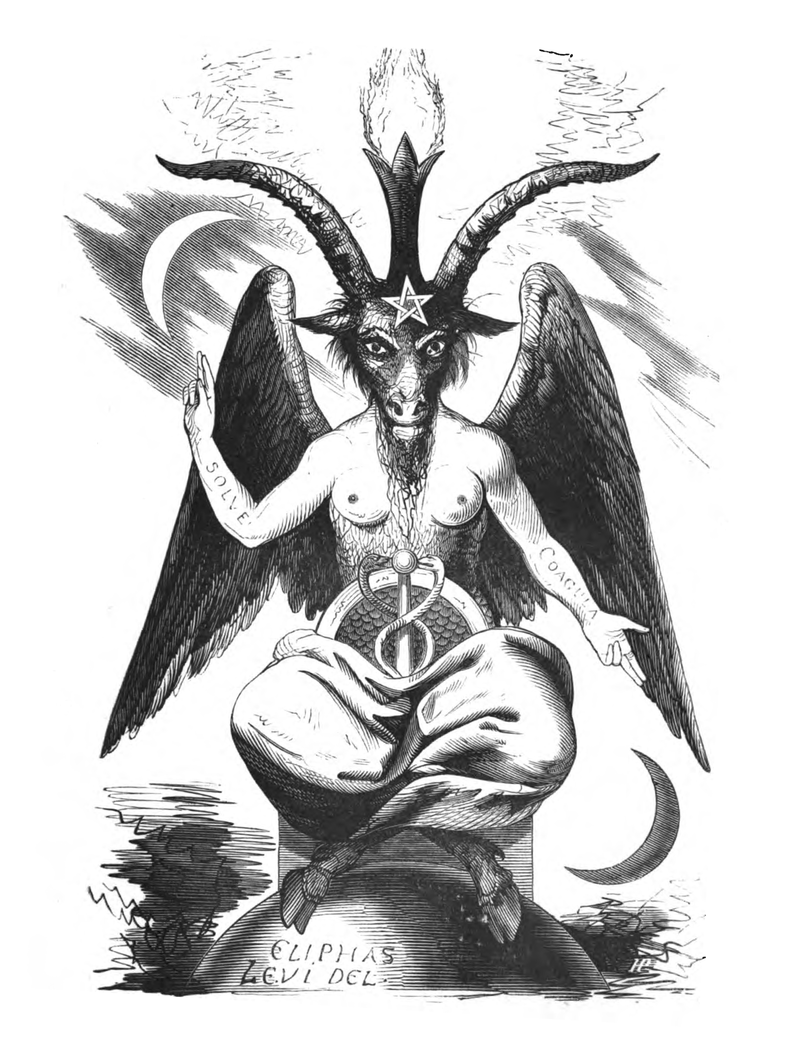
Returning to the matter of stones: Hermes is another example of an apotropaic male function perhaps inherited from a woman. According to Martin Nielson, Hermes was born as a feminine personification of cairns (stone mounds) placed along roads, called hermion in Greek. But this evolution is relatively late: Hermes probably became male only after the Greeks encountered the god Thoth (from Egypt). When did that occur? Possibly in the Hellenistic period, perhaps during Greek-Egyptian interactions, documented from the 7th century BCE, with the founding of Naucratis. Before Hermes was associated with Thoth, his attributes were linked to Pan, whose figure resembles a goat — a being akin to demons in later descriptions. It’s worth noting that heads of demons, even in Heikhalot literature (e.g. in the Book of Enoch), are named after the goat: Azza and Azal, likely not by accident. Later accounts depict the devil with a goat head — most notoriously Baphomet, a figure to which the Templars allegedly worshiped, who also had a pentagram pendant on his head, identical to Solomon’s Seal. That Baphomet is described with breasts, seated in a crouching posture, as if a fertility icon. Some suggest his name is actually a code Atbash of the word shōphîʾa (sophia, wisdom in Aramaic) — indeed, Solomon was considered the wisest among men.
Hermes was, as stated, a hermian entity, but originally a female figure. When the hermionic entities were invented, they were feminine too: Hecate preceded Hermes in that regard as a “guardian goddess” embodied in stone cairns at road junctures, whom one should not look at—or divert one’s gaze from (like Medusa). Before Hecate, Artemis was defined as such, both guardian and pastoral, like Pan, and in Greek “Mother of Beasts” (Potnia Theron). The three gods — Artemis, Hermes, and Hecate — all served as “gate‑keepers” and protectors of travelers, in the Hellenistic era called Propylaios (Προπυλαίος); for this reason they were apotropaic.
Apotropaic features, protection from the evil eye and safeguarding the way, underwent a cultural–religious process of “patriarchy.” Perhaps not coincidentally the word Pater (father) echoes Petra (rock) in sound and spelling. The apostle Peter (Petros in Greek) is described in the Gospel of Thomas as one who complained that Jesus taught Mary Magdalene, claiming she is not a man. Jesus replied that she might even be more of a man than him, hinting at the monotheistic motivation to appropriate feminine attributes of wisdom and protection for men. Originally, those attributes were women’s alone; the qualities of strength and hardness were assigned to men — yet these too are qualities of stone. And perhaps simply because stone symbolizes fertility — like the shell from which the pearl emerges. In Greek myth it is told that the omphalos stone gave birth to Cronus, offering it to Zeus, while Zeus himself was nurtured and hidden in a cave, where nymphs nursed him with… goat’s milk. The Jewish equivalent of the omphalos is the Foundation Stone, the place from which “the world was created,” as the text says.
Another famous stone attributed with magical power is the baetylus (standing stone, bethel‑stone), considered a non‑personal representation of the divine. The omphalos was such, the Kaaba was such, and surely also the Foundation Stone. A black stone in general was regarded as a fertility amulet — often onyx. Women were said to give birth on stones, as a protective rite. It is unclear whether this is intended by Genesis’ phrase, “When you do the office of a midwife to the Hebrew women, you shall look upon the stone birthstool”. In myths of fertility goddesses — for example Cybele — it is said they were born from such stones. Thus a black stone was brought to Rome from Phrygia by senatorial decree to protect Rome from Hannibal’s army. It was said to represent Cybele, the Phrygian fertility goddess, whose temple was erected on the Palatine, and was renowned for its Galli priests, who were often androgynous.
I did not find a connection between the black stone of Cybele and another black stone set in Rome in the Forum, in the temple of Vulcan. However, about the Lapis Niger, there is also a foundational myth: it is said that the Roman state was founded there, when Romulus signed the peace treaty between the Latins and Sabines.
In conclusion, some contend that hierogamic sex rites were performed on bethel‑stones, such as those allegedly practiced in Baal Peor. Peor is so called from the root Paar ("wide open"), perhaps meaning a feminine sexual organ. In Job it is said, “They have gaped ("paaru") upon me with their mouth” which may hint that “Paar” is associated with "Boshet", in the sense of a sexual organ, and perhaps also in the sense of a sexual disease. The connection between Baal Peor and Boshet ("shame") is hinted in Jeremiah, where it is written, “Then Moab shall be ashamed of Chemosh, as the house of Israel was ashamed of Bethel, their confidence”, where the word “ashamed” ("bosh") is doubling in meaning, also implying disgrace in the sense of sexual exposure, and perhaps the sense of abandoning.
-
Death cult as psychadelic ritual
Religion is, first and foremost, a human mechanism for coping with anomalies—irregularities that reason and daily experience cannot fully explain. The primary anomaly is death. Death disrupts the “order of things” by removing a person from the community and destabilizing both social and personal identity. If the deceased was wise, the community is left without wisdom. If skilled, without skill. If a leader, without leadership. And when the community is disoriented, a solution is required.
The solution is the afterlife, an “other place” to which the dead pass, where some form of continuity exists. Out of the assumption that the dead continue to exist emerged the idea that it is worthwhile to communicate with them. And there is a way to communicate with them: by reaching a near-death state, or a death-like state, in which one can touch the edge of death and return. The dead were perceived as bearers of wisdom and accumulated experience, and thus as authoritative figures. An encounter with them served as a form of consultation, and the return meant the implementation of their advice, ensuring the continuity of the community “in this world”.
It follows, then, that religion is first and foremost a social tool. That is, only social animals are capable of sustaining religion, and only those animals that have awareness of death, fear of death, and the ability to grieve and be consoled. Animals do indeed exhibit some of these traits, but it is impossible to know whether they possess the capacity for abstract thought that could generate the idea of an “afterlife”. For such a notion, symbolic imagination and complex language are required, to organize the anxiety of death into an institutionalized system of rituals, symbols, and enduring beliefs. Religion, therefore, is a human mechanism precisely because it enables consolation: rituals that demonstrate that there is a way forward, that loss can be borne. Death is not absolute chaos but only an episode within a larger process—one that includes recovery from death as well.
The idea that fear of death is the religious and social driving force is known in evolutionary psychology as Terror Management Theory. The idea that liminal experiences serve as a bridging mechanism that allows anomalies to be processed and normality restored was formulated by Victor Turner as “social drama.” Together, these explain something simple: psychedelia is nothing more than a tool that enables one to undergo a controlled death and return from it, thereby producing a “living proof” that death is not an absolute end but a gateway to the other world.
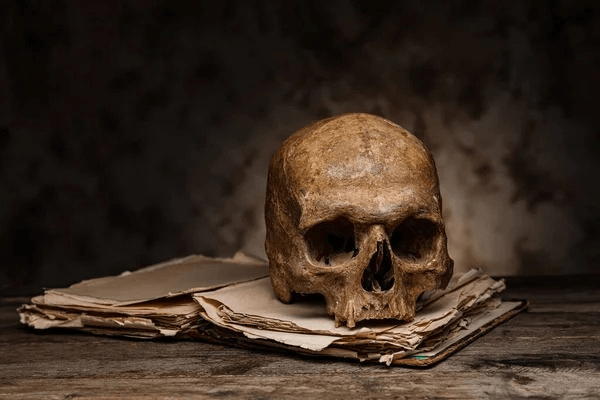
Primitive burial rituals included attempts to “make the dead present”, born of the desire to communicate with them through practices we would now call parapsychological, but which were then considered valid and reliable—no doubt because some of them involved altered states of consciousness. The rituals were ongoing: not only the burial itself but also scheduled encounters with the deceased. From time to time, people would “go up to the grave,” tend to the body, rebury it in secondary burial, and sometimes take a keepsake in the form of a specific body part, to be used later—most often decoratively, but in some cases necromantically. That is, the organ served as a spiritual “conduit” or medium for communication with the dead. Most commonly, this was the skull, regarded as the “house of the spirit”. And if the deceased’s own skull could not be taken, a “surrogate” was used—a generic skull, or even just a bone, sometimes not even human but animal, whether of a totemic creature or simply of another animal. All of this was done to “consult” with the dead and to make them present, even symbolically.
Early psychonauts discovered a variety of ways to communicate with their dead, so necromancy did not always require a physical “memento” of the deceased. It seems that as technologies of communication developed, and people realized that one could meet the dead in dimensions beyond the tangible, such modes of encounter became preferred.
Although we will not discuss it in detail here, the monotheistic religions, which prohibited “inquiring of the dead,” equated encounters mediated by a surrogate with encounters without one. Whether they were correct is unclear, as is whether psychonauts who seek to explore the depths of their own minds and meet “death” itself, rather than “the dead,” truly fall under the broad prohibition: “There shall not be found among you one who makes his son or daughter pass through fire, a diviner, a soothsayer, an augur, or a sorcerer, one who casts spells, or one who consults ghosts or familiar spirits, or who inquires of the dead” (Deut. 18:10–11). But this, in essence, is what we are talking about.
Brian Muraresku, author of the bestseller The Immortality Key, attempted to demonstrate that such funerary rituals existed continuously from prehistory up to the establishment of Christianity at least, and that the Mass itself is nothing but a monotheistic adaptation of such a psychedelic funerary rite. Its very location in a liminal gray area—and its resemblance to forbidden practices—led the Church to censor it and substitute non-psychoactive wine and bread as a kind of “placebo”.
-
Hypoxia as a pioneering psychadelic technique
Induced hypoxia – that is, the deliberate reduction of oxygen supply to the body – appears to be an ancient technology of consciousness used by prehistoric and ancient cultures to create psychedelic experiences. It did not depend on plants or psychoactive substances, but rather on manipulation of a basic mechanism: breathing. The connection between breathing, oxygen supply, and soul – the continuity of life – was already established then, when temporary deprivation of oxygen was perceived as a momentary passage to the other world, and the return from it was interpreted as rebirth.
In Paleolithic caves, for example, these experiences seem to have played an essential role. The descent into dark depths, lighting fires in closed and sealed spaces, and long stays within them created oxygen-deprived conditions. Combustion consumed the air, released smoke, and reduced oxygen levels, producing feelings of euphoria, confusion, and liminal near-death states. It is no coincidence that spaces with acoustic resonance were chosen, such as Chauvet Cave in France, where the animal paintings and flickering shadows created the sensation of other presences. Everything was done to deliberately induce a psychedelic experience – whatever the reason may have been.
This tradition – linking hypoxia to chthonic monuments associated with the earth and the underworld – continued in later cultures. At Lake Avernus in Italy, sulfuric vapors caused unconsciousness and sometimes death, and the site was considered a “gateway to the underworld.” In the Etruscan cults at Mount Soracte, priests entered caves and inhaled poisonous gases as part of initiation rites, and were even known as “wolf priests.” At the Nekromanteion in Epirus, rituals of descent to the realm of the dead took place in a temple built on geological fissures. Classical sources speak of “black vapors” bringing visions of spirits. And of course, at the oracle of Delphi, the Pythia sat above the adytum and inhaled vapors rising from it. The Greeks believed this to be the “breath of Apollo”, and religious interpretation developed around what was perhaps the effect of volatile gases.
But induced hypoxia did not necessarily have to be linked to the underworld. There are other ways to create hypoxia – one of them being an explanation offered for the Pythia’s trance at Delphi. One suggestion is that she used an oleander preparation, which contains a cardiac glycoside that slows heart activity to the point of causing respiratory paralysis. This paralysis, in turn, produces oxygen deprivation in the bloodstream, and one of its side effects, at least initially, is hypoxia (which can later progress to cardiac arrest). In such cases, techniques like mouth-to-mouth resuscitation or chest compressions might theoretically have helped.
Thus, any deliberate induction of hypoxia may have served as a primitive technique for altering consciousness: partial strangulation, near-drowning, live burial, and the like – with the crucial condition of stopping just before a fatal accident occurred. The motivation, however, was the same: the rite of passage included deliberate entry into a liminal state between life and death, ideally with sensory clouding on the verge of hallucination. Initiation rituals that brought initiates to the threshold of death are known worldwide, and accidents sometimes did happen. In fact, modern “hazing” rituals are based on them, especially on the Spartan agoge, which aimed to cultivate endurance among initiates.
It has also been suggested that the Scythian “hot-box” practice mentioned by Herodotus, in which cannabis was smoked in a sealed space, was designed to produce a dual effect: both the use of a consciousness-altering substance and the deliberate depletion of oxygen in the space by filling it with smoke, potentially inducing hypoxia. Another ritual that may have had the same motivation – the multi-effect of altering consciousness – is the Inca capacocha ceremony, in which children were sacrificed by methods that brought them into near-death states of suffocation and oxygen deprivation. This included causing unconsciousness (by strangulation or a blow) and then burying them alive while unconscious, or abandoning them on high mountain peaks with little oxygen and extreme cold. All of this was done after heavy intoxication, so that by the time consciousness returned (and that was the point), they remained in a blurred state between life and death.
Any place where one cannot breathe – where staying, even for a limited time, risks hypoxia – was considered a dwelling place of the gods. Mountain peaks, of course, where the air is thin, but also the depths of water, or alternatively the depths of the earth. Rituals in cultures with such gods usually took place in these locations: whether in the mundus pits of the goddess Ceres, the cenotes of the Maya, or the sacred mountains of Mongolia and Siberia, where shamans are said to have climbed arduous paths to mountain summits to commune with the gods. Mountain climbing, in a sense, is the secularized form of what was originally a religious practice, intentionally undertaken in oxygen-poor environments.
Hypoxia can also be induced through breathing exercises, by holding the breath until consciousness shifts. In yogic tradition, for example, pranayama includes techniques of breath retention (kumbhaka). The goal is mastery of consciousness, extension of life, and the attainment of trance states. Sometimes breath is held to the limits of physical endurance, which can cause mild hypoxia, interpreted as the opening of “gates” to other states of consciousness. In Tibetan Buddhism, tummo breathing and other practices involve controlled inhalation and exhalation, sometimes with deliberate retention to alter consciousness.
If there had been other ways to induce hypoxia, they too would have become established social institutions – whether as rites of passage or as religious practices. Hypoxia was, in fact, the very first and original method by which humans managed to reach altered states of consciousness, and it was the one that first linked two fundamental concepts: breath and soul. As long as the one endures, so does the other. When the one ceases, the other ceases as well. And if it is renewed, the experiencer rises again to life. That is the main idea.
-
A fish-bull fertility cult in Armenia
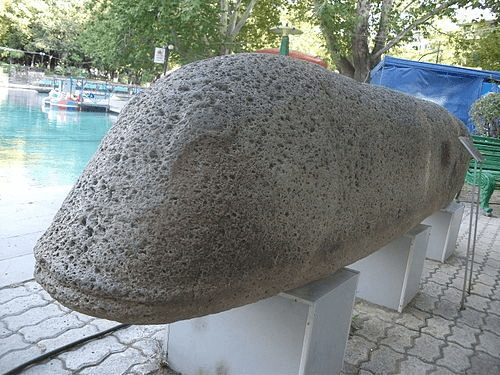
The Vishap Stones are prehistoric stone stelae that were erected in the high plateaus of Armenia starting from the Chalcolithic period (ca. 4200–4000 BCE). They are scattered across the Armenian Highlands, not in one single location, yet their distribution still shows a certain patterned concentration—all of them are set in strategic places, near springs, snow basins, streams, irrigation canals, and so forth. The height of the stelae ranges from one meter to five and a half meters, and their weight could reach up to six tons. Statistical analysis of their locations reveals a clear bi-modal pattern: one concentration at about 1900 meters above sea level, near settled valleys and irrigation systems, and another at around 2700 meters, close to the permanent snow line and high-altitude sources. This division is not accidental: in the lower altitudes, one can see the practical aspect of water—irrigation, daily use, and constant springs. At the higher altitudes, however, the recognition of water as a primordial resource derived from melting snow is reflected. From this arises the hypothesis regarding their significance: these were monuments around which seasonal rituals and pilgrimages were held, in which water sources were endowed with mythical meaning. The stones marked these meeting points and created a defined cultic space. Of course, the pilgrimage itself was not the only event—also the erection of these massive stones, whose quarrying and transportation clearly required great effort. And so the question arises: for what purpose?
The Armenian term vishap (Վիշապ) means “dragon” or “mythological serpent.” In Armenian folklore, the vishap was a powerful entity connected with water, clouds, rain, and lightning—a sort of dragon-serpent monster that could block or release the waters. Naturally, this mythical figure is not unique to Armenia. Comparative mythology shows that in many cultures dragons or mythological serpents hold a similar role: they guard or obstruct water sources, they are associated with fertility and with the cycle of life—the ability to renew, to shed their skin, to regenerate. They represent the boundary between life and death, chaos and order. They embody a primal force—fearsome on the one hand, but on the other, the source of blessing.
Three typical forms have been identified in the Vishap Stones: piscis – fish, vellus – stretched cattle hide (or more precisely a bull figure, with some of its limbs hanging down), and hybrida – a combination of the two, i.e., a hybrid figure of fish and bull. The fish imagery represents the water element itself; the hide imagery symbolizes the idea of renewal through sacrifice. That is, the act of stripping the hide from the sacrificial animal was a magical performance intended to resemble the shedding of the dragon-serpent’s skin. Within this cultic act, herders sought to bring about the renewal of the water sources.
Naturally, the fact that the animal is a bull did not go unnoticed. The bull is the image of the father of the gods and symbolizes masculine power and energy (and thus, fertility). The bull’s association with high places (if not with the heavens themselves) made him, in some depictions, winged. We see this in the Assyrian Lamassu—bull figures with eagle wings. The eagle was an attribute usually attached to the father of the gods, especially in his manifestation as a storm deity. Yet it was not only the bull that was winged. The fish, too, with its fins, sometimes resembles a winged being. The ventral fins look like small wings, especially when fish are depicted as “leaping” in the water. Thus, whales—regarded as giant creatures and therefore monstrous beings—were sometimes described as flying. Their immense weight crashing back into the water, as well as their tail slaps, were considered causes of earthquakes. The tail fin itself, as well as the dorsal fin, are shaped in a way that recalls an eagle’s wing. For this very reason: the fish too is a winged being, connected to the heavens. This is precisely how the Apkallu were described—the Seven Sages who taught humankind crafts and wisdom—sometimes as men clad in fish scales, sometimes as men with a beak and eagle’s wings. The hybridization between bull and fish, therefore, was meant to symbolize that same idea. Such, likely, was also the god Dagon. And perhaps for this reason too, Jesus and his companions were considered fishermen and the cross as a fishbone.
-
world’s oldest embalming form: smoking
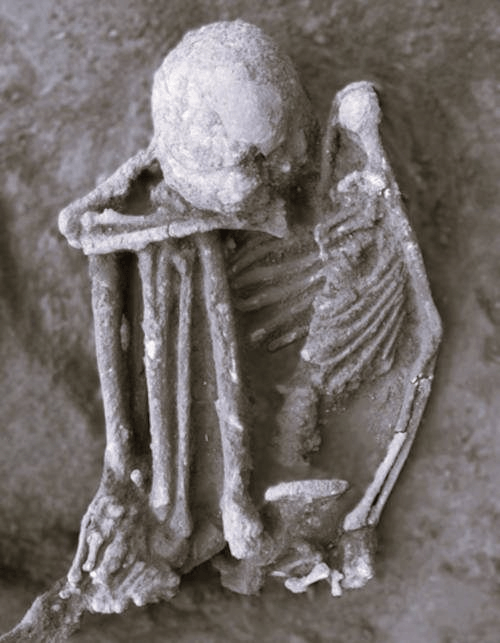
The world’s oldest embalming practice has been discovered—not in Egypt or South America, but in southern China, Vietnam, and Indonesia, dating back some 12,000 years. This is the conclusion of new research published in PNAS. The embalming, it appears, was carried out through smoking of the body, and it predates by thousands of years parallel cases of embalming found in Chile (7,000 years) and ancient Egypt (4,500 years). According to the research team’s hypothesis, there is a connection between this form of embalming and practices still performed today in Papua New Guinea, where modern versions of smoked mummies can take up to three months of treatment for a single body.
So much for the findings. Now, the meaning. Why embalm? First of all, on an emotional level, after a person dies, you want a keepsake of them. You know that if you don’t embalm, they will decay, sometimes very quickly. To preserve them—and especially to preserve them for future generations—you embalm them. In the worst case, the body will last for hundreds of years; in the best case, even thousands. But religion is not an emotional matter; it is a spiritual one. A body that decays is a body whose essence also decays. If continuity of life after death and the presence of the deceased’s spirit are what matter, then everything possible must be done to prevent the dissolution of this important person and to preserve their presence. This is done through embalming. And how is embalming performed? Through fire. But to be precise—not fire, but smoke. It is not the flame that preserves the body but the heat. Thus the body does not become charred but preserved. The bones are not blackened, but retain their form, and the body appears lifelike.
Fire itself is associated in many traditions with divine revelation, purification, and destruction. Smoke, on the other hand, carries a different symbolism—it is perceived as a bridge between worlds, as matter that rises and vanishes from sight, and as a medium for transmitting messages to the gods, a kind of portal. Thus, a body enveloped in smoke for weeks or months was not only physically preserved but also imbued with spiritual meaning: it was transferred into a prolonged liminal state, between life and death. Through the smoke it also passed into the domain of the gods, but at the same time it still remained here, in form and substance. In other words, it became a mediator, a sacred object.
This discovery suggests that embalming began in the form of smoking. What, then, caused the technique to change? The likely reason is aesthetics. The perception that smoked embalming was “unaesthetic” made it not only undignified and unrepresentative but also distasteful. In very dry or cold places, sometimes there was no need for an artificial process to preserve the body, because the body would remain intact in one way or another. This produced a more aesthetic outcome. Smoked embalming “degraded” the body, leaving it faded and shrunken, with a less lifelike appearance. It was also a long and arduous process, involving prolonged preoccupation with death and direct contact with it. This was seen as impure, and apparently even dangerous. The use of substances such as natron, resin, or bitumen was quicker, and presumably more antiseptic and safer. The problem was that these raw materials were not always readily available. Therefore, the more developed the trade, and the more a religion emphasized aesthetics, the more we see advanced and increasingly “sophisticated” forms of embalming.
-
The zoroastrian context of the burning bush story
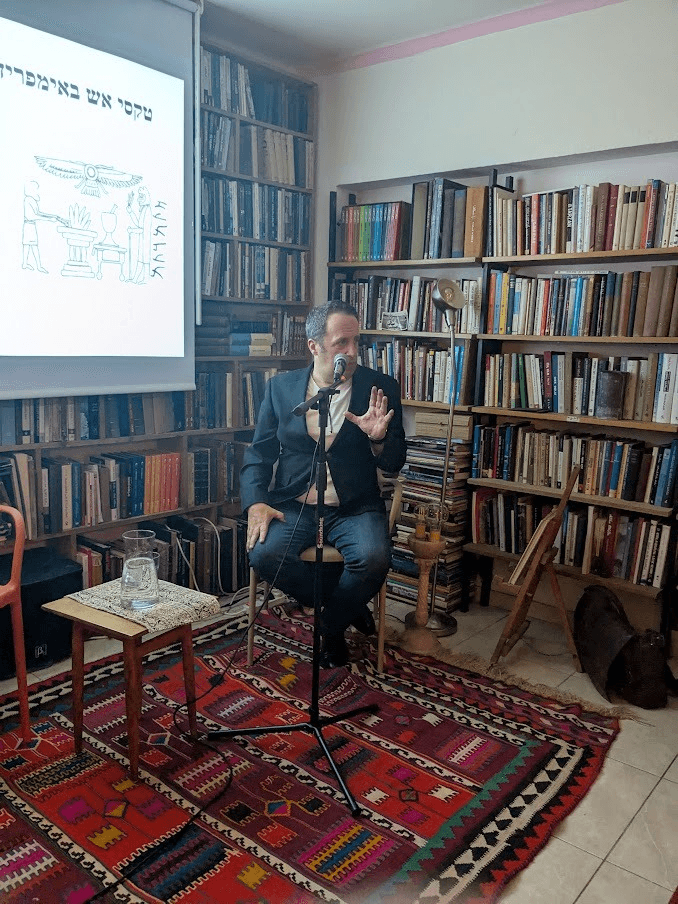
Yesterday was the fifth lecture in the “Temple of Consciousness” series, delivered by Dr. Gad Barnea from the University of Haifa. Unfortunately, the recording of the event was cut off in the middle, so I am unable to distribute or share it. However, I’m attaching the presentation from the lecture, along with brief notes — so it's essentially a kind of transcript of the talk. The presentation is courtesy of Dr. Barnea, who uploaded it to his Academia.edu account (attached in the post body).
The motivation behind the lecture, of course, is to highlight a psychedelic-spiritual interpretation of the Burning Bush story, even though the lecture itself does not explicitly argue that. The one making that claim is me — based on certain clues that I will elaborate on shortly.
What does the lecture claim? In brief: That the Judean cult at Elephantine Island had features influenced by Zoroastrianism, and this points to a little-known variant of Judaism called Yahwism, which had reciprocal interactions with Zoroastrianism due to shared theological principles: The eternal essence of the deity, The revelation of God symbolized in fire, And the divine presence manifest in the continuous existence of fire.
Dr. Gad Barnea is a research fellow in the Department of Jewish History and Bible at the University of Haifa. He works in a bold, unconventional research niche, arguing that throughout Jewish history, there existed a parallel religious stream called Yahwism. This term is used by scholars to refer to belief and worship of Yahweh as a central (but not necessarily exclusive) deity — i.e., not monotheism, but monolatry. Yahwism allows for: The coexistence of other gods alongside Yahweh, a certain anthropomorphism in how Yahweh is depicted, rival powers to Yahweh, and most of all, Yahweh’s revelation in the physical world — through places, natural phenomena, and paradoxical physical manifestations.
We know rabbinic Judaism, but that is a later development and is not identical to Yahwism. Rabbinic Judaism fought against the non-monotheistic expressions of Yahwism, absorbing only the paradoxical dimension while severing it from the physical world. These theological definitions were finalized only much later, especially by Maimonides. Until then, Yahwism continued to exist — sometimes blatantly (e.g., Kabbalah), sometimes latently. It’s important to distinguish Yahwism from Judaism, and acknowledge Yahwism’s existence — and that, says Dr. Barnea, is his mission.
Zoroastrianism is rooted in the Indo-European tradition, which differs from chthonic religions primarily in its view of life after death: Chthonic religions view earth as the source of life, and death as a return to the earth, fueling rebirth. Indo-European religions, in contrast, view death not as a return to earth, but as a return of the soul to the cosmic fire in the heavens. Thus, fire is seen as a celestial-soul element, and cremation was common instead of burial. This religion is not focused on the underworld, but on the sky and what lies above it — known in Greek as the Empyrean. The focus of these religions is the link between humans and the cosmic order. To maintain this balance, theurgic rituals are required, and humans must carry them out meticulously. This ritual precision generates a spiritual-consciousness field where one can encounter the supreme deity, Ahura Mazda. Life is like walking a tightrope — it demands coordination, bodily awareness, and total focus. That's the logic of spiritual action in daily life.
One of the most important Zoroastrian rituals is the preparation and drinking of the Haoma. Its ingredients and procedure remain unclear, but hints suggest it involved a psychoactive substance, with preparation involving pounding and pressing. Even the versions described in the Zoroastrian scriptures are relatively late, and the original form of the ritual is a mystery. Our understanding is based on reverse-engineering: textual archaeology, ritual representations, especially fire rituals involving a sponsor, a barefoot priest, a mortar and pestle (symbolizing Haoma preparation), and a fire altar or container where the image of the deity appears in flame.
The barefoot priest reflects ritual purity: shoes carry dirt, which is a form of ritual impurity. Removing shoes is both technical and symbolic — it represents submission, a “shedding of layers”, and reverence for the sacred earth, Armaiti (Spenta Armaiti).
In Zoroastrian texts, the deity is described not as passively eternal, but as actively creating at every moment, constantly generating his own being. This action continues as long as the fire exists — hence the emphasis on the eternal flame. Once the flame is extinguished — continuity ends.
Through drinking Haoma, we fuel the divine, enabling the deity to continue to create. This idea parallels the description of God in the Burning Bush story: In Hebrew (as in other Semitic languages), there is no present tense form of "to be" in the first person, so the phrase "Ehyeh Asher Ehyeh" ("I will be what I will be") in Exodus 3:14 expresses ongoing being, not static essence. In the Septuagint, the phrase is translated as ἐγώ εἰμι ὁ ὤν (egō eimi ho ōn) — “I am the one who is”, or “I am the existent”.
Two elements appear in the Burning Bush story: the removal of shoes on sacred ground, a deity who refuses to name himself and defines himself only through eternal, self-renewing existence. These are hallmarks of Yahwism — a fire-revealing god, a paradoxical, elusive divine presence. Barnea suggests that the "block" of text describing the bush (Exodus 3:1–6) may be a priestly interpolation inserted between two continuous passages (Ex. 2:23–25 and 3:7–10). Removing that block restores the narrative flow — presenting God seeing the Israelites’ suffering and sending Moses without the elaborate fire-theophany. Thus, this “burning bush” unit was added to give the story a revelatory backdrop, a hallmark of the priestly source, which infused Yahwist theology into the Exodus story.
The Elephantine papyri refer to a fire altar, called "Atrodan", from the Persian Ātar (fire) + -dān (place). If the authors wanted to obscure the Persian influence, they could have used Aramaic, but they didn’t — suggesting conscious embrace of Zoroastrian elements. This proves that the temple at Elephantine was a Yahwist temple, not Rabbinic, and they probably didn’t know Moses, commandments, Shabbat, or Passover — only Yahweh and his uniqueness. The god they worshipped even had a polythesitic flavor: Anat-Yahu.
Barnea argues it’s not a direct Zoroastrian influence, but rather a shared cosmological language. There are indications of Zoroastrian-like elements predating the Persian Empire — the intersections are structural, not necessarily causal.
Up to this point are the ideas that Dr. Barnea states explicitly. What does he not say explicitly? Well, the burning bush is a founding myth of Judaism, or of Yahwism. In Judaism there are several founding myths, and the Torah is a kind of synthesis that tries to insert them all into the foundational mosaic of the Israelite faith. The Torah was received ger at Mount Sinai/Horeb (chapters 19, 24), but also over a source of water (Psalms 114), or a well (Numbers 21). The rock is present in it, but in different places Moses observes YHWH appearing above it (chapter 33), Moses throws a piece of wood into it (chapter 15) or strikes it (chapter 17). The rock is present also in the story of the bush, as an attribute. Indeed at a later stage, when Moses is “at the lodging-place in the desert,” but it is part of the set of stories about revelation at Horeb.
The burning bush is a founding story, according to which in fact the revelation was only to Moses, and not to all the people. In other stories it was before all the people, with Moses only the conductor of the rite. But still, the burning bush is a myth of the receiving of the Torah. And on what basis do I say this? Well, in one of the apocryphal books, whose reason for rejection is unclear, Ezra is described as one who has a series of revelations. The book is called “Vision of Ezra” (aka 2 Esdras or 4 Esdras); in fact it is a series of books, which in biblical criticism are described as First Ezra, Second, Third, etc. They divide it into six, for one reason or another; some of these “books” have Christian connotations altogether, and that may be the reason it was rejected. But it may have been rejected for another reason.
For example: one of the visions is a vision in which the angel appears to Ezra from within the bush and commands him to transcribe the text spoken to him, into 94 books, 24 of which are the written Torah known to us. He had to write it, because the Torah had been forgotten and almost lost. What happened there is a miracle during which it was revealed anew. What the identity of the angel is, is not stated. In one of the visions Uriel is mentioned, the same angel who also appeared to Enoch, and in his name the Lord is revealed in fire (Uriel, the fire of the Lord). As stated, in this vision the name is not mentioned, but a drink is mentioned which the angel instructs Ezra to drink. The drink is indeed described as liquid, but such that “its appearance is like the appearance of fire.” This rhetoric, rhetoric of fire, is familiar to us from Zoroastrianism. What happens to one who drinks fire-drinks is that he undergoes an experience of revelation, clarity of spirit, and hidden secrets are revealed to him; that is, an alteration of consciousness into clear consciousness.
The angel, who was revealed in fire, and tells Ezra to drink a ritual drink by means of which the Torah will be revealed to him, tries to present the story of the burning bush as a ritual of the receiving of the Torah. As if Ezra himself received the Torah, and if he did not receive it, then at least he reconstructed and re-founded it after “they forgot them and returned and founded them.” This foundation is known also in mainstream rabbinic Judaism, according to which the Torah was several times in danger of being forgotten, and certain heroes re-founded it. In fact, there is a famous dispute over whether the content of the two sets of Tablets of the Covenant was similar or not. One of the opinions (Eruvin 54) is: “Had the first tablets not been broken, the Torah would not have been forgotten from Israel”. That is, the original Torah was in the first tablets; what was in the second tablets is a completely different Torah. The original Torah was written by God Himself, and the Torah on the second tablets is the work of human hands. There was a regression over the generations, and therefore the world needs a renewed revival. Who is responsible for this revival? In the sources it is hinted that Ezra is the one who reconstructed the Torah and its stature.
What does this mean? Not so important for our purposes; I do not want to divert the topic of the conversation. Ezra is a prototype of the figure of the Messiah; the Messiah is the one expected to bring that same revival in the future and to bring a new Torah. This is part of the “triplicities” in the messianic myth, which includes a monument that existed the first time, was destroyed and erected a second time and then destroyed again, and is expected to be built the third time and exist forever. You know this from the Temple, but this thing exists also with the Torah. This is also what lies at the basis of the Christians’ “New Testament.”
For the matter at hand, Ezra is considered as one who reconstructed the Torah. Rabbinic Judaism does not like this notion that there was once a different Torah, for the matter is tantamount to heresy. And therefore it deals with the matter in an elegant way. What was forgotten is not the Torah, but the manner of its writing. Here too there is a rogue offshoot that speaks about a “missing letter” that changes the meaning of the Torah having been forgotten. But rabbinic Judaism is much more delicate. The manner of writing is, after all, the font. Before the change they wrote the Torah in a font that does not include final letters; after the renewal they write with final letters (Megillah 3a). Alternatively, what there was before the change was that the Torah was written in da‘atz script, and what changed is that it was written in “Assyrian script,” that is, in square letters (Sanhedrin 21b). The da‘atz script was left to laypeople, and this comes to say that the Samaritan version is not acceptable. And the same applies to other fonts, or other languages: the Septuagint translation, for example, is not valid because it is written in Greek. And only what is written in “Assyrian” is holy (Mishnah Yadayim 4:5).
In short, rabbinic Judaism also holds that Ezra received the Torah. But Judaism does not hold that it was a different Torah, rather that it is the same Torah, with a small and specific twist that distinguishes the rabbinic Jewish version and renders all the rest invalid. But that is not what can be understood from the Vision of Ezra. From the Vision of Ezra one can understand that there is a linkage between the two burning bush stories: between the first Torah received by Moses, and the second Torah received by Ezra. These two receptions, these two revelations in the bush, are one, and both of them, it turns out, were by means of a fire ritual whose center is the drinking of a sacred fire-drink whose drinking brings about revelation. The drinking ritual is absent from the “original” burning bush pericope with Moses, but it is the Zoroastrian component missing from the picture, as Dr. Barnea presents it. Why does Barnea not claim this? Because this is parallelism, at least so long as there is no conclusive proof. It is parallelism exactly as connecting Ahriman and Azazel with demonic figures (daevas) in Zoroastrianism such as Ahriman and his companions. That is one step too far, because a scholar who wants to show seriousness cannot fall into something that is not unambiguous.
This was the bottom line in this lecture. I am the one providing the psychedelic reference. The fact that at the center of Zoroastrianism stands the Haoma ritual — that is clear. Is the Haoma psychedelic? Is the Haoma identified? This is parallelism, and this is speculation. Speculation just as Prof. Benny Shanon hedged in advance when he claimed that the bush is nothing but the syrian rue, which, by the way, also has a counterpart in Zoroastrianism. It is called esfand and it has a role in expelling evil spirits; it is supposedly connected to that same entity of holy earth, Spenta Armaiti.
-
The Fire Archetype in Messianic and Mythological Narratives, and Alcohol as Fire
The Anthropocene is a geological term describing the period in which humankind has fundamentally altered the Earth’s global systems – in fact, the period in which cultural evolution began, and still continues, up until the moment of the end. The end-event is an imaginary point on the timeline where an apocalypse will occur, in the most literal sense of the word: after the revelation, or more precisely after the veil is lifted from the future. That is to say, the very “-calypsis” is nothing more than the forward gaze along the timeline into the unknown, and implicitly, when we imagine the apocalypse, we assume that we live in a problematic present that could lead to an even more problematic future. All that is left to us is to “take ourselves in hand” and improve it. This is the essence of the “philosophy of technology,” which assumes that we live in an “Age of Reckoning”.
This term was coined by Prof. David L. Rodland, a geologist at Muskingum University in Ohio. As a geologist, none is better suited to testify that the Earth is accustomed to cycles of life and death, to “historical resets”, that is, cosmic events in which the world is destroyed and rebuilt. This is the nature of the world, and it is not unlikely that we too will reach such a point. And the reason it is not unlikely is because, from the very birth of culture itself, the seed of calamity sprouted — and that seed of calamity is none other than the uncontrolled release of carbon dioxide and other gases into the atmosphere, creating a greenhouse effect. This was born from the spark of life — literally — fire. Fire, before it even worked its charms upon the human race and set cultural evolution in motion, was already a double-edged sword.
Fire is at once a force of life and of death. Through it, we can understand how the same spark that drove consciousness and technology is also the one that today threatens to make us witnesses to the apocalypse of the “Age of Reckoning.”
Fire was humanity’s first technology, but also its first religious symbol. The moment our ancestors learned to control fire, it became a clear sign of divine power. It warmed, protected, enabled cooking, and transformed the human body and society. At the very same time, it was dangerous, consuming, and threatening. From this tension was born the religious duality: fire as a divine gift and fire as a cursed menace. Fire appears in nearly every mythology as a sacred element, and fire cults existed as early as prehistory.
With the transition to permanent settlements, fire became part of the social-ritual center. On the one hand, it served as a component in sacrificial rites, while on the other, it served in war. What they shared was fire’s control over social order. As we move forward through history, we see fire taking a more central place in human technology, coming to dominate every aspect of life. It suffices to realize that steam energy is fire, electricity is fire — every dimension that allows us to overcome time and space is, in essence, fire.
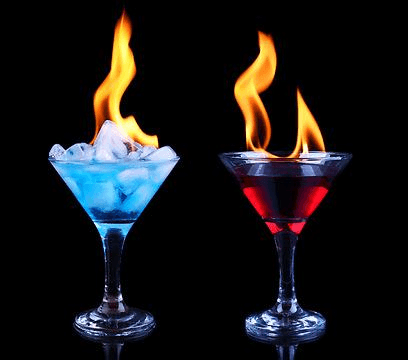
The stage between the discovery and mastery of fire, its use in shaping landscapes and hunting, and the agricultural revolution, Rodland links to the discovery of alcohol, which led to the development of agriculture and religion — itself a fire metaphor. Beyond the obvious fact that alcohol is a flammable liquid, it warms the body, and in some cases produces even a sensation of burning. If fire liberated humankind physically, alcohol liberated it spiritually. Alcohol consumes the previous consciousness and creates a new state of mind, and therefore it can be seen as an “inner fire”, akin to the outer fire that cooks food or forges metal. Naturally, alcohol is also dual-faced, capable of bringing about loss of control, violence, and ruin.
The analogy does not end at the symbolic level but is expressed also at the chemical level. Fire causes combustion. Flammable materials, when reaching the state of combustion, release energy in the form of heat and light. This happens in the physical world, when carbon-based organic matter oxidizes and becomes carbon dioxide, water, and heat. The same happens in the microcosm of the body: cellular respiration oxidizes glucose, thereby releasing energy to our body, but also emitting carbon dioxide. Perhaps this is why the soul is sometimes equated with fire — because this is what actually happens in the body. The same applies to the drinking of alcohol. When we consume it, ethanol reacts with oxygen. When it reaches the liver, it is oxidized there: ethanol turns into acetaldehyde, then into acetic acid, which integrates into the body’s energy system. This is a biochemical process “parallel” to combustion, but carried out under enzymatic and far more delicate control. Yet still, it is combustion.
In any case, Rodland demonstrates how technological progress leads to the emission of greenhouse gases, and thus inevitably brings us to a reckoning — a call to act with sustainability. We have the choice to obey this principle and thereby stabilize the world and bring about a paradise on Earth, or to fail, and fulfill the vision of the Day of Judgment. This, in essence, is the heart of eschatology: confronting the question of sustainability, and at the same time, the question of hubris. Rodland illustrates this through two fire-symbols that embody fire’s duality: the dragon and the phoenix.
The dragon embodies the destructive side of fire. It sits upon its hoard and breathes flames, symbolizing greed, hoarding, and obsession with power. In the modern context this is the fire of heavy industry, fossil fuels, nuclear weapons, or unrestrained artificial intelligence. It is the technological power that generates immense force but scorches the ground beneath our feet. The dragon signifies the possibility that in the Age of Reckoning, we will fail in our task — instead of harnessing fire for life, we will allow it to consume us.
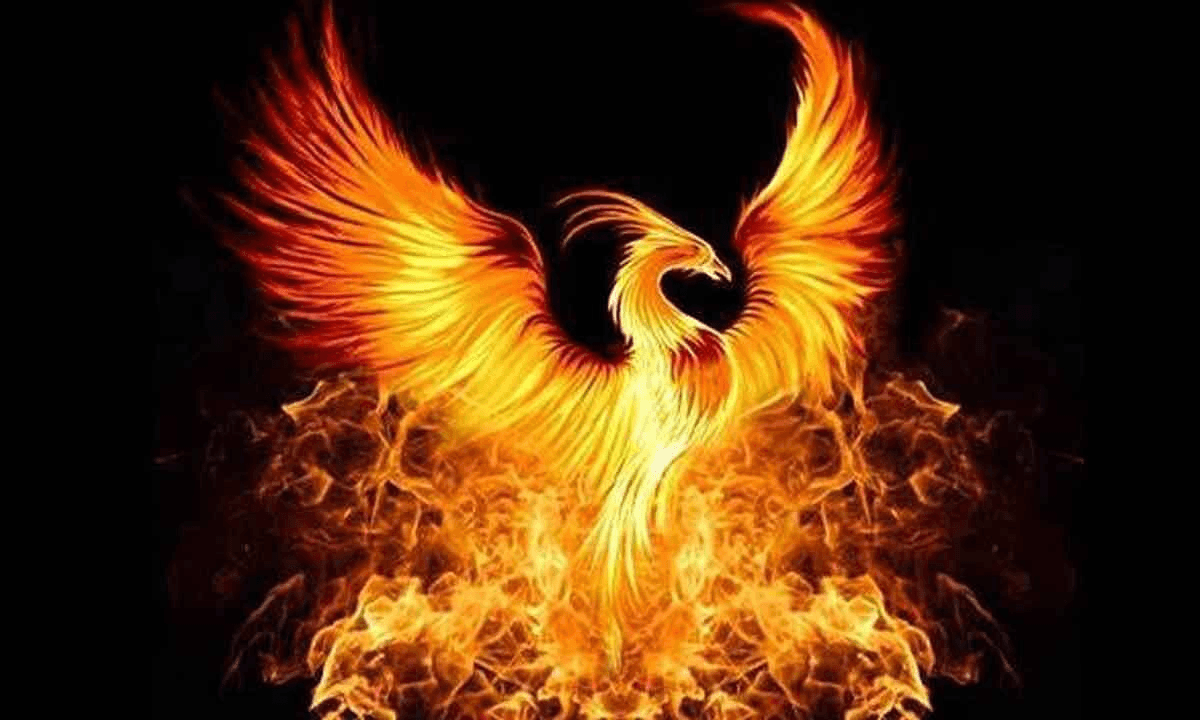
By contrast, the phoenix offers a different reading of fire. It too burns in the flames, but from the ashes it rises anew. Here fire is not greed, but transformation. It consumes the old to make way for the new, representing rebirth, healing, and creation. The phoenix symbolizes the human choice to turn the Anthropocene crisis into an opportunity — to use energy, technology, and knowledge to renew our world rather than destroy it.
We can also note that in various mythologies these two creatures both appear. That is: the fearsome dragon symbolizing the chaos that must be overcome, and the great bird symbolizing wisdom, healing, and renewal. In Judaism: Leviathan and Ziz Shaddai; in Zoroastrianism: Zahhak and the Simurgh; in Egypt: Apophis and Bennu — and so on.
Rodland, David L. “What’s Past Is Prologue: The Dragon, the Phoenix, and the Golden Spike”. In Planet Work: Rethinking Labor and Leisure in the Anthropocene, edited by Ryan Hediger, pp. 35–50. Lewisburg, PA: Bucknell University Press, 2022.
-
The role of fire as an analogy for the psychedelic experience in Jewish tradition
In the Hebrew Bible, fire is a theophanic tool—that is, part of the scenery that accompanies divine revelation. The burning bush, the pillar of fire that leads the camp, the smoking mountain at Mount Sinai where God descends in fire, and so on. Fire symbolizes the divine presence, or more precisely, the only form in which the intangible can be rendered tangible. And even if it is forbidden to depict the intangible, at least the intermediate entities that we are allowed, to some extent, to describe—are described as fire. The divine chariot is described as a “chariot of fire and horses of fire,” the living creatures "running and returning" like a flash of lightning, their appearance like tarshish. Their form is a pyrotechnic display of a wheel within a wheel.
In later biblical books, and especially in apocalyptic literature where the angels are named, fire is embedded within them—or at the very least, in their bodies. One of these angels is Uriel, whose name clearly derives from “ur,” meaning fire or light. Uriel is mentioned as an angel—one who is entrusted with "the world and the underworld"—but according to the vision of Enoch, he is understood not merely as an angel but as the primary tangible embodiment of God: that is, the least intangible aspect that God can possess, or alternatively, the most abstract tangible image that can be assigned to Him.
In terms of inner chambers and hidden secrets, one might envision God as a grand palace of many chambers, each chamber enclosing another, with a guard stationed at its gate to prevent access to the king. Only the most select individuals are permitted to enter the innermost room. Accordingly, the essence of one who enters is defined by their belonging to the innermost circle. And the one who manages that circle is called the “Prince of the Presence” (Hebrew: Sar HaPanim). This, ostensibly, is Uriel.
In Jewish mysticism, this angel is called Metatron, who is believed to be the transformed version of Enoch. However, in the Book of Enoch, this guiding angel is not referred to as Metatron but as Uriel—the one who leads Enoch and takes him on a guided tour through the heavens.
Let us return to this story shortly. The point here is that, in terms of inner chambers and hidden secrets, the image of God may also be likened to a labyrinth at whose center lies a treasure. And that treasure is guarded by a dragon—a monstrous beast, a kind of Minotaur—whose encounter is terrifying and deadly. But that is the nature of a liminal vision: awe and splendor, trembling and sweat, dreadful and sublime. A place beyond description, for even logic there is illogical and paradoxical. Fire and hail, snow and steam—an amalgamation of opposites, and at the same time, two-faced, capable of being good and evil simultaneously.
In short: we are dealing here with duality—both good and evil—whose boundary is thin and elusive. And very soon we arrive at the conclusion that this very “fire,” or the “fire and water” as opposites, may be analogized to poison—or to a psychedelic substance—which, too, is characterized by such duality. That is the ultimate aim of this text. We will arrive at that point shortly.
In 1 Enoch, in the vision of Enoch, he ascends to the heavens. There, he sees a figure of blazing fire dwelling within a house surrounded by tongues of fire and constructed of crystal. The man sits on a throne beneath which flow rivers of fire, and around him there is radiance like the sun and the appearance of cherubim. This man informs Enoch of the punishment of the Watchers and takes him on a guided tour through paradise and hell.
Once again, landscapes of fire are described: a mountain whose peak reaches the heavens, the place of the storm, whose summit holds the luminaries and thunder; at its base are a fiery bow, fiery arrows, a fiery sword, and lightning. A great cliff of fire is described, its top crowned with hills of flame. From the summit flows a river of fire, the fire streaming through it like water. When the river reaches the edge of the cliff, it falls like a fiery waterfall into a deep abyss whose pillars are made of heavenly fire. Within this abyss are columns of fire descending endlessly in height and depth. This waterfall appears as though it were the sky, but the abyss is so deep that the ground "has no foundation"—in other words, it cannot be seen, and it seems as though there is nothing below, a firmament above and an endless sky beneath. What turns this bottom into “heaven” is what resides within it: seven burning stars rolling in fire.
The man, initially described simply as an “angel,” is at some point given a name—Uriel. He explains why the stars fell, stating they were punished and are destined to remain in the depths “until the time their sin is fulfilled.” This transgression is analogous to the sin of the Watchers, who—led by Azazel—will also be cast into the abyss and remain there until the Day of Judgment.
It turns out that Uriel relayed such information to Noah as well, guiding him on how to escape the flood. The flood itself is described as an act carried out by two angels—Raphael and Michael. These two angels perform similar deeds: they cast the leaders of the Watchers into a pit of fire. Raphael throws Azazel into “Dud'el”, a giant furnace of fire, a prison of flame located at the edge of the desert. Michael, for his part, fights against Shemyaza and his followers, binding them “for seventy generations” beneath the hills of the earth. There they will be brought into the “depths of fire, into torment and imprisonment, and they shall be imprisoned there forever.”
The myth of the angels’ battle against demons (theomachy), and especially of Michael against the dragon, recurs as a central thread in later apocalyptic literature, particularly Christian texts such as the Book of Revelation. But its origin is in the Book of Enoch—and if we go further back, we find fragmented hints in the opening chapters of Genesis. All of these, ultimately, can be given a psychedelic interpretation, in which the fire is essentially the psychedelic substance—a double-edged sword, a “flaming sword which turns every way”, that, together with immense madness and terror, can also unveil supreme secrets.
Precisely because humanity is unworthy of these secrets, it is banished. And not only humanity. Those who are exiled from Eden are those who once had access to this knowledge but did not use it wisely—or worse, abused it. This could be a fallen angel, a dragon guarding a treasure, a serpent watching over a tree, or Adam himself and his descendants, expelled after the transgression. All are buried—until they learn to dig themselves out from the depths of the earth, strive with effort, and climb toward the summit.
Uriel is described in the apocrypha as one who holds a sword of fire in his hand—or more precisely, as one whose “sword is drawn in his hand”. We recognize this image from various biblical theophanies. Joshua encountered such an angel who introduced himself as the commander of the Lord’s army, in the plains of Jericho, immediately after the Israelites ate the produce of the land. David encountered a similar angel at the threshing floor of Araunah. Gideon encountered such an angel as well, though this one did not wield a sword, but rather a "staff". Yet in that particular scenario, there was unleavened bread present, and the moment the staff touched it, fire erupted from the rock.
Dan Merkur connects all of these to ergot, which in the Middle Ages was called “holy fire”—perhaps not by coincidence, since ergot is a visionary and psychedelic substance. Be that as it may, scenes involving fire, rock, and divine appearances are familiar to us from Moses in two key revelations: the burning bush at Horeb, and the giving of the second tablets at Mount Sinai. These two events occurred at the same location, which was also the site of another major theophany: the Sinai revelation, where the mountain smoked and God appeared in fire. A similar theophany is described with Elijah—again, at the same place.
I mention the story of the burning bush for another reason. Uriel is considered the one who guided Ezra in the book 2 Esdras aka 4 Ezra (aka The Vision of Ezra). The book contains seven visions, and Uriel is explicitly named in only one of them. However, as mentioned, in the Book of Enoch as well, Uriel is not always named—sometimes he is referred to simply as “the angel.” Uriel is generally considered a guiding angel—or more accurately, a figure who appears to those who prophesy and encounter, ostensibly, the transcendent. And if they do not encounter God Himself—since it is impossible to describe, even in imagination, how God looks or sounds or is sensed—then a name is given to the one who conveys wisdom, and that name is Uriel.
In the seventh vision that concludes The Vision of Ezra, the angel commands Ezra to drink a liquid “the color of fire”. Once he drinks it, the contents of the Torah are revealed to him: “As I drank, my heart poured forth understanding, wisdom grew in my vision, and my spirit retained memory.” He proceeds to write it down, along with seventy esoteric books whose contents are to be revealed only to the righteous who are worthy: “for they are the source of understanding, the fountain of wisdom, and the river of knowledge”.
This vision is constructed with the same imagery: beneath an oak tree, the angel appears to him from within the bush and speaks to him. The angel reminds him of Moses’ revelation—also from within a bush—as if to draw a parallel between the giving of the Torah to Moses and the second giving of the Torah to Ezra. This parallel between Moses and Ezra, and between the two stories of the burning bush, is significant because it includes imagery of fire, a hidden and nameless God, and the drinking of a “fire” potion that turns out to be psychedelic—as if it were haoma.
It seems that both of these episodes were written under Zoroastrian influence—such is the argument presented by Dr. Gad Barnea. This would be, ostensibly, the Zoroastrian source of the veneration of fire, its role as sacred sacrament, and the ritual of drinking a consciousness-altering substance.
In some sources, Uriel is described under a different aspect, bearing the name Nuriel, derived from nur—meaning fire or light. In the midrash The Assumption of Moses, found in the collection Legends of the Jews, he is depicted as an enormous angel—three hundred parasangs tall—accompanied by fifty myriad angels. The essence of Nuriel and his host is unique: they are composed of both water and fire (recall the motif of duality). Nuriel and his retinue are encountered in the second firmament of the seven heavens.
Indeed, The Assumption of Moses is also a kind of guided celestial tour, in which Moses is led by Metatron himself, described as the Sar HaPanim (“Prince of the Presence”) and identified in this text with Enoch—not with Uriel.
These angels of fire and water in the second firmament always turn their faces toward the Shekhinah and sing to her. Such angels, in fact, exist in almost every celestial realm. In the fourth firmament, for example, there is a palace of fire, with pillars made of red fire, beams of green fire, ceilings of white fire, boards and hooks of burning fire, gates made of ruby stones, and treetops made of precious gems. The entire place is filled with angels singing.
Similar angels appear in the fifth firmament, where the lower half of their bodies is made of snow, and the upper half of fire. These are called Ishim. In the sixth firmament, they are called Holy Watchers. And in the seventh: in addition to the angels of wrath, made of black and red fire—including Samael himself—there are the Seraphim with six wings, and the Hayyot (living creatures) that bear the throne of glory, namely, the Cherubim. And among them: one more—the Prince of Torah and Wisdom, who teaches the Torah in seventy languages. Moses asks for a gift, and the Torah is given to him and called by his name. The name of the Prince of Torah and Wisdom: Zagzagel.
Who is Zagzagel? In the Hebrew Book of Enoch—namely, 3 Enoch—there appears an angel named Kerubiel, whose traits align with those of the angels described in the seventh firmament: fierce, rebuking, burning, and consuming—chiefly presiding over a chorus of praising cherubim, from which he also takes his name.
His stature is "filled with smoldering coals". His mouth and tongue are described as torches and consuming fire. His face burns like fire, his eyes flash like lightning and sparks. His sword is like lightning, his arrows like flames, his shield is consuming fire. His neck and its surroundings are filled with glowing broom coals. In both his right and left hands burn fire and flame, and lightning issues from his face.
He is a kind of Zeus figure, with a diadem/tiara on his head like Wonder Woman's—serving both as a symbol and as a weapon when needed: "a crown of holiness is upon his head, upon which is engraved the Ineffable Name, and from it emerge bolts of lightning. The bow of the Shekhinah lies between his shoulders. His sword flashes like lightning, his waist girded with arrows of flame, his armor and shield are consuming fire, his neck wreathed with glowing coals, and he is entirely surrounded by burning coals".
Why is he called Kerubiel of the Lord? Because he is appointed over the chariot of the cherubim. The mighty cherubim are in his hands. He adorns the crowns upon their heads and polishes the diadems upon their foreheads. In short: Kerubiel “binds crowns for his Creator”—as if he himself were Metatron, and if it weren’t made explicit that above him and his subordinates stands a higher Being, “the One who dwells upon the cherubim”, one might mistake him for God Himself (as indeed happened to Elisha ben Abuyah).
But Kerubiel is only number two. He is, after all, Uriel himself—a cherub in his own right—and the one who, with his flaming, revolving sword, guards the gates of Eden against those who knock. A kind of divine doorman, who dispenses wisdom only to those deemed worthy—and only among the reverent.
There is a play here on the Hebrew root R.A.A.H. (to see), which leads us to a reflection on the sense of vision—and on the fact that most “trips” are visual. It is worth recalling that most angels are described as beings whose bodies are filled with eyes. Including, of course, Samael. Including, by the way, Uriel himself—or more precisely, under his other name: Sarafiel.
The Hebrew Book of Enoch (3 Enoch) describes Sarafiel in a manner similar to how Kerubiel is depicted: his form is saturated with imagery of fire and light—lightning, torches, sparks, glowing coals, and electric brilliance. He, too, wears a diadem on his head, featuring a large sapphire that shines with the radiance of the heavens.
His body is filled with eyes, like stars scattered across the firmament—beyond count or comprehension. Each eye shines like the morning star, some resembling the “lesser light,” others the “greater light”. From his ankles to his knees, he glows like stars of lightning; from his knees to his thighs, like the morning star; from his thighs to his loins, like the moon; from his loins to his neck, like the sun; and from his neck to the crown of his head, like “the imperishable light”.
He is appointed over the burning seraphim and teaches them song and sanctity. Why are they called seraphim? Because they burn. The primary task of Sarafiel and his legions is the daily incineration of Satan’s accusation scrolls—so they cannot be presented before God at the time of judgment.
Uriel–Nuriel–Sarafiel–Kerubiel–Metatron—this figure has yet another name, which appears in The Apocalypse of Abraham. Or perhaps even two names, since each figure bearing one of these names is marked by attributes described elsewhere as those of the “Angel of the Presence”.
These two names represent, in fact, two faces—and here we return to the Hebrew root P.N.H. (to turn, face). The Angel of the Presence, who reveals himself to those who enter the innermost sanctum, appears as a being with four faces, as described in Ezekiel 1 and 10. One of those faces is that of a cherub, but each face also represents a different attribute—and since each attribute is governed by a specific angel, these four faces are, in essence, four angels: the same four angels who surround God—Michael on the right, Gabriel on the left, Uriel before Him, and Raphael behind Him. (And above them: the Shekhinah).
In the Apocalypse of Abraham, not all of them are named—but two of them are. The vision describes the heavenly court as possessing two books: the Book of the Righteous on the right, and the Book of Sins on the left. Each book is overseen by an angel—though their names are not mentioned. A third angel, who presides over the scales that weigh the deeds recorded in both books, is called Dukiel; he is the one who carries out judgment.
Opposite him stands an accuser—a fourth angel, blazing and merciless, who holds fire in his hand. This angel “has power over fire and tests the deeds of humankind with fire”, meaning he conducts an ordeal (ordalium, “trial by fire”). The angel burns the deeds. If the fire consumes the deed, then the person’s act is deemed unworthy, and the angel of judgment immediately seizes the person and carries them to the realm of the wicked—a place of harsh punishment. But if the fire does not consume the deed, it is a sign that the act is righteous, the person is considered just, and the angel of justice elevates them to the portion of the righteous.
The wrathful angel who rules over fire is named Puriel. Besides the pleasant rhyme, the name bears linguistic weight: in Greek, the word for fire is πῦρ (pyr). The Greek letter upsilon (υ) hovers between the sounds of u and y, so the pronunciation can shift—sometimes “pyr”, as in today’s pyro, and sometimes “pur”, as in Purim.
And who’s to say that pur meaning "lot" or "fate" in Purim isn’t connected to fire divination? Could it be that Haman is actually described as a magus—a fire-diviner? It turns out that in ancient Persia, divination was indeed practiced by observing flames and the movement of smoke (Agathias 2.25, Encyclopædia Iranica, entry: “Divination”).
Admittedly, Dr. Thamar Eilam-Gindin suggests that the name Purim derives from the Persian festival Farvardigan, a holiday of the souls, which took place around the same time. But (a) even she is uncertain, and (b) in that festival too, fire was used—though not for divination, but to welcome the returning souls into the home. Still, the association between soul and flame is well-known—even in Judaism: “The soul of man is the lamp of the Lord”.
Of course, this interpretation of the angel’s name as deriving from “fire” is circumstantial. The name Puriel does not appear frequently in other Jewish texts, despite the presence of many fire-related angels. The fact that a Greek name is used raises questions: why give a Jewish angel a Greek name rather than a Hebrew one?
This may indicate the time or place in which the text was written, and can work both in favor of and against the story’s credibility. The name Dukiel also seems to bear Greek influence, as dikē in Greek means “justice” or “judgment”. It’s possible that, simply for the sake of making the names accessible to a Greek-speaking audience, the original Hebrew names were translated into Greek—but the intent was to convey their Hebrew meanings.
In that case, Uriel—or any of his variants as a fire-angel—could easily be Puriel, whose very phonetics suggest such a link. And the angel of judgment may be Phanuel, who is described in 1 Enoch (Chapter 40, verse 9) as the “angel set over repentance and the hope of those who inherit eternal life.” That meaning also aligns with the name Dukiel.
This is a good opportunity to note that in the same verse where Phanuel is mentioned in the Book of Enoch, four angels are listed by name, and Phanuel replaces Uriel in the usual quartet—namely: Michael, Raphael, Gabriel, and Phanuel.
Elsewhere in the same book, the quartet does include Uriel as the fourth. There’s no escaping the conclusion that Uriel and Phanuel are, in fact, one and the same—and therefore Uriel is also Dukiel and Puriel. Perhaps all four angels are manifestations of a single being.