
One of the central moves in the transition to monotheism is the manner in which traits that were originally feminine — and especially apotropaic ones, that is protective qualities — were transferred to male figures, foremost among them Yahweh. A paradigmatic and symbolic example of this is the figure of the “Tsur (Rock),” a term that symbolizes Yahweh as a protective power, yet whose roots lie in ancient traditions of worship and beliefs in guardian goddesses identified with precious stones and amulets.
Both the Star of David and Solomon’s Seal, two symbols now closely associated with Judaism, are designed as geometric patterns representing a bird’s‑eye view of a rock stone, thus continuing the tradition of portraying protective amulets made of stones — especially gemstones — which were already common in antiquity as symbols against the evil eye and harmful influences. This imagery directly relates to apotropaic functions that were used across generations; terms like “Tsur Yisrael” are in fact testimony to a process in which a pagan symbol of protection — the stone — was “converted” and transformed into a symbol of the one God.
The association with King Solomon arises in a later tradition, claiming that Solomon possessed an amulet through which he ruled demons. But upon careful scrutiny of those traditions, the nature of that amulet is shrouded in ambiguity: in some versions it is a gemstone; in others, it is a root or plant. Amots Dafni shows that in fact the original legend was about a protective ring (at whose center was a mandrake root) owned by Alexander the Great, which in Jewish tradition was transformed into Solomon. Both the legend itself and the fact of having an amulet against demons underwent a “conversion” of a manifestly pagan phenomenon.
The Star of David is a hexagram, and Solomon’s Seal is a pentagram. These are evolutions of an amulet from the Mesopotamian goddesses such as Ishtar, who was identified with the planet Venus (star). Ishtar’s name in Akkadian comes from star, and she is the Akkadian version of the goddess Inanna, whose Sumerian translation is “Queen of Heaven.” Inanna was a multifunctional goddess: goddess of love, but also of war and fertility — two domains that demand protection from harmful forces. That protection was manifested through her identification with the shining star, which in its graphical form is an octagram. The octagram later transformed into the heptagram, then the hexagram, and finally the pentagram.
In Greek mythology, Inanna’s counterpart was Athena — goddess of fertility and war. Athena had attendants, the Gorgons, one of whom was Medusa. The story of Medusa is less significant for its plot than for the fact that she was punished and turned into a terrifying creature. Her transformation and the literal meaning of “Gorgon” (one who causes dread) hint that she is a double‑faced, demon‑like being — and when that demon looked at you, you turned to stone. Some scholars interpret this as a metaphor for muscular stiffening (rigor), a state in which muscles harden, a sign of death — implying that what is being described is an edge experience, a “battle with demons,” where defeat means death.
Rigor — the sudden hardening of something that was soft — and especially its transition from hardness to softness and back, becomes a symbol of death, or the threshold between death and resurrection. In Jewish symbolism one can see this in Moses’ staff, which became a serpent and then back into a staff. The serpent enters the picture: it is a symbol of duality in venom — able to bring death or madness but also, in some cases, healing and restoration. Serpents were also the “hair” of Medusa.
But Medusa was, as noted, originally an attendant, and it appears that the Gorgons did not serve Athena alone — they also served Zeus, imprinted on his Aegis (shield), as told in the Iliad. That suggests that they functioned as amulets. The literal translation of aigis is “violent windstorm” (Greek kataigis), which resonates with Zeus’ attribute of lightning. But importantly, the term also means “goatskin” (αἴξ, aix), evoking the notion of the amulet as a piece of leather or shield — attributes of warriors.
In this context we also note another warrior fertility goddess, Artemis, who was associated with skins. Artemis is portrayed as virgin, and virginity was a trait of the attendants of the goddess‑shepherdess. Examples include in Rome: Vesta, whose attendants were the Vestal Virgins — their role was to preserve the sacred flame, which symbolized the burning hearth, an attribute of the nurturing goddess. Incidentally, Medusa was a virgin. For precisely that reason Athena was outraged when her temple was defiled by Poseidon’s assault of Medusa; accordingly she punished her by giving her a fearsome appearance.
Raphael Patai, as is known, argues that the consort goddess had, in fact, three manifestations which are one: a virgin with striking breasts, a mother with full nourishing breasts, and an old woman with shrunken breasts. This is essentially a “holy triad” or "trinity" where each manifestation includes one distinguishing symbol: the breasts, a symbol of fertility. The full udders of milk symbolize the goat — which, by the way, also has a beard, making the goddess a kind of androgynous figure, with female attributes (breasts) and male ones (beard). Gradually one notices that the demonic dimension has androgynous traits — both because it is a liminal, fluid realm, and primarily because the very nature of the cult is hierogamy, the sacred union between male and female.
This is also the main thesis of Raphael Patai in his book The Hebrew Goddess. At the center of the fertility cult, there are two figures: the male figure, the Baal, and the female figure, the Rāʿayah (shepherdess/consort). Their union, the union of the two gods, is thus called Elohim, a paired cult — and that was the original cult of Yahwism. That is also the reason Kabbalah is a kind of Yahwism, because it exalts the supreme union between the God and the Shekhina or the Holy Matronita. Marvin Pope, incidentally, contended that this is what lies at the heart of The Song of Songs, where the shepherdess is called “Shulamit.” This is why the book is attributed to Solomon (from the same root). Perhaps the hierogamy is thus called “shalom” and in orthodox idiom “shalom bayit” (peace in the home).
Raphael Patai conceived this idea long before archaeological evidence emerged to show that Canaanite—and thus Jewish—worship was in fact a paired cult of Yahweh and Asherah. The discoveries at Kuntillet Ajrud, Khirbet el‑Qom, and Tel Arad only bolster Patai’s argument: God alone was not enough — He needed a female function in order to be a full deity. The goddess, or rather the two gods, are expressed as stone “standing stones” (matzevot) — which are nothing but stones.
What happened in monotheism is that this element of stone standing stones was ostensibly annihilated, and every trace of the paired cult was erased. Within this framework, feminine attributes were transferred to the single male God, and thus the apotropaic motif as well. Is this purely a Jewish idea? Probably not — it appears that the transfer of apotropaic traits to the masculine began earlier, and Greek mythology is proof of it. Zeus, an Olympian god, inherited attributes of the fertility goddess, especially the Aegis. Thus his Aegis bore the emblem he should have worn, rather than that of a feminine deity — lightning instead of star. (If it reminds you of Wonder Woman’s tiara, that is precisely because it is the original form of the diadem, a headband that once adorned kings, although its origin is the headband placed on the statue of the fertility goddess in her temple.) And the reason for placing a cloth band on her head was to tie on a amulet of that very star.
That band was also dyed in unique colors — scarlet, sky blue (Tekhelet), and tyrian purple. Those bands were woven by priestesses in the temple. Some were virgins, some “holy” (consecrated), and their role was perhaps to enact a symbolic hierogamy with the male deity, the king. Some of them, by the way, were androgynous, but that does not depart from the subject at hand: apotropaic functions. The tzitz (the golden headplate) of the High Priest was a kind of such amulet affixed in a linen band: the mitznefet (turban), whose band was Tekhelet. The tzitz may have taken the form of a mandrake/henbane, as Josephus reports, and perhaps bore the Name of the Ineffable, as in tractate Shabbat 63b. But in any case, its function was apotropaic, and the magical shield was that of the male God, who also had such a diadem, as stated in Chagigah 13b, that Sandalfon “binds crowns to his Creator.” That diadem is reported in Song of Songs for precisely the same reason — the transformation of the woman into a man — Solomon receives the crown, “for a crown he is mother to him.”
If we seek additional Kabbalistic Yahwistic symbols, it’s worth noting that the Shekhina, or rather the place of the Shekhina, is called in the Book of Lamentations an Ateret (crown). In Sefer Heikhalot it is said that Metatron, acting as High Priest in the celestial temple above, has on his tzitz the letters from which heaven and earth were created. These are likely the “crowns” that God Himself crowned those letters with, as described in Menachot 29b — thus Moses, upon ascending on high, found them.
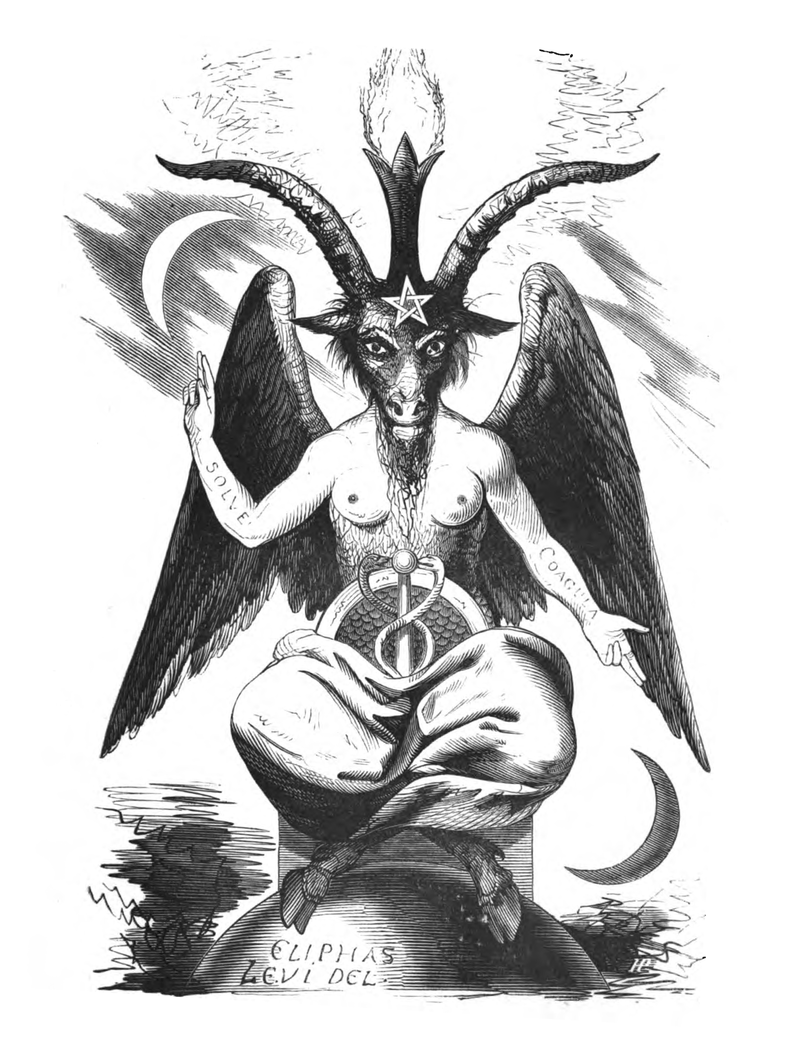
Returning to the matter of stones: Hermes is another example of an apotropaic male function perhaps inherited from a woman. According to Martin Nielson, Hermes was born as a feminine personification of cairns (stone mounds) placed along roads, called hermion in Greek. But this evolution is relatively late: Hermes probably became male only after the Greeks encountered the god Thoth (from Egypt). When did that occur? Possibly in the Hellenistic period, perhaps during Greek-Egyptian interactions, documented from the 7th century BCE, with the founding of Naucratis. Before Hermes was associated with Thoth, his attributes were linked to Pan, whose figure resembles a goat — a being akin to demons in later descriptions. It’s worth noting that heads of demons, even in Heikhalot literature (e.g. in the Book of Enoch), are named after the goat: Azza and Azal, likely not by accident. Later accounts depict the devil with a goat head — most notoriously Baphomet, a figure to which the Templars allegedly worshiped, who also had a pentagram pendant on his head, identical to Solomon’s Seal. That Baphomet is described with breasts, seated in a crouching posture, as if a fertility icon. Some suggest his name is actually a code Atbash of the word shōphîʾa (sophia, wisdom in Aramaic) — indeed, Solomon was considered the wisest among men.
Hermes was, as stated, a hermian entity, but originally a female figure. When the hermionic entities were invented, they were feminine too: Hecate preceded Hermes in that regard as a “guardian goddess” embodied in stone cairns at road junctures, whom one should not look at—or divert one’s gaze from (like Medusa). Before Hecate, Artemis was defined as such, both guardian and pastoral, like Pan, and in Greek “Mother of Beasts” (Potnia Theron). The three gods — Artemis, Hermes, and Hecate — all served as “gate‑keepers” and protectors of travelers, in the Hellenistic era called Propylaios (Προπυλαίος); for this reason they were apotropaic.
Apotropaic features, protection from the evil eye and safeguarding the way, underwent a cultural–religious process of “patriarchy.” Perhaps not coincidentally the word Pater (father) echoes Petra (rock) in sound and spelling. The apostle Peter (Petros in Greek) is described in the Gospel of Thomas as one who complained that Jesus taught Mary Magdalene, claiming she is not a man. Jesus replied that she might even be more of a man than him, hinting at the monotheistic motivation to appropriate feminine attributes of wisdom and protection for men. Originally, those attributes were women’s alone; the qualities of strength and hardness were assigned to men — yet these too are qualities of stone. And perhaps simply because stone symbolizes fertility — like the shell from which the pearl emerges. In Greek myth it is told that the omphalos stone gave birth to Cronus, offering it to Zeus, while Zeus himself was nurtured and hidden in a cave, where nymphs nursed him with… goat’s milk. The Jewish equivalent of the omphalos is the Foundation Stone, the place from which “the world was created,” as the text says.
Another famous stone attributed with magical power is the baetylus (standing stone, bethel‑stone), considered a non‑personal representation of the divine. The omphalos was such, the Kaaba was such, and surely also the Foundation Stone. A black stone in general was regarded as a fertility amulet — often onyx. Women were said to give birth on stones, as a protective rite. It is unclear whether this is intended by Genesis’ phrase, “When you do the office of a midwife to the Hebrew women, you shall look upon the stone birthstool”. In myths of fertility goddesses — for example Cybele — it is said they were born from such stones. Thus a black stone was brought to Rome from Phrygia by senatorial decree to protect Rome from Hannibal’s army. It was said to represent Cybele, the Phrygian fertility goddess, whose temple was erected on the Palatine, and was renowned for its Galli priests, who were often androgynous.
I did not find a connection between the black stone of Cybele and another black stone set in Rome in the Forum, in the temple of Vulcan. However, about the Lapis Niger, there is also a foundational myth: it is said that the Roman state was founded there, when Romulus signed the peace treaty between the Latins and Sabines.
In conclusion, some contend that hierogamic sex rites were performed on bethel‑stones, such as those allegedly practiced in Baal Peor. Peor is so called from the root Paar ("wide open"), perhaps meaning a feminine sexual organ. In Job it is said, “They have gaped ("paaru") upon me with their mouth” which may hint that “Paar” is associated with "Boshet", in the sense of a sexual organ, and perhaps also in the sense of a sexual disease. The connection between Baal Peor and Boshet ("shame") is hinted in Jeremiah, where it is written, “Then Moab shall be ashamed of Chemosh, as the house of Israel was ashamed of Bethel, their confidence”, where the word “ashamed” ("bosh") is doubling in meaning, also implying disgrace in the sense of sexual exposure, and perhaps the sense of abandoning.
הצטרפו לרשימת התפוצה שלנו
כתיבת תגובה