
תגית: Neolithic
-

Early history of the poppy
The opium poppy (Papaver somniferum) is a domesticated species. It has no wild counterpart. In other words, it was created by humans—whether through hybridization, selection, or encouraging mutations. It is considered one of the earliest agricultural species to undergo a process of “primitive genetic engineering,” alongside wheat, barley, and coca. Most botanists agree that its…
-
A neolithic grain cult?
Researchers from the Autonomous University of Barcelona (UAB) argue that the discovery of grinding stones in Neolithic burials in Germany suggests that these were grain milling tools buried alongside individuals in ritual contexts. Several tools were found at different stages of their life cycle: some new, some lightly used, and some completely worn out. The…
-
Stonehenge-like circle unearthed in Denmark may have links to UK
During excavations in January 2025 in the city of Aars, in North Jutland, Denmark, a circle consisting of at least 45 wooden posts was discovered, with a diameter of approximately 30 meters. Researchers estimate that the structure was built between 2600 and 1600 BCE, during the Early Bronze Age. This is the second "woodhenge" of…
-
New Neolithic Stone Circles on Dartmoor: Unlocking the Sacred Landscape of Prehistoric Britain
Two new Neolithic stone circles have been discovered on Dartmoor, an area renowned for its prehistoric heritage. One of the circles, named "Metheral," resembles Stonehenge and may have been part of a henge monument. The second circle, located outside the "sacred arc," was found near a collapsed dolmen known as the "Fallen Brother Dolmen." Additionally,…
-
Newly found 12,000-year-old burial may belong to a female ‘shaman’
In Çemka Höyük, located in southeastern Turkey near the Tigris River, a 12,000-year-old burial site of a 25-year-old woman was discovered. The grave was covered with a stone slab, and along with her were found remains of animals, including the skull of an aurochs, leg of a marten and a partridge wing. These findings suggest…
-
New Study Challenges Human Transport Theory of Stonehenge Bluestones with Glacial Evidence
A new study claims that the bluestones at Stonehenge were not transported to the site by humans but are instead the result of natural glacial movement. The research is based on an analysis of the Newall Boulder, a bluestone discovered at the Stonehenge site in 1924. Until now, the overwhelming majority of archaeologists believed that…
-
mafia uses execution methods that were used in religious ceremonies in the past
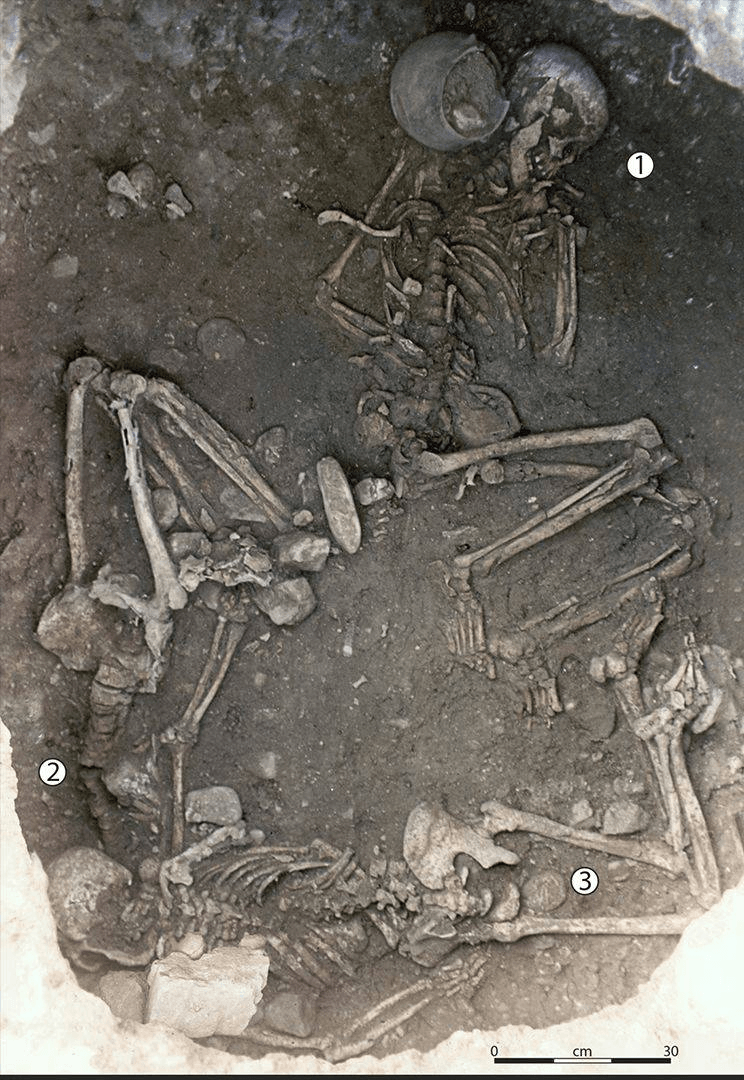
In Avignon in France, the remains of three women from the Neolithic period (5,500 years ago) were found, one of them died naturally and two of them were younger, executed as human sacrifices in a way that is currently used by the mafia. The method is called "Incaprettamento" and in which victims are placed on…
-
8,600-year-old bread found
Researchers from Necmettin Erbakan University discovered that the remains found in an object discovered in Çatalhöyük were dough bread, from 8,600 years ago, which is considered the oldest known bread in the world. Coincidentally or not, Çatalhöyük is considered to be the oldest urban settlement in the world, and during the Neolithic period in question,…
-
Vittrup Man, a human sacrifice in Denmark
A preserved body of a human sacrifice from the Neolithic period from 5300 years ago was found in a bog in Denmark. According to dna analysis and according to the analysis of the enamel in his teeth, it seems that the man was an immigrant from a fishing community from northern Scandinavia who joined the…
-
An Early Neolithic Dolmen with Early Megalithic Tombs on Sweden
A dolmen from 5000 years ago is found in Sweden and is considered the oldest found in Scandinavia. What indicates its antiquity is the fact that it differs from the form of burial common in the Neolithic era in the same area, the so-called "passage grave". In the dolmen, 12 human remains were found, all…