
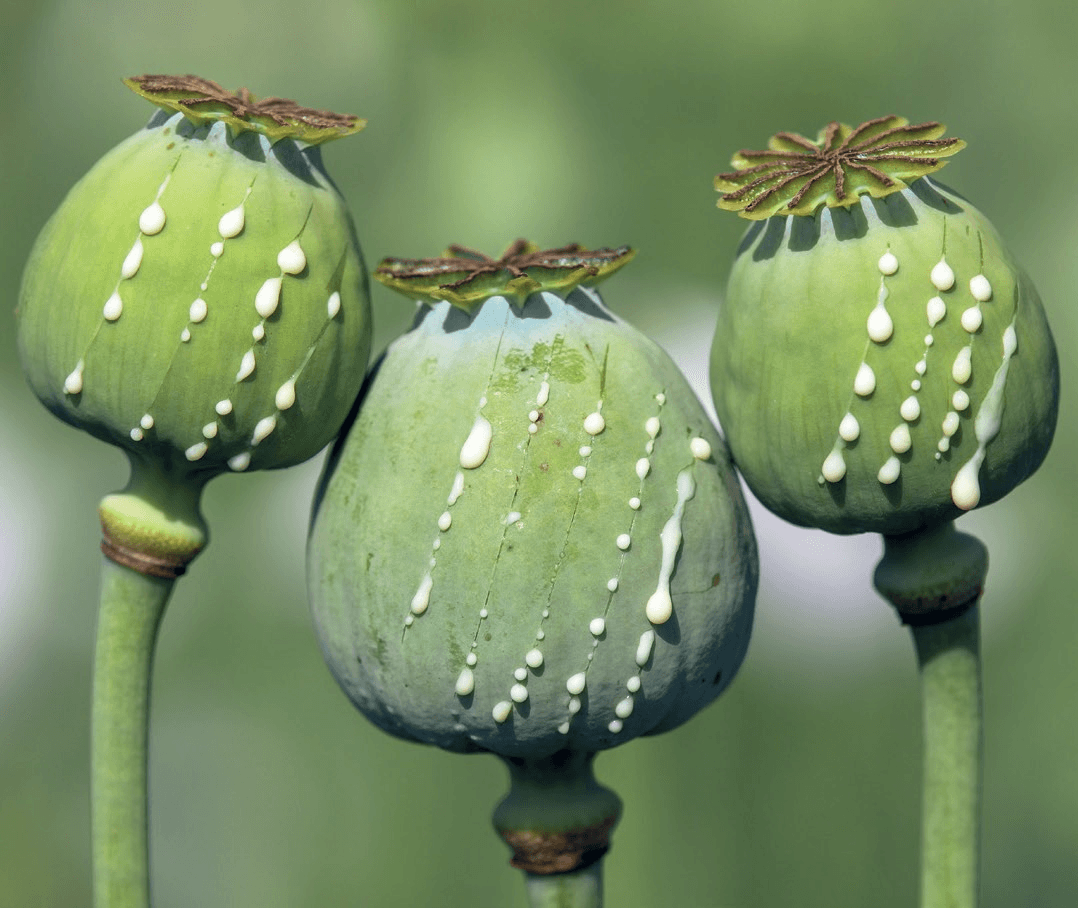
The opium poppy (Papaver somniferum) is a domesticated species. It has no wild counterpart. In other words, it was created by humans—whether through hybridization, selection, or encouraging mutations. It is considered one of the earliest agricultural species to undergo a process of “primitive genetic engineering,” alongside wheat, barley, and coca.
Most botanists agree that its closest relative is the Mediterranean dwarf poppy, Papaver setigerum, common in the western Mediterranean (Spain, southern France, North Africa). This species also contains some alkaloids, but in quantities too negligible for medical or psychoactive use. Hence the assumption that systematic cultivation and prolonged domestication are what caused the sharp increase in morphine content and the creation of P. somniferum.
The two main opinions on the place of domestication are the western Mediterranean and the Near East, more precisely Anatolia. The view that locates domestication in the western Mediterranean is based on the distribution of Papaver setigerum in that area for thousands of years. Archaeological finds have been uncovered in Britain (Raunds), in Spain (Murciélagos Cave), and in Italy (La Marmotta). Some argue that the poppy was initially domesticated as an oil and food plant (seeds, oil), and only later were its opiate qualities discovered “by accident.”
The opinion that locates domestication in Anatolia is based on the fact that this area contained the earliest conditions for agriculture. Early trade routes from Mesopotamia and Egypt suggest that already around 3400 BCE the Sumerians knew the “plant of joy,” identified with opium. In addition, the climatic conditions in Egypt and Anatolia were especially suited to Papaver somniferum, and later evidence (Thebes, Egypt) points to a very potent strain (Thebaicum).
Since there is still no scholarly consensus, it may well have been a case of dual domestication—independent experimentation in two centers, as happened with wheat and rice. Archaeobotany shows that already in the late Neolithic (c. 5000–4000 BCE), poppies were cultivated both in the western Mediterranean basin and around Anatolia.
The earliest history of opium begins in the early Neolithic period. The first relevant find is the horned poppy (Glacium flavum), not yet a psychoactive substance. Its active compound is glaucine. It was found in the southern Jordan Valley and dated to 8,000–10,000 years ago. It is assumed that it was used for early experiments in relieving pain and cough, despite severe side effects.
At the same time, Neolithic expansion reached Europe. In Spain (Gavà, the Can Tintorer site), in burials inside ancient jade mines, a skeleton was found with a poppy capsule inserted into a decayed tooth and evidence of chronic consumption in the bones. This is the earliest evidence of opiate analgesic-narcotic use.
Between 5700 and 4900 BCE appears the Linearbandkeramik (LBK) culture in northwestern Europe (Switzerland). Clear evidence of poppy cultivation was found in their settlements, where opium was apparently used both for medical purposes (toothaches, childbirth pain, joint disease) and as a nutritional source (seeds and oil). The settlements appeared peaceful, but archaeology reveals severe rates of violence and massacres (Talheim, Herxheim). It is possible that opium was also used for ritual purposes, to forget pain and trauma, or perhaps as part of preparations for internal battles.
At La Marmotta, a Neolithic village under Lake Bracciano near Rome (5700–5200 BCE), long wooden boats and artifacts indicating Mediterranean trade were found, as well as opium poppy seeds. The settlement represents an advanced community that brought seeds and animals with them, showing that the spread of the poppy was part of the cultural-agricultural expansion wave from the Levant through the Mediterranean.
In Britain, the Raunds finds (3800–3600 BCE) are the earliest evidence of the poppy—a non-native species that must have been imported via trade routes. Later, at the Wilsford Shaft site near Stonehenge, poppy seeds were found alongside henbane (Hyoscyamus niger), which was usually taken together with opium, with opium soothing headaches and nausea. It is tempting to think this was for psychoactive use, but it seems to have been medical, and in that case, it is sufficient evidence for pre-scientific pharmacological knowledge in this region, even in places where these plants were not native.
In Spain, at Murciélagos Cave (“Cave of the Bats”), burials dating from 4000 BCE were found with poppy capsules in woven grass bags, alongside flowers, shells, and gemstones. The elaborate burial indicates high status and ceremonial-spiritual use of the poppy—both to ease the pains of dying and to prepare for the journey after death. Later, in the Rhine and Rhône valleys, pottery vessels with poppy residue were found, suggesting similar use.
Around 3000 BCE, the Sumerians referred to the “plant of joy,” generally identified with opium. However, modern scholarship questions this, arguing it may have meant “joy cucumber.” There is no unequivocal Sumerian term for opium. Thus, while the Neolithic and early Bronze Age West were actively cultivating it, in the Near East the evidence is less certain.
In the Minoan culture (2000–1400 BCE), lekythoi vessels were found with depictions resembling scarified poppy capsules. The famous figurine of the “Poppy Goddess” (1300–1250 BCE) was discovered—with closed eyes, an ecstatic expression, and hairpins shaped like poppy capsules—clear evidence of ecstatic-ritual use. Alongside it were clay pipes for heating opium gum—possibly for collective use in ceremonies.
In Mycenaean Greece, bronze pins with poppy-shaped heads were discovered, as well as a gold ring depicting a fertility goddess holding three poppy capsules—symbols of wealth, health, and fertility. In Cyprus, in the city of Kition, an ivory pipe (1300 BCE) was found with an image of the Egyptian god Bes—household deity of childbirth, humor, and music—indicating a link between fertility cults and opium smoking.
In Egypt’s New Kingdom (1600–1100 BCE), climatic conditions enabled the cultivation of a local strain of Papaver somniferum—“Theban opium” (Thebaicum). Finds include earrings and necklaces with capsule-shaped pendants in royal tombs, faience vessels in the shape of poppy capsules, and of course the Ebers Papyrus (1550 BCE), recommending the administration of opium to infants to quiet their crying. There is also evidence that sometimes children died of overdoses, as indicated by capsule-shaped jars in children’s tombs. The Ebers Papyrus testifies to opium’s use as a wonder drug treating ailments from headaches to constipation. For headaches, poppy was ground together with coriander and other plants. For constipation, stalks of poppy were mixed with castor oil, dates, and beer. Opium also served as a tonic to fortify the body (met), much like today’s dietary supplements.
In Egypt it had a dual role—both medical and religious. Opium was used in sacred oil anointing, ritual baths, amulets, and mystical inscriptions on the body. This use likely spread to Greece. Homer, in the Odyssey, speaks of “nepenthe,” the drug of forgetfulness or of dulling grief, given to Helen of Troy by an Egyptian queen named Polydamna. Later, Greek and Roman coins bore poppy imagery. In Roman mythology, Somnus (god of sleep) was depicted with poppies, and Ceres (goddess of fertility) used it as a pain reliever.
At the same time, scientific medicine emerged, emphasizing that these plants possessed therapeutic properties not necessarily tied to religion. Hippocrates, Dioscorides, and Pliny all wrote about opium and its analgesic—and sometimes addictive—qualities. Galen is said to have prescribed opium to the emperor, which led to symptoms of dependency, necessitating its continued administration over time.
Bibliography
- Thomas M. Santella – Opium (2006)
- John H. Halpern – Opium (2019)
- Lucy Inglis – Milk of Paradise (2018)
הצטרפו לרשימת התפוצה שלנו
כתיבת תגובה