
The extraction of Tyrian purple dye and opium from the opium poppy (Papaver somniferum) are fundamentally different processes, but they share a symbolic and conceptual similarity. Both involve the extraction of a rare and highly valuable substance from a living organism, and the act of extraction itself is tied to wounding and the release of an essential essence for a prized purpose. Another commonality is that the extraction of both is often described in terms of drawing nectar from a “flower”—a metaphor that encapsulates not only the physical nature of the substance but also its symbolism, as a representation of life cut short and the cost of obtaining something precious.
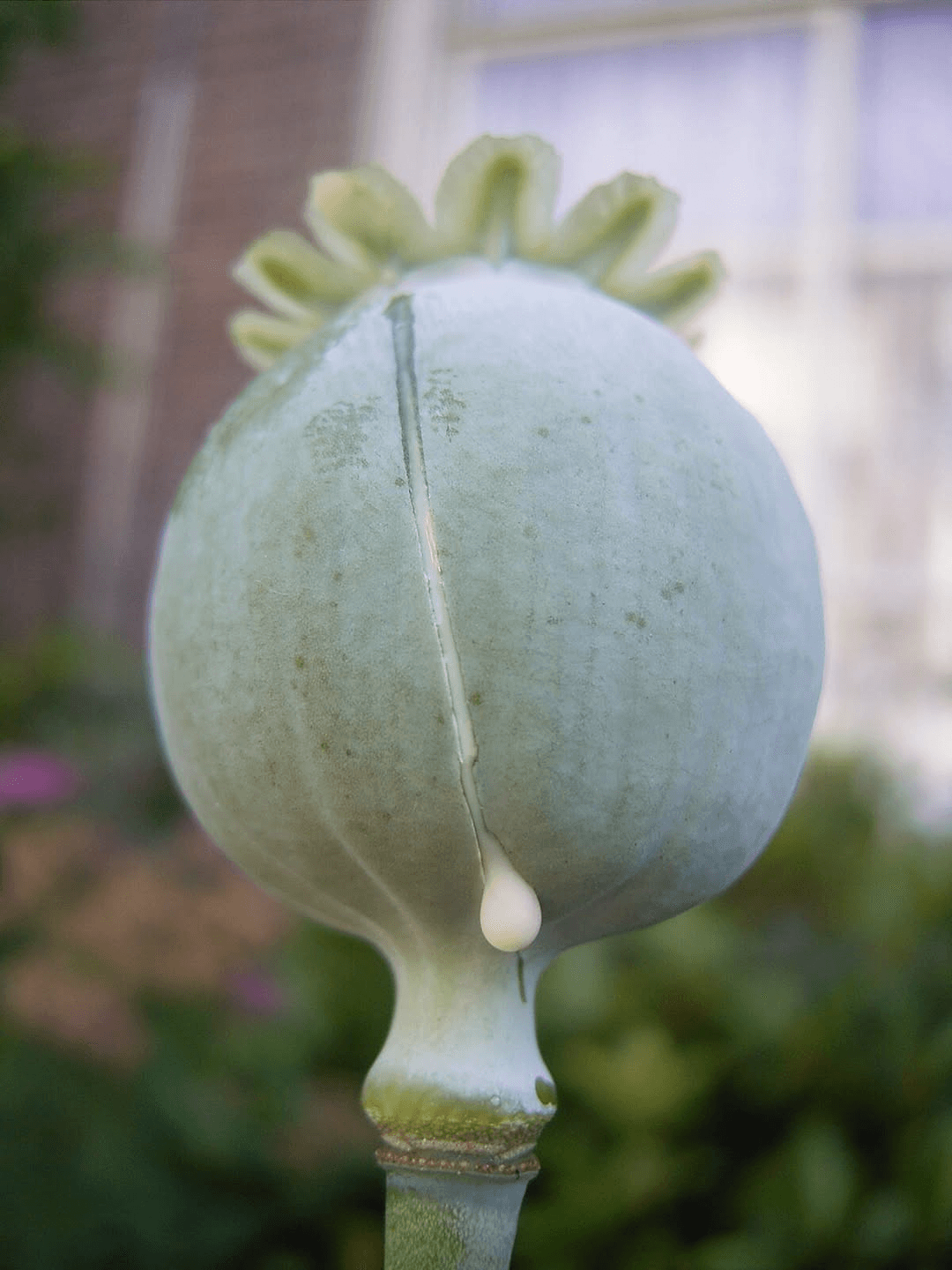
The process of extracting Tyrian purple from sea snails is metaphorically described by Aristotle and Pliny the Elder, who refer to the juice extracted from the mollusk as a “flower” (ἄνθος in Greek, flos in Latin). This juice is drawn from an organ in the mollusk’s neck, and it must be extracted while the mollusk is alive, as the creature “vomits” the juice upon death, diminishing its quality (Aristotle, Hist. an. 547a26-27; Pliny, Nat. 9.125-26). The metaphor of the “flower” conveys the substance not only as a product of great value but also as a symbol of life interrupted—like a flower plucked from its stem. This process is reminiscent of opium extraction, which involves scoring the unripe seed pod of the opium poppy to release its milky latex, considered the plant’s essence. In both cases, the act of wounding or incising is essential for extracting the substance, which represents the organism’s life force.
The term “flower” offers a dual-layered symbolism: on one hand, it emphasizes the beauty and natural origin of the extracted substance, and on the other, it hints at the fragility of life and the cost of extracting the essence. Aristotle, for instance, uses the term “flower” to describe the juice extracted from the Tyrian mollusk, noting that it is located between anatomical structures, one of which he calls (μηκῶν), often translated as “a liver-like organ” but also interpretable as “poppy.” This connection bridges the processes of dye production and opium extraction, linking them as substances associated with sacrifice, unique uses, and prestige.
The act of “vomiting” in these processes evokes an analogy to the shedding of blood. The question is what connotation this carries. Claire Stocks argues that it parallels blood spilled in battle. In the Aeneid, Virgil uses the process of Tyrian purple extraction as a symbol of life and death, akin to the bloodshed in battle. The blood of young warriors who die in combat is likened to “purple flowers” plucked before their time. Similarly, Virgil frames the fall of the Roman Republic through the scene where Aeneas plunges his sword into Turnus, staining it with Rutulian blood and dyeing it purple. This act symbolizes the fall of the Republic as a necessary foundation for the reestablishment of Roman imperium, achieved through violence. The civil wars, which Augustus concluded with his Pax Romana, are framed as both an inevitable and perhaps desirable process.
It is worth noting that in Roman culture, Tyrian purple was seen as a symbol of imperium but also of greed and decadence. Cicero described it as such, particularly in reference to Julius Caesar’s arrogance and his purple robe, which emphasized his monarchical status—a direct affront to traditional Roman republican values. Thus, Tyrian purple also came to symbolize destructive, unchecked power. Pliny the Elder, for example, describes the process of dye production as marked by “madness” (insania), hinting at humanity’s relentless pursuit of unbounded luxury.
Returning to the notion of bloodletting, it is tempting to interpret the “vomiting” of the opium and Tyrian substances as analogous to the afterbirth expelled from a woman’s body post-delivery, or perhaps even the child itself. A perspective, treated with skepticism in one of my previous posts, suggests a connection to menstrual blood. In any case, the moment of scoring the poppy pod and the crushing of the mollusk’s operculum are likened to the moment of childbirth, imbuing the act with an additional sacred reference.
הצטרפו לרשימת התפוצה שלנו
כתיבת תגובה