
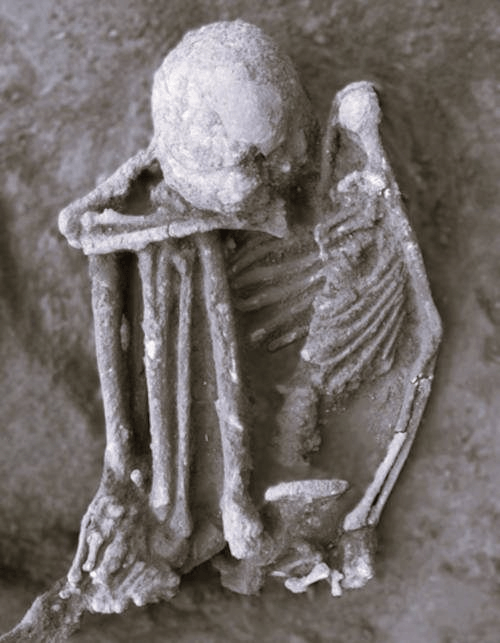
The world’s oldest embalming practice has been discovered—not in Egypt or South America, but in southern China, Vietnam, and Indonesia, dating back some 12,000 years. This is the conclusion of new research published in PNAS. The embalming, it appears, was carried out through smoking of the body, and it predates by thousands of years parallel cases of embalming found in Chile (7,000 years) and ancient Egypt (4,500 years). According to the research team’s hypothesis, there is a connection between this form of embalming and practices still performed today in Papua New Guinea, where modern versions of smoked mummies can take up to three months of treatment for a single body.
So much for the findings. Now, the meaning. Why embalm? First of all, on an emotional level, after a person dies, you want a keepsake of them. You know that if you don’t embalm, they will decay, sometimes very quickly. To preserve them—and especially to preserve them for future generations—you embalm them. In the worst case, the body will last for hundreds of years; in the best case, even thousands. But religion is not an emotional matter; it is a spiritual one. A body that decays is a body whose essence also decays. If continuity of life after death and the presence of the deceased’s spirit are what matter, then everything possible must be done to prevent the dissolution of this important person and to preserve their presence. This is done through embalming. And how is embalming performed? Through fire. But to be precise—not fire, but smoke. It is not the flame that preserves the body but the heat. Thus the body does not become charred but preserved. The bones are not blackened, but retain their form, and the body appears lifelike.
Fire itself is associated in many traditions with divine revelation, purification, and destruction. Smoke, on the other hand, carries a different symbolism—it is perceived as a bridge between worlds, as matter that rises and vanishes from sight, and as a medium for transmitting messages to the gods, a kind of portal. Thus, a body enveloped in smoke for weeks or months was not only physically preserved but also imbued with spiritual meaning: it was transferred into a prolonged liminal state, between life and death. Through the smoke it also passed into the domain of the gods, but at the same time it still remained here, in form and substance. In other words, it became a mediator, a sacred object.
This discovery suggests that embalming began in the form of smoking. What, then, caused the technique to change? The likely reason is aesthetics. The perception that smoked embalming was “unaesthetic” made it not only undignified and unrepresentative but also distasteful. In very dry or cold places, sometimes there was no need for an artificial process to preserve the body, because the body would remain intact in one way or another. This produced a more aesthetic outcome. Smoked embalming “degraded” the body, leaving it faded and shrunken, with a less lifelike appearance. It was also a long and arduous process, involving prolonged preoccupation with death and direct contact with it. This was seen as impure, and apparently even dangerous. The use of substances such as natron, resin, or bitumen was quicker, and presumably more antiseptic and safer. The problem was that these raw materials were not always readily available. Therefore, the more developed the trade, and the more a religion emphasized aesthetics, the more we see advanced and increasingly “sophisticated” forms of embalming.
הצטרפו לרשימת התפוצה שלנו
כתיבת תגובה