
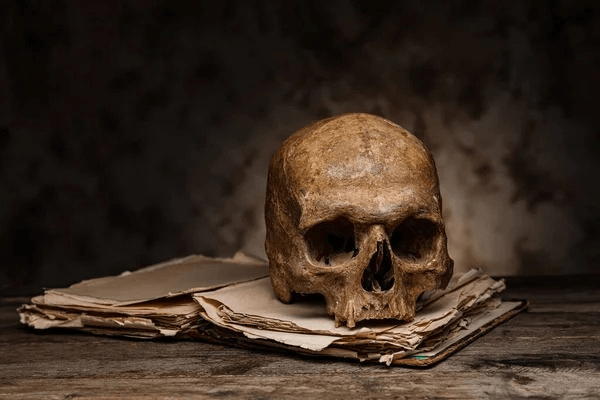
Religion is, first and foremost, a human mechanism for coping with anomalies—irregularities that reason and daily experience cannot fully explain. The primary anomaly is death. Death disrupts the “order of things” by removing a person from the community and destabilizing both social and personal identity. If the deceased was wise, the community is left without wisdom. If skilled, without skill. If a leader, without leadership. And when the community is disoriented, a solution is required.
The solution is the afterlife, an “other place” to which the dead pass, where some form of continuity exists. Out of the assumption that the dead continue to exist emerged the idea that it is worthwhile to communicate with them. And there is a way to communicate with them: by reaching a near-death state, or a death-like state, in which one can touch the edge of death and return. The dead were perceived as bearers of wisdom and accumulated experience, and thus as authoritative figures. An encounter with them served as a form of consultation, and the return meant the implementation of their advice, ensuring the continuity of the community “in this world”.
It follows, then, that religion is first and foremost a social tool. That is, only social animals are capable of sustaining religion, and only those animals that have awareness of death, fear of death, and the ability to grieve and be consoled. Animals do indeed exhibit some of these traits, but it is impossible to know whether they possess the capacity for abstract thought that could generate the idea of an “afterlife”. For such a notion, symbolic imagination and complex language are required, to organize the anxiety of death into an institutionalized system of rituals, symbols, and enduring beliefs. Religion, therefore, is a human mechanism precisely because it enables consolation: rituals that demonstrate that there is a way forward, that loss can be borne. Death is not absolute chaos but only an episode within a larger process—one that includes recovery from death as well.
The idea that fear of death is the religious and social driving force is known in evolutionary psychology as Terror Management Theory. The idea that liminal experiences serve as a bridging mechanism that allows anomalies to be processed and normality restored was formulated by Victor Turner as “social drama.” Together, these explain something simple: psychedelia is nothing more than a tool that enables one to undergo a controlled death and return from it, thereby producing a “living proof” that death is not an absolute end but a gateway to the other world.
Primitive burial rituals included attempts to “make the dead present”, born of the desire to communicate with them through practices we would now call parapsychological, but which were then considered valid and reliable—no doubt because some of them involved altered states of consciousness. The rituals were ongoing: not only the burial itself but also scheduled encounters with the deceased. From time to time, people would “go up to the grave,” tend to the body, rebury it in secondary burial, and sometimes take a keepsake in the form of a specific body part, to be used later—most often decoratively, but in some cases necromantically. That is, the organ served as a spiritual “conduit” or medium for communication with the dead. Most commonly, this was the skull, regarded as the “house of the spirit”. And if the deceased’s own skull could not be taken, a “surrogate” was used—a generic skull, or even just a bone, sometimes not even human but animal, whether of a totemic creature or simply of another animal. All of this was done to “consult” with the dead and to make them present, even symbolically.
Early psychonauts discovered a variety of ways to communicate with their dead, so necromancy did not always require a physical “memento” of the deceased. It seems that as technologies of communication developed, and people realized that one could meet the dead in dimensions beyond the tangible, such modes of encounter became preferred.
Although we will not discuss it in detail here, the monotheistic religions, which prohibited “inquiring of the dead,” equated encounters mediated by a surrogate with encounters without one. Whether they were correct is unclear, as is whether psychonauts who seek to explore the depths of their own minds and meet “death” itself, rather than “the dead,” truly fall under the broad prohibition: “There shall not be found among you one who makes his son or daughter pass through fire, a diviner, a soothsayer, an augur, or a sorcerer, one who casts spells, or one who consults ghosts or familiar spirits, or who inquires of the dead” (Deut. 18:10–11). But this, in essence, is what we are talking about.
Brian Muraresku, author of the bestseller The Immortality Key, attempted to demonstrate that such funerary rituals existed continuously from prehistory up to the establishment of Christianity at least, and that the Mass itself is nothing but a monotheistic adaptation of such a psychedelic funerary rite. Its very location in a liminal gray area—and its resemblance to forbidden practices—led the Church to censor it and substitute non-psychoactive wine and bread as a kind of “placebo”.
הצטרפו לרשימת התפוצה שלנו
כתיבת תגובה