
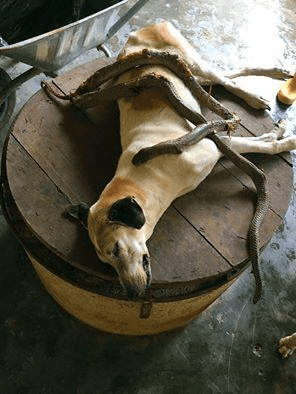
The term "psychopomp" is derived from the Greek words "psyche" (soul) and "pompos" (guide). It refers to a being that guides souls to the afterlife, whether through death or reincarnation. Psychopomps can be human figures, animals, or gods. In many cultures, their role was to prepare souls for meeting the gods or to lead them to the realm of the dead. As we all understand, talk of encounters with death is essentially a metaphor for the use of substances that might bring death, which is code for poisons, which is itself a code for substances that induce consciousness-altering reactions. When you reach that liminal consciousness, where you are hanging by a thread between life and death, the "psychopomp" is there—like Don Juan of Castaneda —to guide you back from that place. And then, you come back to life, born anew.
Throughout the ages, when humans searched for someone who was, on the one hand, present beside corpses and decay, yet, on the other, also a protector, they found it in the dog. In ancient Egypt, the god of death, Anubis, who had the head of a dog, served as the guide for souls. Anubis was responsible for the mummification process, preparation for the afterlife, and guarding tombs. The dog in Egypt represented the connection between the living and the dead, serving as a linking entity. In Greek mythology, Hades, the ruler of the underworld, had a fearsome guard dog that protected the gates of the underworld, preventing the dead from escaping. Only Orpheus was able to trick him, by charming him, thus returning from the dead.
Orpheus was not the only one to return from the underworld—Persephone did as well, after being abducted by Hades. The one who helped her rise from the underworld was Hecate, who is also said to have helped Demeter, her mother, search for her with the aid of torches. Hecate was considered a sort of psychopomp, a goddess of fertility who was associated with poisons and witchcraft, and thus guided souls to the underworld and, presumably, back from it for those who "returned from the dead." In her cult, dogs were sacrificed, as evidenced by the finds in the Mas Castellar de Pontos, where, according to the book The Immortality Key, a beer cup with ergot remnants was found—suggesting that as part of Hecate's cult, people drank fortified beer, and here's the evidence that the cult of the dead included the use of psychedelics, and that this practice existed from the dawn of civilization and even before it (see Merzach).
I have written in the past extensively on the cult of the wolf and its domesticated version, the dog, in Germanic religions. Odin himself, described as a drunk living solely on a diet of mead, had two wolf servants: Geri and Freki. There was also a segment of the Greek cult involving wolves. Apollo was said to be born to a she-wolf, and in Lycaeon there existed a mystery in which it was claimed that rebirth ceremonies were conducted where participants would turn into werewolves, i.e., people in the form of the god, a code for those who imbibe the divine fluid—the intoxicating drink.
Since no one really knows what happened there, the rumors spoke of human sacrifice, and the ceremony there was compared to the cult of Moloch. What really happened was that, like in the mass ritual, when one eats the flesh of the god and drinks his blood… you get it, the god is the psychedelic substance, and if the god is human, eating him is cannibalism. All this convoluted discussion is to say that archaeologists recently uncovered 12 ritual pits from the Salzmünde culture, 5,000 years old, which hint at such ritual ceremonies. In the pits, human skulls, complete dog skeletons used as sacrifices, unique pottery, and the ashes of burned structures were found. This suggests that there was a cult there that included, in addition to the sacrifice of dogs and the burial of ancestor skulls, also deliberate burning, which during the Neolithic was considered itself a liminal ritual.
הצטרפו לרשימת התפוצה שלנו
כתיבת תגובה