
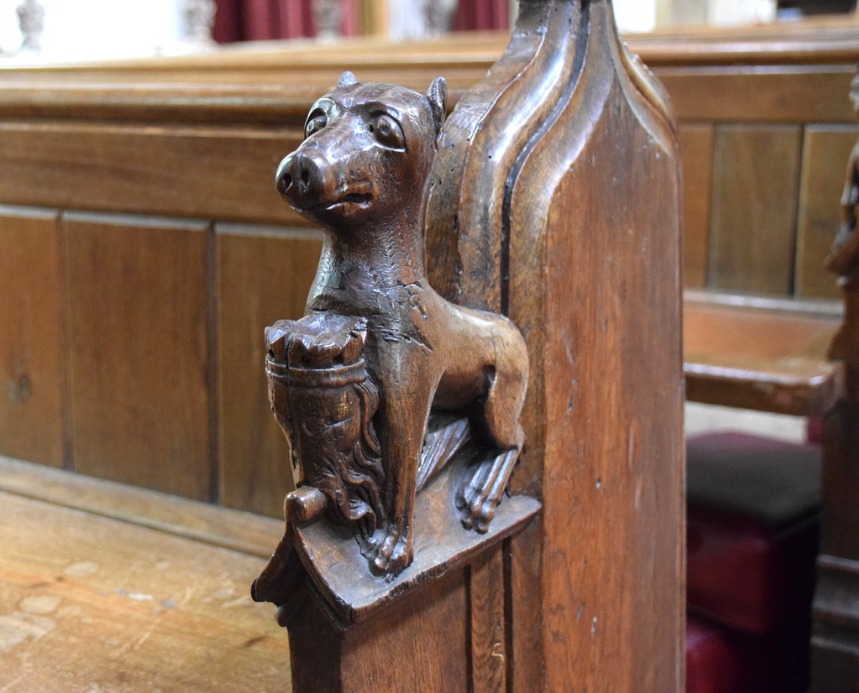
The English ancestors, by necessity of being Germanic, adored the wolves. They saw in them the power of the wild, and the guardians of nature. But it turns out that at some point, evidently a Christian influence, since Christianity saw the wolf and the wild in general as a symbol of evil, the admiration for the wolf decreased. The image of the wolf was damaged and the wolf was considered a carrier of diseases, attacking people, causing them to become werewolves, murderous and shape-shifting. And perhaps because the wolf is associated with the Berserker tradition that, as part of the drinking ceremony before going to war, they recieved their war frenzy power from Odin, and in this context they donned skins and fur. In other words, the image of the wolf was damaged not only because it symbolized the wilderness, but also because it symbolized idolatry and especially because Christianity was mainly pacifist and anything that was related to killing was considered impure. At least until the Crusades, when the term "holy war" was invented, and thus those who had a desire to murder, were channeled towards a religious mission that allowed them relatively easily to become righteous. Christianity served as a remedy against the wolf.
Let's return to England. It turns out that social and cultural pressures turned the wolf into an enemy, and in the 13th century a guild was even established whose purpose was to kill wolves. The wolves were considered to be those who prey on the herds, endanger women and children, and, as mentioned, transmit diseases. Killing wolves was considered a virtue, and was allowed to such an extent that anyone who encountered a wolf was free to kill it. And so the wolves almost disappeared from the English nature.
Environmental activists see this as an ecological disaster and are working to restore wolves to the wild, in this case the English. One of them, Derek Gow, is currently publishing a book that deals with the subject and seeks to emphasize the ancient affinity of the English to wolves. Among other things, he tells about the Wuffingas, whose literal translation is "the kin of the wolves". Before I tell about the role of the wolf in the Wuffingas culture I would like to tell a little about their background, so that the ends connect well.
The Wuffingas were a Germanic people who originally came from Jutland (southern Denmark) and ruled the kingdom of East Anglia in the early Middle Ages. The kingdom was founded in the sixth century by a king named "Wuffa" whose name means "little wolf", who united the peoples (folks) of the north and the peoples of the south, what is now called Suffolk and Norfolk. Later there were also other kings who combined the name "Wolf" (wolf) in their name such as for example King "Ealdwulf" or "Aldwulf", you can see how the name "Adolf" was derived from his name and the meaning of his name is "the majestic wolf". Aldwulf's son was named Ælfwald, which probably means "deer of the forests", and from which the names Eliot were probably derived. That is, the Anglo-Saxons saw nature and the wild as empowering and pastoral forces, as well as the animals that symbolize them.
The king who converted the Wuffingas to Christianity was called Rædwald, whose name means "ruler of the forest", and here it can also be noted that the word "wald" in the English language has two meanings, both forest but also power, or alternatively, a powerful ruler. It should be noted that the word for "old man" is also ald, and there is probably an etymological connection between old age and ruler. So, for example, Aldwulf's father was called Æthelwald, which means either "the noble forest" or "the noble ruler". Therefore, "Ælfwald" does not necessarily mean "deer of the forests" but rather "ruler of the deer". This is the opportunity to mention another name that uses this motif, "Alfred" which, according to what we understood, also means "Alf" or "El" which means deer or elk, and "Ræd" which means ruler or judge ("Chancellor").
It is believed that the Anglo-saxon saga "Beowulf" was written in the court of Ælfwald or Alfred. Beowulf literally means "god wolf" (bēow = diety of agriculture). A Norse nation in Beowulf who lived in the south of today's Sweden were called the Wulfings (or Ylfings), and are believed to be somehow related to the Wuffingas, and both have the element "wolf" in their name.
These "wolf peoples" saw the wolf as their totem animal that functioned as a mediator or messenger between the living world and the underworld of their ancestors. Rædwald, who, as mentioned, converted the local Angels (i.e englishmen) to Christianity, only converted the religion to semi-Christianity. The policy of the church was, if not to fully Christianize, at least to gradually bring the pagans closer to Christianity, or to give their folk legends a Christian touch, and let inertia do its thing. This is how we also see so-called Christian elements in Beowulf.
The Diocese in Canterbury was established in order to oversee the spread of Christianity in England, as the Saxons also had a tradition (even the continental ones), to semi convert to Christianity or to convert to Christianity only in appearance and then abandon Christianity. It turns out that there is such a tribal barbarian practice to adopt a religion for political or practical needs if it is required, and when it is not required to abandon this religion. This also happened among the Arab tribes in the generation after Muhammad, this is also evident from a description in the Bible, how generation after generation this story is repeated that the Israelites return to their home and worship idols and not God.
Another reason for the establishment of the diocese is of course due to the geographical distance from Rome, it was a relay station of the Roman faith and one of its major manifestations as described by Beda Venerabilis who wrote the "ecclesiastical history of England", is the controversy surrounding the date of the Easter celebrations. Due to the fact that the Celts remained semi-pagan, they still kept their own calendar and therefore Easter came out on a different date than that of the Roman diocese. Beda describes how only the Synod of Whitby in the seventh century settled the problem.
The findings of the ship burial in Sutton Hoo where King Rædwald was buried, and in it many luxury objects that allude to the worship of the god Odin with the wolves Geri (greedy) and Freki (ravenous) who guarded the borders of his kingdom forever against his giant enemies – only perpetuate his remaining pagan connection, and the fact that such ship burials and other descriptions that was found in Sutton Hoo are also mentioned in Beowulf, only supporting the claims made earlier regarding the form in which Germanic folklore was preserved among the English.
The one who is considered to be the last descendant of the Wuffinga dynasty was King Edmund, who succeeded to the throne of the kingdom of East Anglia at the age of fourteen in about 855. He was a devout Christian who was considered in his time to be "the model of good princes … a declared enemy of flatterers and informers … The peace and happiness of his people were his whole concern". In 865, a "great heathen force of Danes" led by Ivar the Boneless landed in England to form a permanent army of occupation.
When Edmund was captured, he refused to surrender unless the Danes converted to Christianity and this Ivar refused to do. On November 20, the king was captured, tied to a tree, beaten and finally executed by a volley of arrows. His body was mutilated and his head was cut. When his followers returned and searched for his body, they discovered it without a head. They searched and then suddenly they heard a big wolf who supposedly called out in the Latin language, 'Here, here, here!' (in Latin hic hic hic). They followed the voice and found that the wolf was guarding the king's head. Miraculously, when his body and head were reunited, the people connected the two parts of the body and found that it was connected exactly and it hardly seen that the body had been mutilated, except for a small and insignificant red mark. Whole again, Edmund was buried in the monastery in the bury of St. Edmund. To this day there is a statue depicting this occurrence, which is carved and placed in the church of St Mary and St Lambert in Stoneham Aspal in Suffolk.
הצטרפו לרשימת התפוצה שלנו
כתיבת תגובה