
Italy has many volcanoes, although the active ones are in the south, but also in the center in the area of Rome and Lazio there are many dormant volcanoes, some of which have become crater lakes. Therefore it is not surprising to see the local peoples worshiping the gods of the underworld and volcanoes, we see this in the Roman god Vulcan, Pluto or Dis Pater, and also among the Etruscans the god called Soranus.
The ancients saw the bowels of the earth as a sacred place, it can be explained in all kinds of ways, but for the purpose it matters less. Mount Soracte, which is now called Monte Sorrate, is a mountain where there are many natural caves, which, being the bowels of the earth, were considered the doors of the underworld. The fact that this mountain stands out above the Tiber valley and passes near the Via Flaminia, the main road that led from Rome to northern Italy, made it revered among all the surrounding cultures. And so the Etruscans also adored it and built temples to Soranus on it.
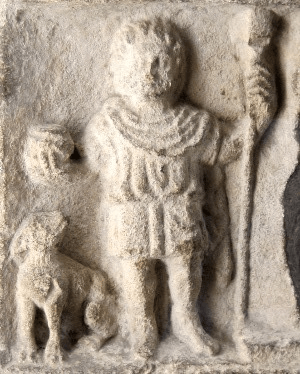
Servius, a Roman grammarian who commented on Virgil's writings, said that once on one of the occasions when the Etruscans offered their sacrifices to God, they separated the internal organs of the goats they slaughtered in order to use them in divination, and without noticing, they noticed that some wolves infiltrated the compound and stole the organs. The priests who saw the organs as sacred things chased after the wolves in order to get back these "teraphim" from them, but the wolves were faster than them and escaped into one of these caves. The priests entered the caves, and since they were in the bowels of the earth, they were exposed to poisonous gases and died. Their friends saw that they had died and they also came to capture the wolves, but they also died. And the following, again, and so on and so forth. The Etruscans asked their gods what the meaning of the case was and received a message according to which the death happened because the priests dared to chase the wolves. The priests' atonement will be, the message said, when they behave like wolves – live like them and imitate them. This means that they will live on the spoils, and at the same time they will walk on the coals carrying the goats' internal organs as the wolves did. Since then, the priests of Soranus were called "the wolves of Soranus", "the Sorani harpies". Apparently these wolves are an incarnation of the three-headed dog Cerberus who guarded the gates of Hades, since later incarnations of the same god of the underworld in Roman mythology, when they met the Celts, depict this god walking around wearing a wolf skin cloak accompanied by a fearsome hound dog and holding a hammer.
This god is called Sucellos Silvanus, and is an incarnation of a Celtic pagan god simply called Sucellos. Julius Caesar claimed that the Celts believed they were descendants of the same god of the underworld, whom Caesar identified with Dis Pater. And there are those who believe that he is himself an incarnation of a slightly more familiar god of the Celts called Cernunnos or "the horned god", who in Celtic mythology has many roles, including the god of the underworld. Being also the god of hunting, he is usually depicted accompanied by two companions, the deer and the wolf.
What is interesting is that Virgil himself claims that the temple on Mount Sorrate was used in the Imperial Roman period as a mountain sacred to Apollo. From finds in the province of Roman Britannia it can be seen that Apollo was united with the Celtic hunting god Cunomaglos, whose name means "Lord of the hounds", or "Lord of the wolves", cuno in Celtic means wolf. As we have already mentioned, also in Greece Apollo was a wolf god and was called Apollo Lycaeus. We also know that Apollo is the brother of Artemis, the Greek goddess of the hunt, so such a connection makes sense. One of the functions of Cernunnos is also the patron of hunters, and probably the horns on his head symbolize a hunting ritual or hunting magic. The other side of the hunting ritual is obviously to put on a wolf skin, since one of God's companions was also the wolf. Indeed, says Derek Gow in his book, the Celtic chiefs would sit on wolf skin mats, attach helmets made of wolf heads to symbolize courage, and also train their dogs together with wolves in order to teach them to be fearsome.
In fact, the beginning of the dog trade and their cultivation was in the British Isles, and at that time they began to cultivate and breed dogs in order to improve them and their qualities. We see contemporary Roman writers refer to the British dogs as fast and strong, war or hunting dogs specially trained for that purpose. It is told about the soldiers of Julius Caesar who fought with dogs wearing spiked collars and armor in the Gallic Wars. Gaius Marius 50 years before him is also described as having fought with war dogs as part of his war with the Cimbris and Teutons. It turns out that there is also a relatively dark side to the admiration of the ancient European peoples for wolves, the artificial selection in the breeding of purebred dogs…
הצטרפו לרשימת התפוצה שלנו
כתיבת תגובה