
King David is considered to be the archetypal figure of Messiah, and his son Solomon is the one who built the Temple. Hur is considered the son of Caleb and Ephrath (1 Chronicles 2:20), and the grandfather of Bezalel. David himself is considered an "Ephratian" man (1 Samuel 17:12) and according to tractate Sota 11b he is of Caleb's ancestry. According to what can be understood from the writings of the Chronicles and is also assumed in Tractate Sota, Caleb ben Jephunneh is Caleb ben Hezron and therefore the grandson of Peretz (the archetypical Messiah). This is how you can actually see that the choice of Bezalel, the descendant of Caleb, is actually an attempt to parallelize between Caleb and David and with Bezalel and Solomon. Both built the temple, both were "wise men of heart". Both symbolize this high spiritual level achieved by the "knower" who has acquired wisdom.
It is said of Solomon, "And he was wiser than all men" (1 Kings 5), and in the vision he had in Gibeon (1 Kings: 3) he asks God to "give your servant a hearing heart to judge your people to understand between good and evil" and therefore God promises him " Behold, I have done according to your words, Behold, I have given you a wise and prudent heart, the like of which was not before you, and after you there will not be another like you". In this story we see an explicit reference to the "wise men" who built the tabernacle, and especially Bezalel. Also the distinction between "good and evil" is a reference to Eden.
There are many parallels between the temple and especially between the Holy of Holies and the Garden of Eden, the first and foremost among them are the cherubim, which in the book of Genesis are said to "guard the way of the tree of life" (guard is the same word for perserve in hebrew, "shamar"). Of course, in the apochrypal books this comparison is explicitly stated, as in the book of Jubilees in chapter 3, where it is explained why Eve could not enter heaven until she was cleansed from the impurity of childbirth, because it is forbidden to enter the temple in impurity. It is said of Enoch in chapter 4 there that his role was to judge in heaven, "and he was taken from among men and we brought him to heaven to greatness and honor and there he writes judgment and law for the world" – this is also how Solomon's request for expertise in judgment is described, and this is how, in the judgment, Solomon's wisdom is also described, "And all Israel heard the judgment which the king judged, and they respected him because they saw that the wisdom of God was in his midst to make a judgment" (1 Kings 3).
It is said about the Wisdom in Proverbs 3, "It is a tree of life to those who hold it". It is said: "Blessed is a man who finds wisdom and a man who got understanding". It is said of the wisdom that it is more precious than pearls, precious metals and gems, and it is emphasized that it is exactly the building block with which God created the world, "The Lord in wisdom founded the earth and established the heavens in understanding". The fact that the Holy of Holies is forbidden to enter except for the High Priest on Yom Kippur indicates that a person without wisdom is not allowed to enter the Holy, but once he has acquired wisdom and reached the level called "High Priest", or "High Priest on Yom Kippur", he is allowed because this is his return to the Garden of Eden.
To finish with the subject of sacred plants, I will mention that when the priest enters the Holy of Holies, he burns incense. The burning of this incense is likened to eating from the tree of life, as in Levi's Testament it is said of the righteous who will be honored in the end of days: "And then God will raise up a new priest to whom all the words of God will be revealed, and he will bring true judgment on earth when the time will come… and he will open the gates of the garden Eden and remove the sword that frightens man and let the saints eat from the tree of life." (Testament of Levi 12)
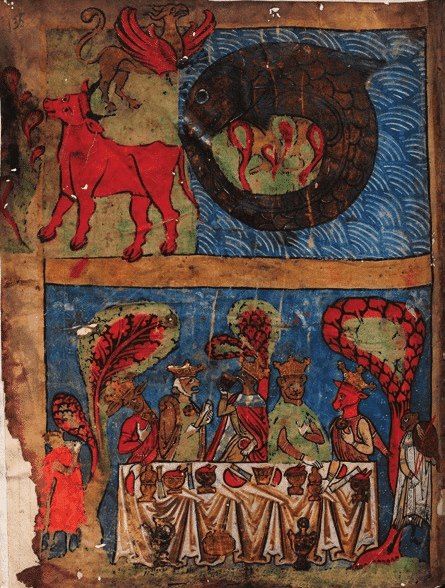
If you look at the description of this eating from the tree of life in the Jewish myth, you can find the description of the feast of the Leviathan (among other things: Baba Batra, 85a). It is described there that in the future to come the righteous will eat at a feast from the Leviathan and the Behemoth (aka "the wild bull"). The Leviathan is the one who is described in the book of Isaiah (27:1) as a snake, which echoes the serpent in the Garden of Eden that represented the forbidden knowledge and the eating of the fruit of the tree of knowledge.
In the book of Ezekiel, the prophet twice describes the figure of the "Ophanim", whose appearance is like gems. One time he claims that one of their faces is the image of a bull (chapter 1) and the second time he claims that the image of the bull is the image of a "cherub" (chapter 10). From this it can be understood that a cherub is actually a bull, and I am not talking at all about the Akkadian "karabu" (aka "lamassu"), which is actually a winged bull. The fact that at the Feast of the Leviathan they will eat wild bull, makes us understand that what the righteous will eat in the future is the fruit of the tree of knowledge, which is symbolized by a serpent, and the fruit of the tree of life, which is symbolized by cherub. The tree of knowledge is not fundamentally different from the tree of life, and even modern bible critics believe that it is actually a description of the same tree. And so actually the feast of the righteous for the future to come should be all about eating the wisdom itself, or internalizing the thing in their bodies.
Again, I would like to leave to your wide imagination what is missing in this equation, of what you eat and as a result of which you reach a higher consciousness. The "Kaneh".
הצטרפו לרשימת התפוצה שלנו
כתיבת תגובה