
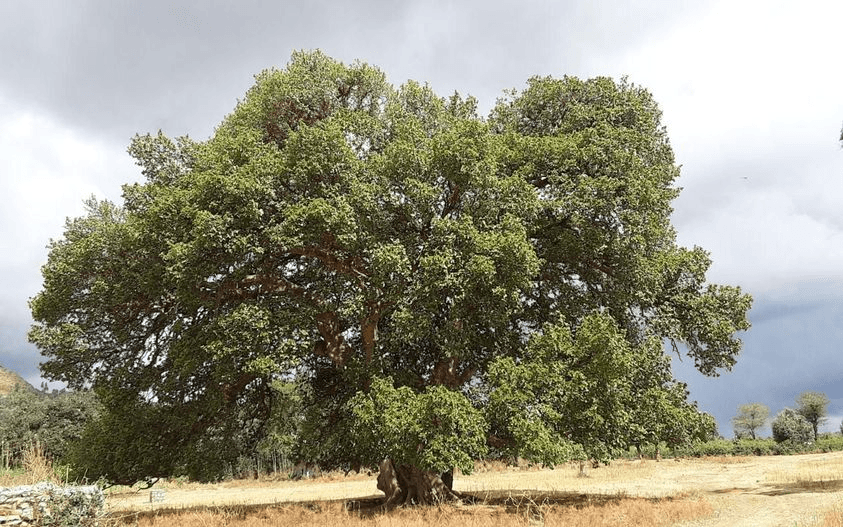
The Oromo people in Ethiopia worship the sycamore tree. The Oromo refer to this tree as the Odaa. For the Oromo, Odaa has spiritual and ecological significance as a site for political assemblies, religious worship and cultural ceremonies. In terms of politics, the sycamore tree played a key role in the traditional Oromo government system, known as the Gadaa. The Gadaa system is a complex political governing body based on a generational and age system, according to which all men born in a clear period of eight years are of the same age, and can rule in a generational rule of 40 years, after which the rule will pass to the members of the next generation. All the political ceremonies of the Gadaa and all the legal activities are held under the shade of the Odaa tree. The system of the Gadaa also reinforces a whole concept of preserving sycamore trees (and other sacred plants), the cutting of these trees is prohibited, and the traditional gathering places are considered sites that should be treated with reverence.
The Odaa tree also stands at the center of the local mythology and the story of the creation of the Oromo religion, the Waaqeffanna. At the cosmic point of the center of the universe on the primordial hill, man and the primordial bull were created under a sycamore tree. In fact, as in most Kushite religions, the tree is considered the source of life. In Egyptian mythology, a sycamore tree is also considered as such. Likewise in Waaqeffanna, the sycamore tree is the tree of life and immortality, a symbol of fertility and renewal. This is expressed in the fact that it can be reproduced using cut branches that develop roots, which symbolizes renewal and a reproduction of life. The tree is considered the abode of the spirits and in the Oromo culture it could be said that they consider the tree to be what we would call today "the center of an ecosystem". The tree sustains its environment at every stage of its life cycle, starting with its unripe fruits and ending with their ripening. Many types of plants grow under its shade, which, unlike other trees, develop a symbiosis with it and thrive under it instead of fighting it. The tree is always in a source of water, a symbol of fertility in itself. And regardless, it meets most of the Oromo's material needs, from food, through clothing, to everyday tools such as stools built from the logs of the Odaa tree, and ropes and sacks woven from fibers produced from the bark and roots of the tree.
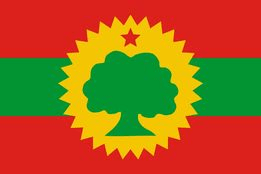
The most important thing about the sycamore tree, at least in the modern aspect, is that the Oromo took the colors of its fruits, starting from the green unripe stage and ending at the ripe stage, where the fruit turns from yellow to red, as their flag. The tree appears in the flag of the Oromia region, and the flag of the Oromo Liberation Front (OLF) is composed of these colors, with the Odaa tree framed by a yellow star, symbolizing Gadaa, the democratic system of Oromo rule. In fact, when the Ethiopian government tried to suppress the Oromo, it banned the gatherings of the Gadaa and outlawed them, this is probably the reason that this tree also has a nationalist and separatist meaning for the Oromo, and this protest also stands in the background of the civil war in Ethiopia, starting from the 1970s in the 20th century and actually in the present days.
הצטרפו לרשימת התפוצה שלנו
כתיבת תגובה