
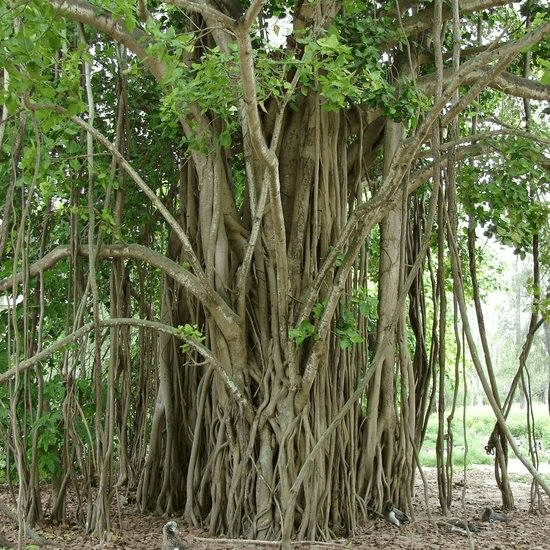
The Indian Banyan tree ("Ficus benghalensis"), also known as the Indian fig tree, holds extensive cultural, religious, and medicinal significance in Indian culture and religion. Its status as a sacred tree has developed over generations and continues to influence daily life, worship, and common beliefs. In addition to its religious value, this tree possesses medicinal properties that have made it an integral part of traditional Indian treatments, and its chemical attributes have also attracted scientific and research-based attention.
In Hinduism, the Banyan tree symbolizes the Trimurti—the sacred trinity of the gods Vishnu, Brahma, and Shiva. According to tradition, the tree’s bark represents Vishnu, the roots signify Brahma, and the branches symbolize Shiva. The belief gives the tree spiritual importance as a symbol of life and fertility, and it is therefore worshipped by childless individuals seeking blessings for fertility. The deep roots of the Banyan and its ability to spread and form a vast canopy are perceived as symbols of eternal wisdom and the connection between heaven and earth. In India, a ritual known as "Vata-Savitri Vrata" is practiced, where married women fast and circumambulate the Banyan tree, praying for the longevity of their husbands, inspired by the story of Savitri, who saved her husband, Satyavan, from the god of death. Buddhists also attribute great importance to the Banyan tree, as it is believed that Buddha sat under a Banyan tree for seven days after attaining enlightenment, though an alternative tradition suggests that Buddha sat under a different fig tree, the Bodhi tree ("Ficus religiosa"), rather than "Ficus benghalensis".
Beyond its religious significance, the Banyan tree is widely used in traditional Indian medicine, including Ayurveda, Siddha, and homeopathy. Every part of the tree—the roots, leaves, bark, and fruit—has various medicinal applications. For example, the bark is used to treat ulcers, skin diseases, and inflammatory conditions; the roots aid in managing diabetes, and the fruits serve to strengthen the immune system. The tree is considered essential in local medicine, especially for preventing infections and promoting general health.
The scientific basis for the Banyan tree's importance lies in its chemical composition, rich in bioactive compounds like flavonoids, terpenoids, and tannins. These components are responsible for the tree’s anti-inflammatory, antibacterial, and anti-diabetic properties. Studies have shown that these chemical compounds are particularly effective in boosting the immune system, preventing diseases, and enhancing overall health, which explains its widespread use in traditional medicine.
הצטרפו לרשימת התפוצה שלנו
כתיבת תגובה