
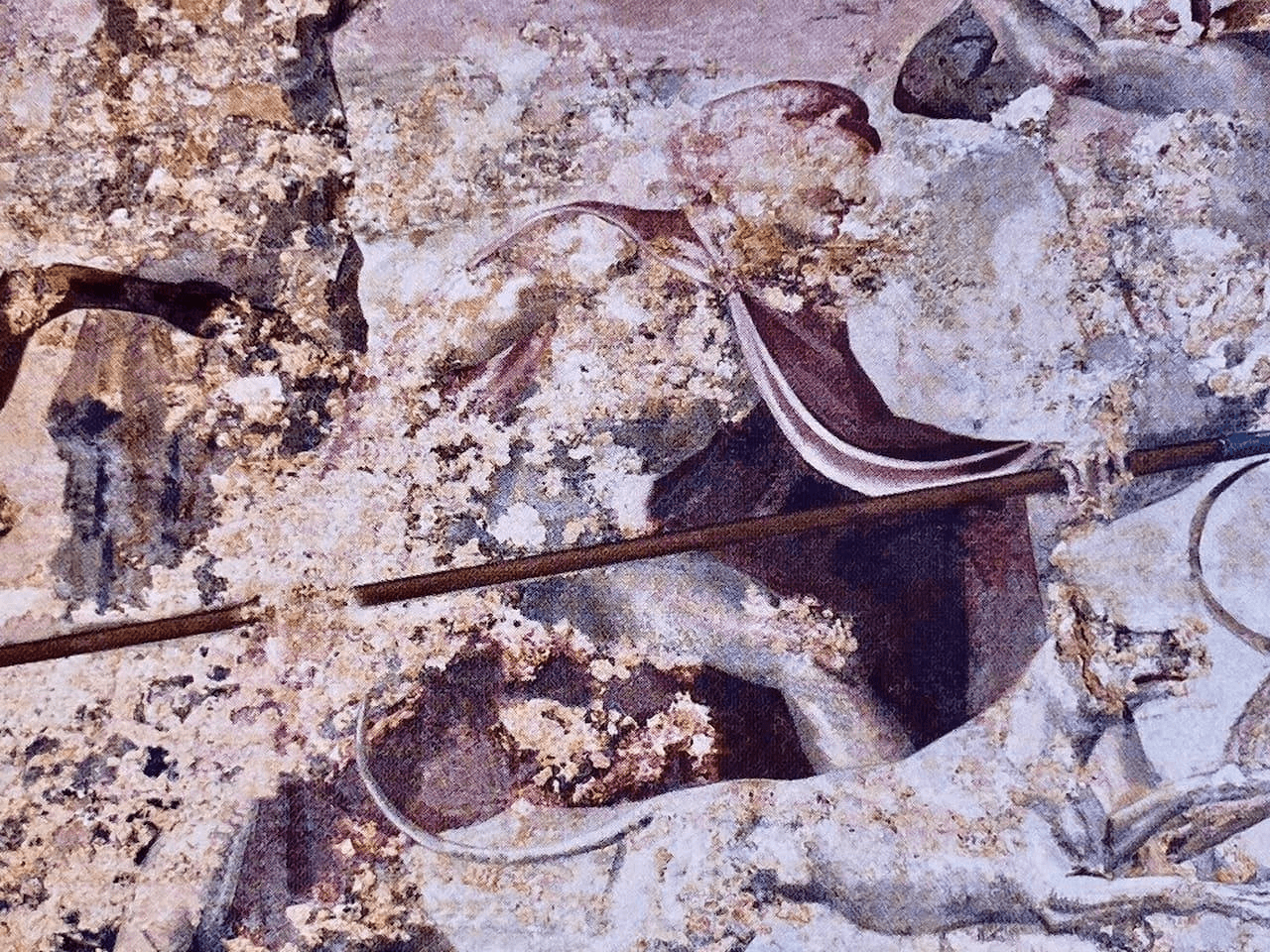
During excavations in Royal Tomb II at Vergina, Macedonia, Greece, archaeologists uncovered several prestigious artifacts, including a purple tunic, a golden oak wreath, and various royal items like a diadem and scepter. The purple tunic is made of cotton and dyed in Tyrian purple, a color associated with royalty. The golden oak wreath was found beside male skeletal remains in the tomb, aligning with ancient descriptions of Macedonian royal symbols. Among the textile layers in the tunic, traces of a white mineral called huntite were discovered—a material highly valued in Persia for its bright whiteness. This mineral was considered rare and costly, prized both for its pure color and its exceptional durability, marking it as a symbol of prestige. One of the figures in the fresco discovered at the site is wearing such a garment.
Historical sources indicate that Alexander the Great adopted the Persian tunic, the sarapis, as part of embracing Eastern royal customs, underscoring his role not only as ruler of the Greek empire but also as the sovereign of the kingdoms he conquered—Egypt and Persia. It appears that after Alexander's death, his half-brother Philip III Arrhidaeus inherited his position, suggesting that the tomb may belong to him or his successors, with these Eastern symbols as part of the legacy.
In nearby tombs, known as Royal Tomb I, a male figure with a fused knee was found, leading to the speculation that this was Philip II, Alexander’s father. The other tombs have been identified as those of Philip’s wife, Cleopatra, and their newborn son. These tombs were excavated in 1978. Initially, Tomb II was thought to belong to Philip II, who died in 336 BCE. However, shortly after the excavation, an alternate hypothesis emerged, proposing that Tomb II actually belongs to Philip III Arrhidaeus, who died in 317 BCE, Alexander the Great’s half-brother, while Philip II was buried in Tomb I, which had been looted.
הצטרפו לרשימת התפוצה שלנו
כתיבת תגובה