
I am currently writing a seminar paper on the sanctity of the color purple in the context of the Hellenistic ruler cult and am required to connect the preferences of Hellenistic rulers for purple garments to their aspirations of being regarded as gods. Within this framework, I am delving into the origins of admiration for purple. In the past, I wrote about the role of incense made from operculums (shell covers) of snails, which served as an anesthetic during childbirth. The powder derived from these operculums had medicinal properties, supposedly endowing the shamanic midwives who used it with sanctity and elevating the materials they worked with into symbols of holiness. Similarly, ergot functioned as a type of anesthetic and is also purple, just like the chaste tree (Vitex agnus-castus), as noted in Dr. Suembikya Frohmann’s lecture, which was used to relieve menstrual pain and as a natural abortifacient. I am jotting down these inputs mainly as references for further exploration.
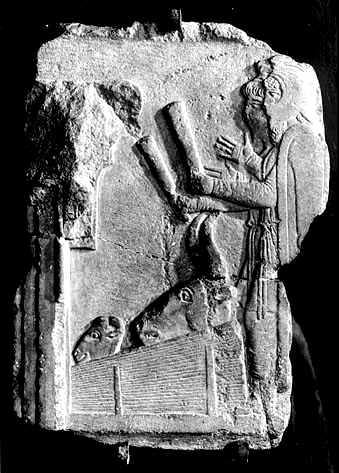
Mary Boyce argues in the second part of her book A History of Zoroastrianism that purple was the color of the warrior class in ancient Persian society and that their garments, known as kandys and sarapis, were purple. A relief found in Dascylium, Asia Minor, the seat of the satrap after Cyrus’s conquest, depicts two magi wearing purple kandys and holding a barsom (bundle of twigs) as well as a mortar and pestle, both items associated with the haoma ritual (see attached image). The barsom, initially made of branches and later of metal wires, symbolized creation and immortality. Regardless of the material, the focus here is that those wearing the purple kandys performed the haoma ritual. The question remains whether they were priests or warriors. Boyce suggests it is possible that warriors themselves conducted the ritual.
Why warriors and purple? In her book on the goddess Anahita, Manijeh Saadi-Nejad of the Free University of Berlin claims a connection between Anahita and warriors. She was often referred to as “heroic” (sura), which explains why her chariot was described as draped in purple by Xenophon. Anahita was a water deity, and in the Ābān Yašt she is described as receiving offerings that included “haoma mixed with milk, barsom, and good thoughts, words, and deeds.” It can be inferred that warriors dedicated their victories to Anahita by preparing haoma as part of their pre-battle preparations, similar to other Indo-European traditions, such as Germanic warriors using mead in rituals.
Anahita’s martial attributes were inherited from the Babylonian Ishtar or, more accurately, the Sumerian Inanna, who was considered a goddess of war. Inanna also had an ambiguous gender, perhaps due to the association of warfare with masculinity. Her cult involved transvestite priests called kurgarrū, who performed ritual war dances. These priests were often described as engaging in ritualistic sexual acts, sometimes homosexual in nature. Later, these priests were referred to as qedeshim, and it is said that they wove garments for Asherah, typically goat wool dyed scarlet. Interestingly, Barbara G. Walker claims these colors were associated with fertility goddesses because they resembled menstrual blood. Whether Walker’s claims, as a feminist scholar and knitting guru, are fully substantiated is debatable. However, when addressing fertility within the context of warfare and bloodshed, the connection to sanctity and altered states of consciousness becomes apparent.
Akkadian documents reference crowns of purple wool adorning Ishtar’s head. Isaiah 28:1 seems to allude to such a crown, using the Hebrew term tzitz, which parallels the tzitz (frontlet) of the high priest, connected by a cord of tekhelet (blue). The term, according to the Septuagint (petalos), and descriptions in Kings, might indicate a floral shape. Josephus also compares the tzitz to the flower of the thorn-apple (datura). While its flower is not purple, its relatives often are. However, the form might resemble the bloom of the myrtle plant. Myrtle was used in fertility rituals and life-death ceremonies. Some argue that the barsom is essentially made of myrtle branches.
Myrtle was believed to ward off the evil eye. Similarly, the tzitz was said to protect against the evil eye with the name of God inscribed on it, functioning as an amulet. In Greek, hērōs means “protector.” Some suggest Hera’s name derives from this. The word itself originates from the Proto-Indo-European root ser- (“to flow” or “river”), appearing in Greek (ἥρως, hērōs) and Sanskrit (सरित्, sarit). This etymology also aligns with the Avestan word for “hero,” sura.
This leads me to consider: is there a connection between myrtle and the color purple? Likely so, given the myrtle’s purple berries. Was there a link to women’s health? Indeed, myrtle was used to alleviate excessive menstrual bleeding and ease menstrual symptoms.
To conclude: the theme of protection is closely tied to the color purple. By donning purple garments, one symbolizes oneself as a protector and savior. Fertility is also linked to purple. Wearing purple signifies an association with birth and rebirth. In Greek thought, this concept correlates with eudaimonia—a state of happiness or flourishing. Most significantly, victory in battle is tied to the color purple. Alireza Shapour Shahbazi of Harvard argued that Xenophon’s description of a chariot draped in purple was not in honor of Anahita but of Kavi Vishtaspa, the warrior-king and patron of Zoroaster—or, more precisely, of his spirit (fravashi / frauuast). Vishtaspa is depicted as a warrior in the name of Ahura Mazda, though at some point his battle becomes allegorical—a fight for faith against its enemies. For example, in the Denkard, he is described not as a physical warrior but as a spiritual one. Purple signifies being a warrior in every sense: an invincible king who defends his realm and a spiritual warrior fighting for the gods, symbolizing a unique covenant with them.
הצטרפו לרשימת התפוצה שלנו
כתיבת תגובה