
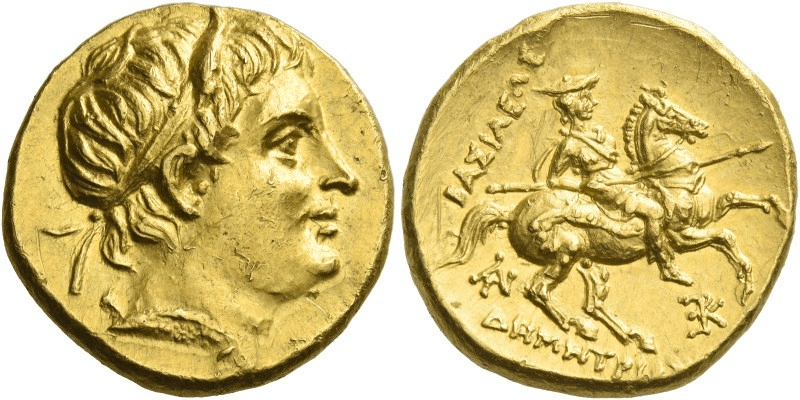
This semester, I'm studying "Ruler Worship in the Hellenistic Period." Ruler worship originated in the East. Although there were certain honors given to heroes after the Spartan and Athenian wars, and even a hero named Lysandros had a festival named after him, he did not actively intervene in religious practices. Alexander, after conquering the East, sought to establish his rule according to the norms there and requested to be treated as a god. The Greeks, however, were not ready to accept such an idea, at least not during Alexander's lifetime. With Demetrius I Poliorcetes, however, things were different. Demetrios was a "Diadochi" ruler, meaning he was the son of one of Alexander's prominent generals, who divided Alexander's conquered territories among themselves after his death. Demetrios ruled about 40 years after Alexander’s death, but unlike Alexander, he did indeed seek to reform religious life in Greece.
Demetrios attempted to intervene in at least three types of religious practices. First, he sought initiation into the Eleusinian Mysteries, an ancient and secret tradition that required long preparations and precise stages. Demetrios demanded that the mysteries adapt to his schedule, requesting that the intervals between the stages be shortened so that they could all be completed in a short period. This step provoked opposition from the priest Pythodoros, who held the office of the torchbearer (Daduchos) and protested the disruption of the sacred order of the ritual. However, his protest was unsuccessful due to Demetrios’ political power. This move was perceived as a severe violation of a sensitive and sacred ritual. The timing and preparations for the ritual were crucial, likely because they involved practices for altered states of consciousness. When someone attempts to carry out the ritual without these practices, it essentially desecrates the ceremony.
After enemies of Athens took over the Delphic oracle, the Athenians were unable to visit and celebrate the Pythian Games. So what did they do? Demetrios decided to hold the games not in Delphi but in Athens. He permitted himself to do this since he saw himself as a god; as a god, he had the right to enact religious reforms. This act was unprecedented in Greek history and was considered a radical move, seen as a takeover of a sacred Greek rite. But again, there’s an underlying aspect here: Delphi's sanctity lay in the fact that only there could the Pythia prophesy because only in that place were there underground gases that induced her mystical state. Holding the festival elsewhere meant losing the psychoactive effect. Once again, this was perceived as desecration, as the ceremonies lost their consciousness-altering power.
The last thing he sought to change was likely also related to altered states of consciousness. Dionysus was revered in the Dionysia festival as the god of wine. Demetrios demanded that the festival's name and the month in which it was celebrated be changed to bear his name, "Demetrion." He insisted that the ceremony be conducted in honor of his worship, as if he were Dionysus himself.
His desire for this was not only a matter of prestige. Demetrios demanded the title "Soter," Σωτήρ, which means "savior" or "rescuer." This title was not merely a military honor for a leader who won a war and saved the residents of the area he liberated. It was a general title given to one who saved his community from a great threat or provided essential needs—such as healing, community protection, and cosmic order. Gods were called Soter because they possessed these qualities, which were considered spiritual. Demetrios sought to endow himself with this spiritual quality, which politically signified that whoever supported him would receive his blessing. Religiously, however, it was akin to the Christian view of Jesus—that whoever believes in his messianism achieves personal salvation. Thus, the messiah is a figure that represents both a governing ideal and a spiritual ideal. For those who participated in these celebrations with psychoactive elements but were previously excluded, the ruler’s intervention in the ritual granted them access to the mystery, promising them eternal life. In essence, Demetrios sought to democratize the religious experience, suggesting that those who support him could reach spiritual heights. Supporting him meant entering the holy of holies.
Naturally, I have much more to write about the similarity between ruler worship and the belief in a “messiah” and between the attributes given to a ruler and those ascribed to a messiah. I plan to explore this further over the semester. Meanwhile, I’d like to note that on a coin minted by Demetrios, he is depicted with a bull’s horn on his forehead—an image symbolizing the “exalting of the horn of his anointed one” (I Samuel 2.10)
הצטרפו לרשימת התפוצה שלנו
כתיבת תגובה