
Yesterday was the fifth lecture in the “Temple of Consciousness” series, delivered by Dr. Gad Barnea from the University of Haifa. Unfortunately, the recording of the event was cut off in the middle, so I am unable to distribute or share it. However, I’m attaching the presentation from the lecture, along with brief notes — so it's essentially a kind of transcript of the talk. The presentation is courtesy of Dr. Barnea, who uploaded it to his Academia.edu account (attached in the post body).
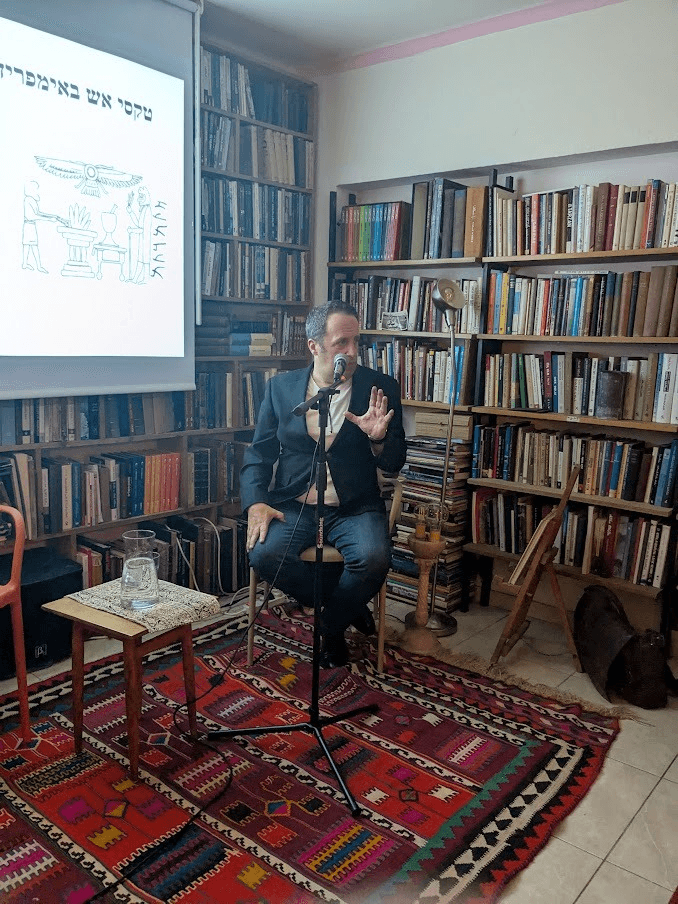
The motivation behind the lecture, of course, is to highlight a psychedelic-spiritual interpretation of the Burning Bush story, even though the lecture itself does not explicitly argue that. The one making that claim is me — based on certain clues that I will elaborate on shortly.
What does the lecture claim? In brief: That the Judean cult at Elephantine Island had features influenced by Zoroastrianism, and this points to a little-known variant of Judaism called Yahwism, which had reciprocal interactions with Zoroastrianism due to shared theological principles: The eternal essence of the deity, The revelation of God symbolized in fire, And the divine presence manifest in the continuous existence of fire.
Dr. Gad Barnea is a research fellow in the Department of Jewish History and Bible at the University of Haifa. He works in a bold, unconventional research niche, arguing that throughout Jewish history, there existed a parallel religious stream called Yahwism. This term is used by scholars to refer to belief and worship of Yahweh as a central (but not necessarily exclusive) deity — i.e., not monotheism, but monolatry. Yahwism allows for: The coexistence of other gods alongside Yahweh, a certain anthropomorphism in how Yahweh is depicted, rival powers to Yahweh, and most of all, Yahweh’s revelation in the physical world — through places, natural phenomena, and paradoxical physical manifestations.
We know rabbinic Judaism, but that is a later development and is not identical to Yahwism. Rabbinic Judaism fought against the non-monotheistic expressions of Yahwism, absorbing only the paradoxical dimension while severing it from the physical world. These theological definitions were finalized only much later, especially by Maimonides. Until then, Yahwism continued to exist — sometimes blatantly (e.g., Kabbalah), sometimes latently. It’s important to distinguish Yahwism from Judaism, and acknowledge Yahwism’s existence — and that, says Dr. Barnea, is his mission.
Zoroastrianism is rooted in the Indo-European tradition, which differs from chthonic religions primarily in its view of life after death: Chthonic religions view earth as the source of life, and death as a return to the earth, fueling rebirth. Indo-European religions, in contrast, view death not as a return to earth, but as a return of the soul to the cosmic fire in the heavens. Thus, fire is seen as a celestial-soul element, and cremation was common instead of burial. This religion is not focused on the underworld, but on the sky and what lies above it — known in Greek as the Empyrean. The focus of these religions is the link between humans and the cosmic order. To maintain this balance, theurgic rituals are required, and humans must carry them out meticulously. This ritual precision generates a spiritual-consciousness field where one can encounter the supreme deity, Ahura Mazda. Life is like walking a tightrope — it demands coordination, bodily awareness, and total focus. That's the logic of spiritual action in daily life.
One of the most important Zoroastrian rituals is the preparation and drinking of the Haoma. Its ingredients and procedure remain unclear, but hints suggest it involved a psychoactive substance, with preparation involving pounding and pressing. Even the versions described in the Zoroastrian scriptures are relatively late, and the original form of the ritual is a mystery. Our understanding is based on reverse-engineering: textual archaeology, ritual representations, especially fire rituals involving a sponsor, a barefoot priest, a mortar and pestle (symbolizing Haoma preparation), and a fire altar or container where the image of the deity appears in flame.
The barefoot priest reflects ritual purity: shoes carry dirt, which is a form of ritual impurity. Removing shoes is both technical and symbolic — it represents submission, a “shedding of layers”, and reverence for the sacred earth, Armaiti (Spenta Armaiti).
In Zoroastrian texts, the deity is described not as passively eternal, but as actively creating at every moment, constantly generating his own being. This action continues as long as the fire exists — hence the emphasis on the eternal flame. Once the flame is extinguished — continuity ends.
Through drinking Haoma, we fuel the divine, enabling the deity to continue to create. This idea parallels the description of God in the Burning Bush story: In Hebrew (as in other Semitic languages), there is no present tense form of "to be" in the first person, so the phrase "Ehyeh Asher Ehyeh" ("I will be what I will be") in Exodus 3:14 expresses ongoing being, not static essence. In the Septuagint, the phrase is translated as ἐγώ εἰμι ὁ ὤν (egō eimi ho ōn) — “I am the one who is”, or “I am the existent”.
Two elements appear in the Burning Bush story: the removal of shoes on sacred ground, a deity who refuses to name himself and defines himself only through eternal, self-renewing existence. These are hallmarks of Yahwism — a fire-revealing god, a paradoxical, elusive divine presence. Barnea suggests that the "block" of text describing the bush (Exodus 3:1–6) may be a priestly interpolation inserted between two continuous passages (Ex. 2:23–25 and 3:7–10). Removing that block restores the narrative flow — presenting God seeing the Israelites’ suffering and sending Moses without the elaborate fire-theophany. Thus, this “burning bush” unit was added to give the story a revelatory backdrop, a hallmark of the priestly source, which infused Yahwist theology into the Exodus story.
The Elephantine papyri refer to a fire altar, called "Atrodan", from the Persian Ātar (fire) + -dān (place). If the authors wanted to obscure the Persian influence, they could have used Aramaic, but they didn’t — suggesting conscious embrace of Zoroastrian elements. This proves that the temple at Elephantine was a Yahwist temple, not Rabbinic, and they probably didn’t know Moses, commandments, Shabbat, or Passover — only Yahweh and his uniqueness. The god they worshipped even had a polythesitic flavor: Anat-Yahu.
Barnea argues it’s not a direct Zoroastrian influence, but rather a shared cosmological language. There are indications of Zoroastrian-like elements predating the Persian Empire — the intersections are structural, not necessarily causal.
Up to this point are the ideas that Dr. Barnea states explicitly. What does he not say explicitly? Well, the burning bush is a founding myth of Judaism, or of Yahwism. In Judaism there are several founding myths, and the Torah is a kind of synthesis that tries to insert them all into the foundational mosaic of the Israelite faith. The Torah was received ger at Mount Sinai/Horeb (chapters 19, 24), but also over a source of water (Psalms 114), or a well (Numbers 21). The rock is present in it, but in different places Moses observes YHWH appearing above it (chapter 33), Moses throws a piece of wood into it (chapter 15) or strikes it (chapter 17). The rock is present also in the story of the bush, as an attribute. Indeed at a later stage, when Moses is “at the lodging-place in the desert,” but it is part of the set of stories about revelation at Horeb.
The burning bush is a founding story, according to which in fact the revelation was only to Moses, and not to all the people. In other stories it was before all the people, with Moses only the conductor of the rite. But still, the burning bush is a myth of the receiving of the Torah. And on what basis do I say this? Well, in one of the apocryphal books, whose reason for rejection is unclear, Ezra is described as one who has a series of revelations. The book is called “Vision of Ezra” (aka 2 Esdras or 4 Esdras); in fact it is a series of books, which in biblical criticism are described as First Ezra, Second, Third, etc. They divide it into six, for one reason or another; some of these “books” have Christian connotations altogether, and that may be the reason it was rejected. But it may have been rejected for another reason.
For example: one of the visions is a vision in which the angel appears to Ezra from within the bush and commands him to transcribe the text spoken to him, into 94 books, 24 of which are the written Torah known to us. He had to write it, because the Torah had been forgotten and almost lost. What happened there is a miracle during which it was revealed anew. What the identity of the angel is, is not stated. In one of the visions Uriel is mentioned, the same angel who also appeared to Enoch, and in his name the Lord is revealed in fire (Uriel, the fire of the Lord). As stated, in this vision the name is not mentioned, but a drink is mentioned which the angel instructs Ezra to drink. The drink is indeed described as liquid, but such that “its appearance is like the appearance of fire.” This rhetoric, rhetoric of fire, is familiar to us from Zoroastrianism. What happens to one who drinks fire-drinks is that he undergoes an experience of revelation, clarity of spirit, and hidden secrets are revealed to him; that is, an alteration of consciousness into clear consciousness.
The angel, who was revealed in fire, and tells Ezra to drink a ritual drink by means of which the Torah will be revealed to him, tries to present the story of the burning bush as a ritual of the receiving of the Torah. As if Ezra himself received the Torah, and if he did not receive it, then at least he reconstructed and re-founded it after “they forgot them and returned and founded them.” This foundation is known also in mainstream rabbinic Judaism, according to which the Torah was several times in danger of being forgotten, and certain heroes re-founded it. In fact, there is a famous dispute over whether the content of the two sets of Tablets of the Covenant was similar or not. One of the opinions (Eruvin 54) is: “Had the first tablets not been broken, the Torah would not have been forgotten from Israel”. That is, the original Torah was in the first tablets; what was in the second tablets is a completely different Torah. The original Torah was written by God Himself, and the Torah on the second tablets is the work of human hands. There was a regression over the generations, and therefore the world needs a renewed revival. Who is responsible for this revival? In the sources it is hinted that Ezra is the one who reconstructed the Torah and its stature.
What does this mean? Not so important for our purposes; I do not want to divert the topic of the conversation. Ezra is a prototype of the figure of the Messiah; the Messiah is the one expected to bring that same revival in the future and to bring a new Torah. This is part of the “triplicities” in the messianic myth, which includes a monument that existed the first time, was destroyed and erected a second time and then destroyed again, and is expected to be built the third time and exist forever. You know this from the Temple, but this thing exists also with the Torah. This is also what lies at the basis of the Christians’ “New Testament.”
For the matter at hand, Ezra is considered as one who reconstructed the Torah. Rabbinic Judaism does not like this notion that there was once a different Torah, for the matter is tantamount to heresy. And therefore it deals with the matter in an elegant way. What was forgotten is not the Torah, but the manner of its writing. Here too there is a rogue offshoot that speaks about a “missing letter” that changes the meaning of the Torah having been forgotten. But rabbinic Judaism is much more delicate. The manner of writing is, after all, the font. Before the change they wrote the Torah in a font that does not include final letters; after the renewal they write with final letters (Megillah 3a). Alternatively, what there was before the change was that the Torah was written in da‘atz script, and what changed is that it was written in “Assyrian script,” that is, in square letters (Sanhedrin 21b). The da‘atz script was left to laypeople, and this comes to say that the Samaritan version is not acceptable. And the same applies to other fonts, or other languages: the Septuagint translation, for example, is not valid because it is written in Greek. And only what is written in “Assyrian” is holy (Mishnah Yadayim 4:5).
In short, rabbinic Judaism also holds that Ezra received the Torah. But Judaism does not hold that it was a different Torah, rather that it is the same Torah, with a small and specific twist that distinguishes the rabbinic Jewish version and renders all the rest invalid. But that is not what can be understood from the Vision of Ezra. From the Vision of Ezra one can understand that there is a linkage between the two burning bush stories: between the first Torah received by Moses, and the second Torah received by Ezra. These two receptions, these two revelations in the bush, are one, and both of them, it turns out, were by means of a fire ritual whose center is the drinking of a sacred fire-drink whose drinking brings about revelation. The drinking ritual is absent from the “original” burning bush pericope with Moses, but it is the Zoroastrian component missing from the picture, as Dr. Barnea presents it. Why does Barnea not claim this? Because this is parallelism, at least so long as there is no conclusive proof. It is parallelism exactly as connecting Ahriman and Azazel with demonic figures (daevas) in Zoroastrianism such as Ahriman and his companions. That is one step too far, because a scholar who wants to show seriousness cannot fall into something that is not unambiguous.
This was the bottom line in this lecture. I am the one providing the psychedelic reference. The fact that at the center of Zoroastrianism stands the Haoma ritual — that is clear. Is the Haoma psychedelic? Is the Haoma identified? This is parallelism, and this is speculation. Speculation just as Prof. Benny Shanon hedged in advance when he claimed that the bush is nothing but the syrian rue, which, by the way, also has a counterpart in Zoroastrianism. It is called esfand and it has a role in expelling evil spirits; it is supposedly connected to that same entity of holy earth, Spenta Armaiti.
הצטרפו לרשימת התפוצה שלנו
כתיבת תגובה