
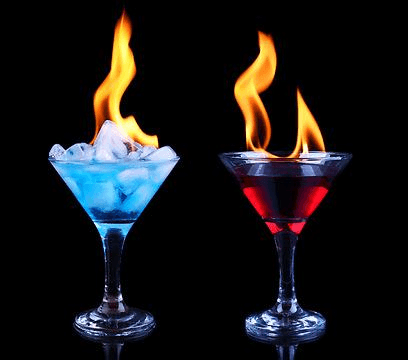
In the Hebrew Bible, fire is a theophanic tool—that is, part of the scenery that accompanies divine revelation. The burning bush, the pillar of fire that leads the camp, the smoking mountain at Mount Sinai where God descends in fire, and so on. Fire symbolizes the divine presence, or more precisely, the only form in which the intangible can be rendered tangible. And even if it is forbidden to depict the intangible, at least the intermediate entities that we are allowed, to some extent, to describe—are described as fire. The divine chariot is described as a “chariot of fire and horses of fire,” the living creatures "running and returning" like a flash of lightning, their appearance like tarshish. Their form is a pyrotechnic display of a wheel within a wheel.
In later biblical books, and especially in apocalyptic literature where the angels are named, fire is embedded within them—or at the very least, in their bodies. One of these angels is Uriel, whose name clearly derives from “ur,” meaning fire or light. Uriel is mentioned as an angel—one who is entrusted with "the world and the underworld"—but according to the vision of Enoch, he is understood not merely as an angel but as the primary tangible embodiment of God: that is, the least intangible aspect that God can possess, or alternatively, the most abstract tangible image that can be assigned to Him.
In terms of inner chambers and hidden secrets, one might envision God as a grand palace of many chambers, each chamber enclosing another, with a guard stationed at its gate to prevent access to the king. Only the most select individuals are permitted to enter the innermost room. Accordingly, the essence of one who enters is defined by their belonging to the innermost circle. And the one who manages that circle is called the “Prince of the Presence” (Hebrew: Sar HaPanim). This, ostensibly, is Uriel.
In Jewish mysticism, this angel is called Metatron, who is believed to be the transformed version of Enoch. However, in the Book of Enoch, this guiding angel is not referred to as Metatron but as Uriel—the one who leads Enoch and takes him on a guided tour through the heavens.
Let us return to this story shortly. The point here is that, in terms of inner chambers and hidden secrets, the image of God may also be likened to a labyrinth at whose center lies a treasure. And that treasure is guarded by a dragon—a monstrous beast, a kind of Minotaur—whose encounter is terrifying and deadly. But that is the nature of a liminal vision: awe and splendor, trembling and sweat, dreadful and sublime. A place beyond description, for even logic there is illogical and paradoxical. Fire and hail, snow and steam—an amalgamation of opposites, and at the same time, two-faced, capable of being good and evil simultaneously.
In short: we are dealing here with duality—both good and evil—whose boundary is thin and elusive. And very soon we arrive at the conclusion that this very “fire,” or the “fire and water” as opposites, may be analogized to poison—or to a psychedelic substance—which, too, is characterized by such duality. That is the ultimate aim of this text. We will arrive at that point shortly.
In 1 Enoch, in the vision of Enoch, he ascends to the heavens. There, he sees a figure of blazing fire dwelling within a house surrounded by tongues of fire and constructed of crystal. The man sits on a throne beneath which flow rivers of fire, and around him there is radiance like the sun and the appearance of cherubim. This man informs Enoch of the punishment of the Watchers and takes him on a guided tour through paradise and hell.
Once again, landscapes of fire are described: a mountain whose peak reaches the heavens, the place of the storm, whose summit holds the luminaries and thunder; at its base are a fiery bow, fiery arrows, a fiery sword, and lightning. A great cliff of fire is described, its top crowned with hills of flame. From the summit flows a river of fire, the fire streaming through it like water. When the river reaches the edge of the cliff, it falls like a fiery waterfall into a deep abyss whose pillars are made of heavenly fire. Within this abyss are columns of fire descending endlessly in height and depth. This waterfall appears as though it were the sky, but the abyss is so deep that the ground "has no foundation"—in other words, it cannot be seen, and it seems as though there is nothing below, a firmament above and an endless sky beneath. What turns this bottom into “heaven” is what resides within it: seven burning stars rolling in fire.
The man, initially described simply as an “angel,” is at some point given a name—Uriel. He explains why the stars fell, stating they were punished and are destined to remain in the depths “until the time their sin is fulfilled.” This transgression is analogous to the sin of the Watchers, who—led by Azazel—will also be cast into the abyss and remain there until the Day of Judgment.
It turns out that Uriel relayed such information to Noah as well, guiding him on how to escape the flood. The flood itself is described as an act carried out by two angels—Raphael and Michael. These two angels perform similar deeds: they cast the leaders of the Watchers into a pit of fire. Raphael throws Azazel into “Dud'el”, a giant furnace of fire, a prison of flame located at the edge of the desert. Michael, for his part, fights against Shemyaza and his followers, binding them “for seventy generations” beneath the hills of the earth. There they will be brought into the “depths of fire, into torment and imprisonment, and they shall be imprisoned there forever.”
The myth of the angels’ battle against demons (theomachy), and especially of Michael against the dragon, recurs as a central thread in later apocalyptic literature, particularly Christian texts such as the Book of Revelation. But its origin is in the Book of Enoch—and if we go further back, we find fragmented hints in the opening chapters of Genesis. All of these, ultimately, can be given a psychedelic interpretation, in which the fire is essentially the psychedelic substance—a double-edged sword, a “flaming sword which turns every way”, that, together with immense madness and terror, can also unveil supreme secrets.
Precisely because humanity is unworthy of these secrets, it is banished. And not only humanity. Those who are exiled from Eden are those who once had access to this knowledge but did not use it wisely—or worse, abused it. This could be a fallen angel, a dragon guarding a treasure, a serpent watching over a tree, or Adam himself and his descendants, expelled after the transgression. All are buried—until they learn to dig themselves out from the depths of the earth, strive with effort, and climb toward the summit.
Uriel is described in the apocrypha as one who holds a sword of fire in his hand—or more precisely, as one whose “sword is drawn in his hand”. We recognize this image from various biblical theophanies. Joshua encountered such an angel who introduced himself as the commander of the Lord’s army, in the plains of Jericho, immediately after the Israelites ate the produce of the land. David encountered a similar angel at the threshing floor of Araunah. Gideon encountered such an angel as well, though this one did not wield a sword, but rather a "staff". Yet in that particular scenario, there was unleavened bread present, and the moment the staff touched it, fire erupted from the rock.
Dan Merkur connects all of these to ergot, which in the Middle Ages was called “holy fire”—perhaps not by coincidence, since ergot is a visionary and psychedelic substance. Be that as it may, scenes involving fire, rock, and divine appearances are familiar to us from Moses in two key revelations: the burning bush at Horeb, and the giving of the second tablets at Mount Sinai. These two events occurred at the same location, which was also the site of another major theophany: the Sinai revelation, where the mountain smoked and God appeared in fire. A similar theophany is described with Elijah—again, at the same place.
I mention the story of the burning bush for another reason. Uriel is considered the one who guided Ezra in the book 2 Esdras aka 4 Ezra (aka The Vision of Ezra). The book contains seven visions, and Uriel is explicitly named in only one of them. However, as mentioned, in the Book of Enoch as well, Uriel is not always named—sometimes he is referred to simply as “the angel.” Uriel is generally considered a guiding angel—or more accurately, a figure who appears to those who prophesy and encounter, ostensibly, the transcendent. And if they do not encounter God Himself—since it is impossible to describe, even in imagination, how God looks or sounds or is sensed—then a name is given to the one who conveys wisdom, and that name is Uriel.
In the seventh vision that concludes The Vision of Ezra, the angel commands Ezra to drink a liquid “the color of fire”. Once he drinks it, the contents of the Torah are revealed to him: “As I drank, my heart poured forth understanding, wisdom grew in my vision, and my spirit retained memory.” He proceeds to write it down, along with seventy esoteric books whose contents are to be revealed only to the righteous who are worthy: “for they are the source of understanding, the fountain of wisdom, and the river of knowledge”.
This vision is constructed with the same imagery: beneath an oak tree, the angel appears to him from within the bush and speaks to him. The angel reminds him of Moses’ revelation—also from within a bush—as if to draw a parallel between the giving of the Torah to Moses and the second giving of the Torah to Ezra. This parallel between Moses and Ezra, and between the two stories of the burning bush, is significant because it includes imagery of fire, a hidden and nameless God, and the drinking of a “fire” potion that turns out to be psychedelic—as if it were haoma.
It seems that both of these episodes were written under Zoroastrian influence—such is the argument presented by Dr. Gad Barnea. This would be, ostensibly, the Zoroastrian source of the veneration of fire, its role as sacred sacrament, and the ritual of drinking a consciousness-altering substance.
In some sources, Uriel is described under a different aspect, bearing the name Nuriel, derived from nur—meaning fire or light. In the midrash The Assumption of Moses, found in the collection Legends of the Jews, he is depicted as an enormous angel—three hundred parasangs tall—accompanied by fifty myriad angels. The essence of Nuriel and his host is unique: they are composed of both water and fire (recall the motif of duality). Nuriel and his retinue are encountered in the second firmament of the seven heavens.
Indeed, The Assumption of Moses is also a kind of guided celestial tour, in which Moses is led by Metatron himself, described as the Sar HaPanim (“Prince of the Presence”) and identified in this text with Enoch—not with Uriel.
These angels of fire and water in the second firmament always turn their faces toward the Shekhinah and sing to her. Such angels, in fact, exist in almost every celestial realm. In the fourth firmament, for example, there is a palace of fire, with pillars made of red fire, beams of green fire, ceilings of white fire, boards and hooks of burning fire, gates made of ruby stones, and treetops made of precious gems. The entire place is filled with angels singing.
Similar angels appear in the fifth firmament, where the lower half of their bodies is made of snow, and the upper half of fire. These are called Ishim. In the sixth firmament, they are called Holy Watchers. And in the seventh: in addition to the angels of wrath, made of black and red fire—including Samael himself—there are the Seraphim with six wings, and the Hayyot (living creatures) that bear the throne of glory, namely, the Cherubim. And among them: one more—the Prince of Torah and Wisdom, who teaches the Torah in seventy languages. Moses asks for a gift, and the Torah is given to him and called by his name. The name of the Prince of Torah and Wisdom: Zagzagel.
Who is Zagzagel? In the Hebrew Book of Enoch—namely, 3 Enoch—there appears an angel named Kerubiel, whose traits align with those of the angels described in the seventh firmament: fierce, rebuking, burning, and consuming—chiefly presiding over a chorus of praising cherubim, from which he also takes his name.
His stature is "filled with smoldering coals". His mouth and tongue are described as torches and consuming fire. His face burns like fire, his eyes flash like lightning and sparks. His sword is like lightning, his arrows like flames, his shield is consuming fire. His neck and its surroundings are filled with glowing broom coals. In both his right and left hands burn fire and flame, and lightning issues from his face.
He is a kind of Zeus figure, with a diadem/tiara on his head like Wonder Woman's—serving both as a symbol and as a weapon when needed: "a crown of holiness is upon his head, upon which is engraved the Ineffable Name, and from it emerge bolts of lightning. The bow of the Shekhinah lies between his shoulders. His sword flashes like lightning, his waist girded with arrows of flame, his armor and shield are consuming fire, his neck wreathed with glowing coals, and he is entirely surrounded by burning coals".
Why is he called Kerubiel of the Lord? Because he is appointed over the chariot of the cherubim. The mighty cherubim are in his hands. He adorns the crowns upon their heads and polishes the diadems upon their foreheads. In short: Kerubiel “binds crowns for his Creator”—as if he himself were Metatron, and if it weren’t made explicit that above him and his subordinates stands a higher Being, “the One who dwells upon the cherubim”, one might mistake him for God Himself (as indeed happened to Elisha ben Abuyah).
But Kerubiel is only number two. He is, after all, Uriel himself—a cherub in his own right—and the one who, with his flaming, revolving sword, guards the gates of Eden against those who knock. A kind of divine doorman, who dispenses wisdom only to those deemed worthy—and only among the reverent.
There is a play here on the Hebrew root R.A.A.H. (to see), which leads us to a reflection on the sense of vision—and on the fact that most “trips” are visual. It is worth recalling that most angels are described as beings whose bodies are filled with eyes. Including, of course, Samael. Including, by the way, Uriel himself—or more precisely, under his other name: Sarafiel.
The Hebrew Book of Enoch (3 Enoch) describes Sarafiel in a manner similar to how Kerubiel is depicted: his form is saturated with imagery of fire and light—lightning, torches, sparks, glowing coals, and electric brilliance. He, too, wears a diadem on his head, featuring a large sapphire that shines with the radiance of the heavens.
His body is filled with eyes, like stars scattered across the firmament—beyond count or comprehension. Each eye shines like the morning star, some resembling the “lesser light,” others the “greater light”. From his ankles to his knees, he glows like stars of lightning; from his knees to his thighs, like the morning star; from his thighs to his loins, like the moon; from his loins to his neck, like the sun; and from his neck to the crown of his head, like “the imperishable light”.
He is appointed over the burning seraphim and teaches them song and sanctity. Why are they called seraphim? Because they burn. The primary task of Sarafiel and his legions is the daily incineration of Satan’s accusation scrolls—so they cannot be presented before God at the time of judgment.
Uriel–Nuriel–Sarafiel–Kerubiel–Metatron—this figure has yet another name, which appears in The Apocalypse of Abraham. Or perhaps even two names, since each figure bearing one of these names is marked by attributes described elsewhere as those of the “Angel of the Presence”.
These two names represent, in fact, two faces—and here we return to the Hebrew root P.N.H. (to turn, face). The Angel of the Presence, who reveals himself to those who enter the innermost sanctum, appears as a being with four faces, as described in Ezekiel 1 and 10. One of those faces is that of a cherub, but each face also represents a different attribute—and since each attribute is governed by a specific angel, these four faces are, in essence, four angels: the same four angels who surround God—Michael on the right, Gabriel on the left, Uriel before Him, and Raphael behind Him. (And above them: the Shekhinah).
In the Apocalypse of Abraham, not all of them are named—but two of them are. The vision describes the heavenly court as possessing two books: the Book of the Righteous on the right, and the Book of Sins on the left. Each book is overseen by an angel—though their names are not mentioned. A third angel, who presides over the scales that weigh the deeds recorded in both books, is called Dukiel; he is the one who carries out judgment.
Opposite him stands an accuser—a fourth angel, blazing and merciless, who holds fire in his hand. This angel “has power over fire and tests the deeds of humankind with fire”, meaning he conducts an ordeal (ordalium, “trial by fire”). The angel burns the deeds. If the fire consumes the deed, then the person’s act is deemed unworthy, and the angel of judgment immediately seizes the person and carries them to the realm of the wicked—a place of harsh punishment. But if the fire does not consume the deed, it is a sign that the act is righteous, the person is considered just, and the angel of justice elevates them to the portion of the righteous.
The wrathful angel who rules over fire is named Puriel. Besides the pleasant rhyme, the name bears linguistic weight: in Greek, the word for fire is πῦρ (pyr). The Greek letter upsilon (υ) hovers between the sounds of u and y, so the pronunciation can shift—sometimes “pyr”, as in today’s pyro, and sometimes “pur”, as in Purim.
And who’s to say that pur meaning "lot" or "fate" in Purim isn’t connected to fire divination? Could it be that Haman is actually described as a magus—a fire-diviner? It turns out that in ancient Persia, divination was indeed practiced by observing flames and the movement of smoke (Agathias 2.25, Encyclopædia Iranica, entry: “Divination”).
Admittedly, Dr. Thamar Eilam-Gindin suggests that the name Purim derives from the Persian festival Farvardigan, a holiday of the souls, which took place around the same time. But (a) even she is uncertain, and (b) in that festival too, fire was used—though not for divination, but to welcome the returning souls into the home. Still, the association between soul and flame is well-known—even in Judaism: “The soul of man is the lamp of the Lord”.
Of course, this interpretation of the angel’s name as deriving from “fire” is circumstantial. The name Puriel does not appear frequently in other Jewish texts, despite the presence of many fire-related angels. The fact that a Greek name is used raises questions: why give a Jewish angel a Greek name rather than a Hebrew one?
This may indicate the time or place in which the text was written, and can work both in favor of and against the story’s credibility. The name Dukiel also seems to bear Greek influence, as dikē in Greek means “justice” or “judgment”. It’s possible that, simply for the sake of making the names accessible to a Greek-speaking audience, the original Hebrew names were translated into Greek—but the intent was to convey their Hebrew meanings.
In that case, Uriel—or any of his variants as a fire-angel—could easily be Puriel, whose very phonetics suggest such a link. And the angel of judgment may be Phanuel, who is described in 1 Enoch (Chapter 40, verse 9) as the “angel set over repentance and the hope of those who inherit eternal life.” That meaning also aligns with the name Dukiel.
This is a good opportunity to note that in the same verse where Phanuel is mentioned in the Book of Enoch, four angels are listed by name, and Phanuel replaces Uriel in the usual quartet—namely: Michael, Raphael, Gabriel, and Phanuel.
Elsewhere in the same book, the quartet does include Uriel as the fourth. There’s no escaping the conclusion that Uriel and Phanuel are, in fact, one and the same—and therefore Uriel is also Dukiel and Puriel. Perhaps all four angels are manifestations of a single being.
הצטרפו לרשימת התפוצה שלנו
כתיבת תגובה