
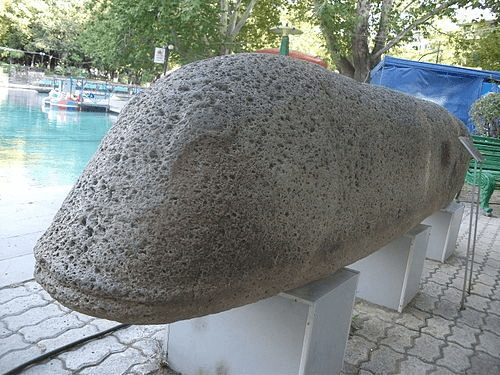
The Vishap Stones are prehistoric stone stelae that were erected in the high plateaus of Armenia starting from the Chalcolithic period (ca. 4200–4000 BCE). They are scattered across the Armenian Highlands, not in one single location, yet their distribution still shows a certain patterned concentration—all of them are set in strategic places, near springs, snow basins, streams, irrigation canals, and so forth. The height of the stelae ranges from one meter to five and a half meters, and their weight could reach up to six tons. Statistical analysis of their locations reveals a clear bi-modal pattern: one concentration at about 1900 meters above sea level, near settled valleys and irrigation systems, and another at around 2700 meters, close to the permanent snow line and high-altitude sources. This division is not accidental: in the lower altitudes, one can see the practical aspect of water—irrigation, daily use, and constant springs. At the higher altitudes, however, the recognition of water as a primordial resource derived from melting snow is reflected. From this arises the hypothesis regarding their significance: these were monuments around which seasonal rituals and pilgrimages were held, in which water sources were endowed with mythical meaning. The stones marked these meeting points and created a defined cultic space. Of course, the pilgrimage itself was not the only event—also the erection of these massive stones, whose quarrying and transportation clearly required great effort. And so the question arises: for what purpose?
The Armenian term vishap (Վիշապ) means “dragon” or “mythological serpent.” In Armenian folklore, the vishap was a powerful entity connected with water, clouds, rain, and lightning—a sort of dragon-serpent monster that could block or release the waters. Naturally, this mythical figure is not unique to Armenia. Comparative mythology shows that in many cultures dragons or mythological serpents hold a similar role: they guard or obstruct water sources, they are associated with fertility and with the cycle of life—the ability to renew, to shed their skin, to regenerate. They represent the boundary between life and death, chaos and order. They embody a primal force—fearsome on the one hand, but on the other, the source of blessing.
Three typical forms have been identified in the Vishap Stones: piscis – fish, vellus – stretched cattle hide (or more precisely a bull figure, with some of its limbs hanging down), and hybrida – a combination of the two, i.e., a hybrid figure of fish and bull. The fish imagery represents the water element itself; the hide imagery symbolizes the idea of renewal through sacrifice. That is, the act of stripping the hide from the sacrificial animal was a magical performance intended to resemble the shedding of the dragon-serpent’s skin. Within this cultic act, herders sought to bring about the renewal of the water sources.
Naturally, the fact that the animal is a bull did not go unnoticed. The bull is the image of the father of the gods and symbolizes masculine power and energy (and thus, fertility). The bull’s association with high places (if not with the heavens themselves) made him, in some depictions, winged. We see this in the Assyrian Lamassu—bull figures with eagle wings. The eagle was an attribute usually attached to the father of the gods, especially in his manifestation as a storm deity. Yet it was not only the bull that was winged. The fish, too, with its fins, sometimes resembles a winged being. The ventral fins look like small wings, especially when fish are depicted as “leaping” in the water. Thus, whales—regarded as giant creatures and therefore monstrous beings—were sometimes described as flying. Their immense weight crashing back into the water, as well as their tail slaps, were considered causes of earthquakes. The tail fin itself, as well as the dorsal fin, are shaped in a way that recalls an eagle’s wing. For this very reason: the fish too is a winged being, connected to the heavens. This is precisely how the Apkallu were described—the Seven Sages who taught humankind crafts and wisdom—sometimes as men clad in fish scales, sometimes as men with a beak and eagle’s wings. The hybridization between bull and fish, therefore, was meant to symbolize that same idea. Such, likely, was also the god Dagon. And perhaps for this reason too, Jesus and his companions were considered fishermen and the cross as a fishbone.
הצטרפו לרשימת התפוצה שלנו
כתיבת תגובה