
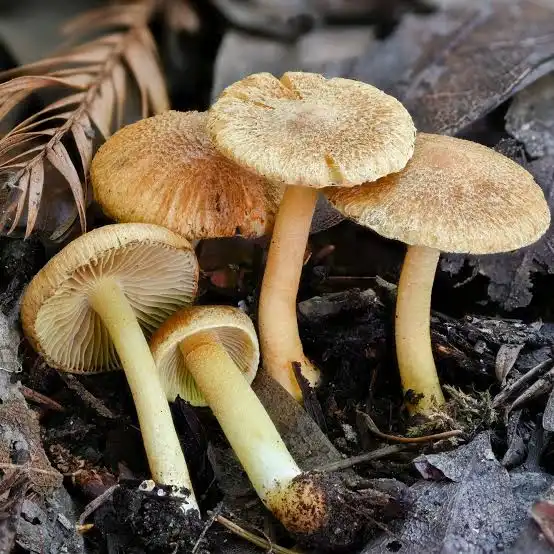
A recent German study challenges previous assumptions about the evolutionary origins of psilocybin. A team led by Prof. Dirk Hoffmeister from Friedrich Schiller University in Jena discovered that two mushroom genera, Psilocybe and Inocybe, independently evolved completely different biochemical mechanisms to produce psilocybin. This phenomenon, known as convergent evolution, occurs when unrelated organisms develop similar solutions to the same biological function.
In Psilocybe mushrooms, the psi gene cluster responsible for psilocybin biosynthesis has long been known. However, in the new study, examination of Inocybe corydalina revealed an entirely different gene cluster, termed ips, which produces the same molecule through a completely different set of enzymes. The researchers reconstructed the activity of these genes in bacteria and confirmed that they could generate psilocybin step by step—evidence of an independent biosynthetic pathway. Although the enzymes in both genera perform the same metabolic roles, they are not evolutionarily related. Inocybe also produces psilocybin derivatives such as baeocystin, indicating additional chemical diversity.
The presence of psilocybin in Inocybe was already known, but previously it was based solely on chemical evidence; the biosynthetic system behind it had not been understood. As early as the 1980s and 1990s, several Inocybe species were identified as containing psilocybin and psilocin: Inocybe aeruginascens, Inocybe corydalina, and Inocybe calamistrata. All of them grow in temperate forests — in Germany, Scotland, Japan, Canada, and Russia.
These mushrooms prefer to grow near trees, as they live in a symbiotic partnership: the tree roots provide them with sugars, and in return the fungus helps the tree absorb water and minerals from the soil. This relationship is called mycorrhiza—or more precisely, ectomycorrhiza—where the fungus envelops the tree’s roots from the outside like a sheath.
The main trees they associate with are oak, beech, pine, spruce, chestnut, alder, and birch. Notably, many of these trees are considered sacred in various cultures—from the Celts and Norse (Yggdrasil), through the Slavs, Romans, and Greeks (Dodona), and of course in the Hebrew tradition. One need only recall the biblical Elon Moreh, Elon Zaanannim (Elon = oak), and Beit Arazim (“House of the Cedars”). All belong to the beech (Fagaceae) and conifer families—precisely the tree families these fungi prefer. They are highly selective: each fungal species is adapted to a particular tree type. In general, however, their mycorrhizal systems are concentrated in forests—one reason why these trees grow in groves or woodlands, mainly in taiga and temperate forests, both typical of the northern continents.
Inocybe fungi require acidic or neutral soil, rich in organic matter but not waterlogged. They thrive in old, undisturbed forests—ecosystems that have remained stable for decades. Because their host trees are either deciduous or long-lived conifers, a thick layer of decomposing leaves and needles accumulates, creating ideal conditions for fungal mycelia. Thus, Inocybe almost never appears in open fields or cultivated soils—it “loves true forests”.
This may explain why, although these trees also grow in Mediterranean climates, psychedelic mushrooms are generally absent there. The Mediterranean climate is harsher—frequent fires and forest regeneration prevent the development of old, stable woodlands. Over time, Inocybe species in such regions adapted through mutations allowing survival in drier, warmer, and more exposed conditions—yet these Mediterranean varieties are not psychedelic.
In these regions, periodic droughts dry out the soil. The fungus needs nutrient-rich, moist, partially shaded ground. Such conditions exist only in relatively high mountains with humidity from dew or mountain fog, where dense woodland and moderately acidic soil prevail. These microclimates can be found along the Mediterranean coast: in the Lebanese mountains, the Taurus range in Turkey, and the Carmel range in Israel. Indeed, these fungi are found there—but not psychedelic strains.
Could psychedelic mushrooms have once existed in these areas? Possibly – (a) during periods of sparse human settlement, when forests could mature undisturbed; (b) during cooler epochs, such as minor ice ages that occasionally occurred in the Levant, for example around the mid–2nd millennium BCE. A more significant glacial period occurred about 20,000 years ago, ending roughly when agriculture began—probably as a response to these climatic shifts. It is likely that in the Levant, including ancient Canaan, some cultural memory persisted from the Neolithic age, when psychedelic mushrooms could still be found in forests, and around them early proto-shamanic religions developed.
Perhaps John Marco Allegro was not entirely mistaken after all. In these same forests grow not only Inocybe mushrooms but also various Amanita species—such as Amanita muscaria, well known across Europe. Allegro claimed that early Christians used Amanita muscaria, though this species does not naturally grow in Israel. However, other Amanita species do, and there are even legends about Amanita pantherina (the panther cap) growing among the oaks in the Golan Heights. Who knows—perhaps the Amanita species in the Levant have “degenerated” during the past 12,000 warm years, and before that, they too once thrived here.
הצטרפו לרשימת התפוצה שלנו
כתיבת תגובה