
Back when we dealt with volcanoes and myths about the battle between the storm god and the gods of the underworld and waters, I brought the example of Lake Tana in Ethiopia and the Blue Nile waterfall, as an ancient attempt to personify a volcanic natural phenomenon. Seemingly, this myth was an attempt to explain a technological development like obsidian, and its physical and gemological qualities were linked to properties against demons. That was the second example, while the first example was Mount Erciyes in Anatolia (in antiquity: Mount Argaeus). I showed how mythification of geological phenomena in the region created the original myth of the Anatolian storm god, who arrived via trade also to Mesopotamia and ancient Greece. This is none other than Zeus, Marduk, Hadad, and Baal. The same storm god fights a terrifying and distorted primordial monster, and after defeating it, creates the world from its remains. The myth evolved into a story about a warrior fighting a monster, especially at the end of days, when his victory brings redemption – a kind of eternal return.
We dealt with Ethiopia. So it turns out that a similar myth also developed in Ethiopia. Today I want to expand on it. First of all, how did such a myth arrive in Ethiopia? Is it a kind of collective subconscious that can transmit themes from one edge of the known world to the other? I argued that it is a personification of natural phenomena and mythification of primitive scientific explanations. Did people at both ends act the same way? Maybe. And maybe it’s the mediation of a “scientific” culture whose representatives transmitted the knowledge. Such a culture could be Greece—the Ptolemaic dynasty sent research missions to Ethiopia and was also interested in Anatolia. Of course, it believed in Zeus.
Historians thought otherwise. Joseph Halévy believed the Ethiopian myth was born from the direct influence of merchants who arrived at the kingdom of Aksum, specifically Iranian merchants who told the myth of Zahhak, the Iranian dragon-king. Conti Rossini hypothesized that the story’s origin was in Egypt, from a snake-god figure who ruled the land of Punt during the Middle Kingdom. In any case, at a relatively late stage, it is clear that the myth underwent a Christian makeover under biblical influence from the Book of Isaiah and the story of Bel and the Dragon (one of the apocryphal additions to the Book of Daniel), and the defeat of the dragon symbolized victory over the infidels. At first, of Christianity over paganism, and finally, as Zeev Rubin argues (in the article “Mythological Snakes in Iran and Ethiopia: Tradition and Religious-Political Propaganda in Late Antiquity” from the book Humans and Other Animals in Historical Perspective, Carmel Publishing, 2007), the Christian kingdom of Aksum’s victory over the Jewish Himyarite kingdom in 525 CE. Be that as it may.
The myth is about a monstrous snake named Arwe who rules Ethiopia and imposes a reign of terror until he is eventually killed by a savior figure named Angabo, who is rewarded with the crown for his deeds. In some versions, he is called by another name, Wainaba, and in some cases, this is not Angabo who kills him, but the idea is clear.
Broadly speaking, there are three versions of the story, probably reflecting three layers: the first is pre-Christian, the second is propaganda of the Solomonic dynasty that tried to appropriate the ancient Ethiopian myth and thus give itself legitimacy, and the third is the hagiography of the Ethiopian Orthodox Church linked to Aksum’s Christianization. What all have in common is that the monster demands a human sacrifice, usually virgins, sometimes just livestock. A mysterious hero appears and kills the snake using tricks and strategies, and in return, as noted, inherits the throne and leads Ethiopia to a golden age of justice and order. And as it was then, so it will be in the future. That is, even if there was decadence, there will be future revival, and order will return forever.
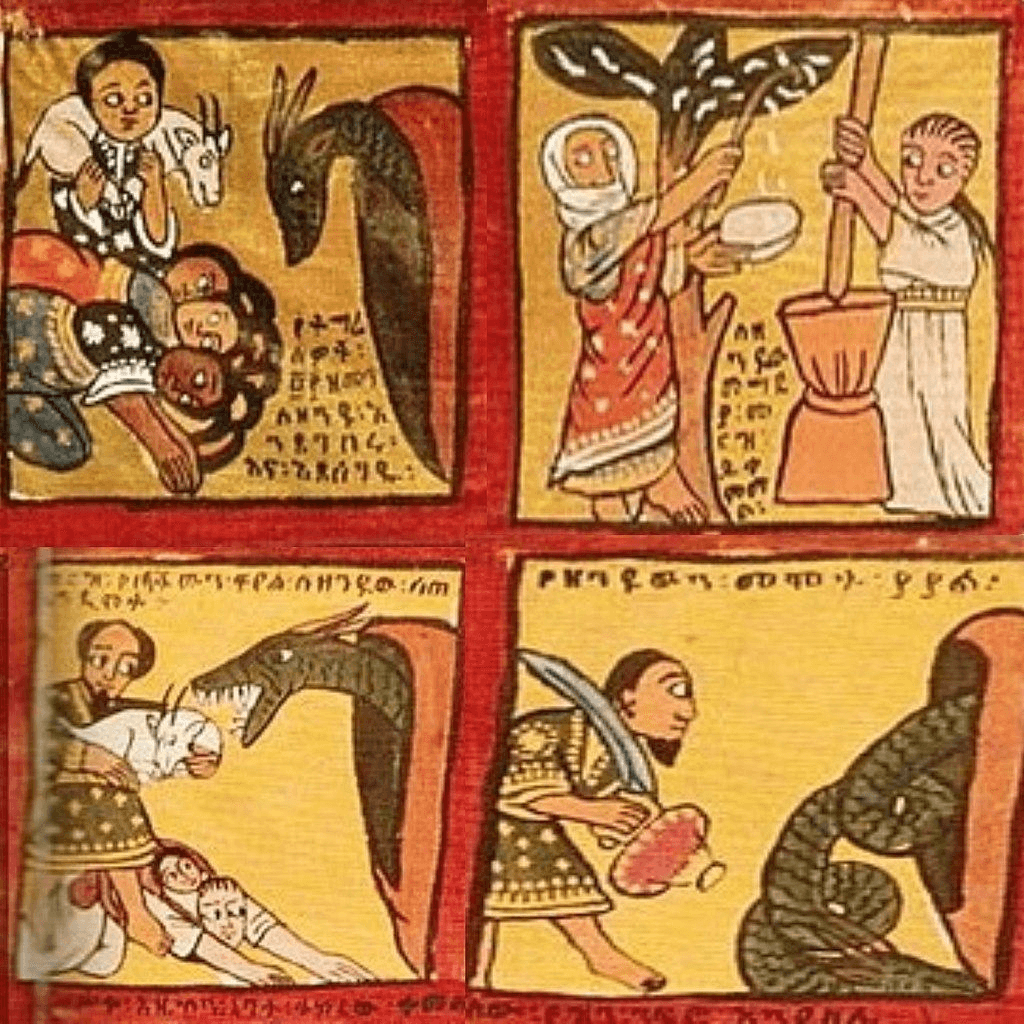
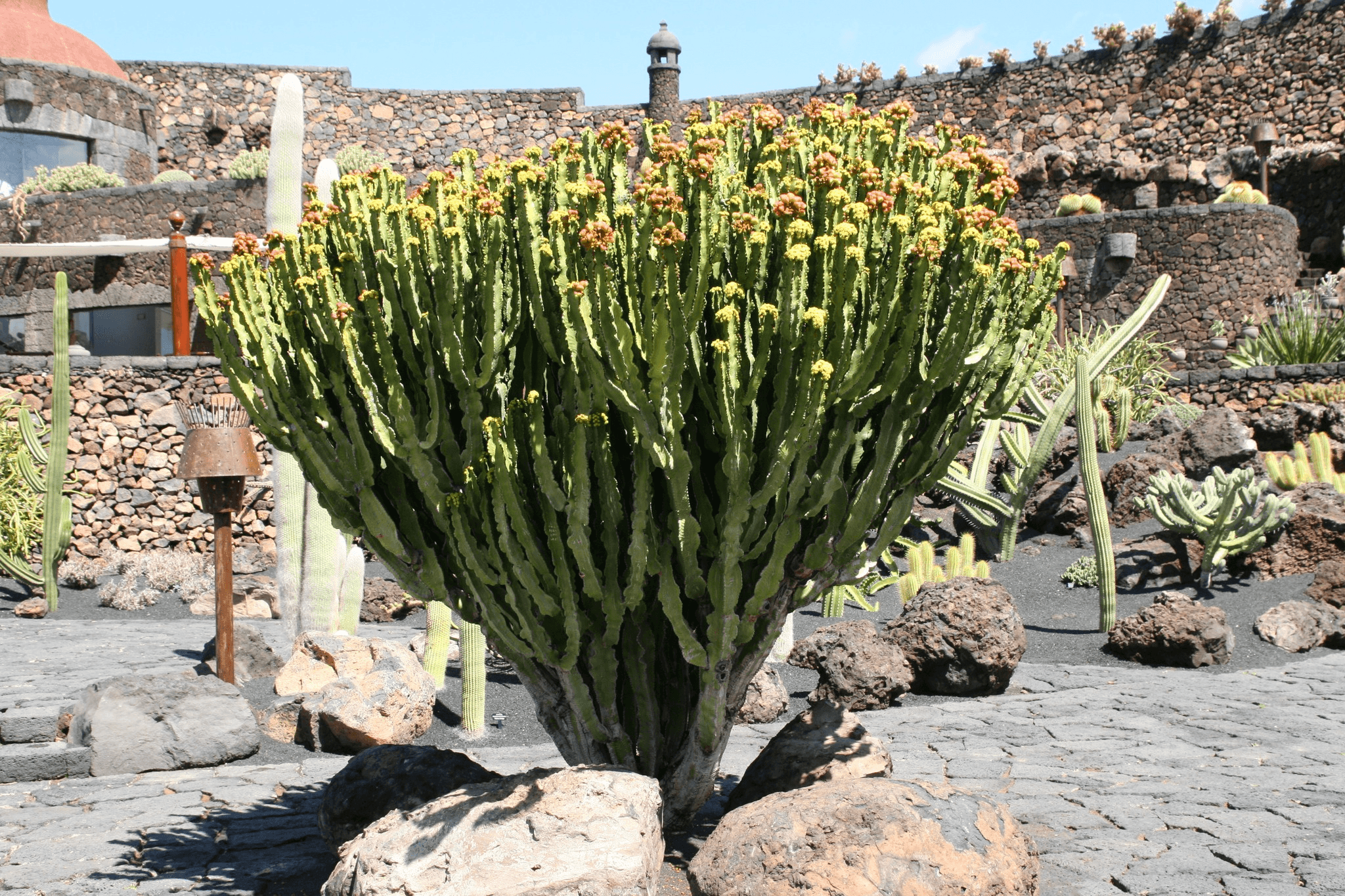
The first pre-Christian version was transmitted orally and does not appear in a canonical text. According to this version, the dragon Arwe ruled Ethiopia for 400 years and demanded sacrifices of virgin girls and bulls. A foreign man offers to save the next daughter in line, gives the dragon a sacrificial ritual including poison, and causes his death. The hero is appointed king, sometimes called Agabos or Angabo. The poison is described as from the euphorbia plant, indeed a toxic plant whose white sap is harmful to the skin and of course forbidden to ingest, as it causes burns to internal organs. The euphorbia growing in Ethiopia is unique in that it is not just a shrub but a tree, sometimes huge. Its sap was used as arrow poison throughout Africa.
It turns out that among the Zulu there is a legend about the umdlebe, a carnivorous tree with claw-like branches and octopus-like roots, which according to stories can move when no one is looking. This tree is involved in black magic, and people are afraid to even be near it, because it emits a pleasant and seductive scent and then kills whoever approaches. It is believed to be a variant of euphorbia considered a plant used in black magic. This thing is not related to Ethiopian folklore and is found only among the Zulu, but maybe the second version links it after all.
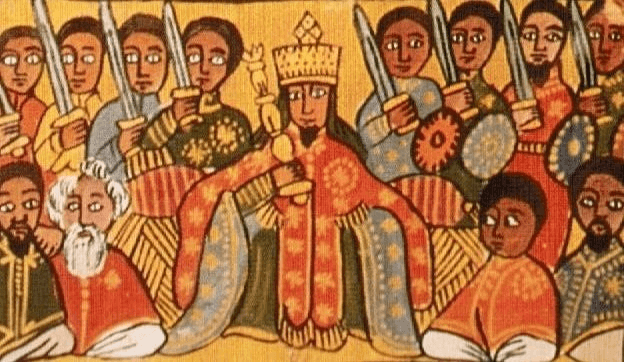
The second version is the one meant to give legitimacy to the Solomonic dynasty. In this version, Angabo turns out to be the father of the Queen of Sheba, so in exchange for killing the snake Wainaba, he received the kingdom lawfully. In fact, that was his condition for killing it using his magical abilities. And what are they? The practice he uses is burying a glowing iron tool in the dragon’s lair – the burial of fire in the ground is a purification ritual that threatens evil spirits. Angabo is described as a kind of sorcerer who tricks and kills the monster, a kind of Ethiopian equivalent to the West African Anansi.
As noted, the connection to other traditions from Africa is speculative, but similar rituals can be seen in all directions. Among the Zulu, for example, we spoke of using the umdlebe tree, which is not clearly identified but is believed to be euphorbia (Synadenium arborescens or Euphorbia cupularis). Berglund describes a ritual in which an umkhovu is created – a kind of zombie, a person brought back to life after death through dark magic and used as a servant-messenger by witches for sabotage tasks through seduction. This umkhovu is created by extracting a freshly buried corpse and reviving it. Usually, the one who killed the person is the one performing the ritual, but exhuming him is dangerous. To do so, they use one of two methods: either using a proxy, an anteater to do it so that if someone is harmed, it’s him. Or simply perform magic and the dead comes out by himself. The magic is taking a branch from the umdlebe tree, striking the grave, and calling the dead by name. Then, the dead emerges from his grave. Afterwards, the dead is neutralized by inserting a sharpened stick of umdlebe through his body – the stick enters through the fontanel (the soft spot on the skull) and exits through the anus. The umkhovu’s tongue is split to resemble a snake’s tongue (ukunquma ulimi), and his eyes are painted red – “so that he can see at night.” (From: Berglund, Axel-Ivar. Zulu Thought-Patterns and Symbolism. London: C. Hurst & Co., 1976, p. 442)
This slightly resembles voodoo, and Anansi resembles the description of the umdlebe tree – so the connection is possible. But in this context, what’s important to us is the connection to the snake. A forked tongue is considered among the Zulu a trait of duplicity, of cunning that can be negative but mostly reflects wisdom and therefore must be used responsibly. Such a tongue has the python. The Zulu revere the python (imamba), and see it as amakhhosi ("the lords") – a symbol of power, spiritual wisdom, connection to sources and ancestral spirits. In certain contexts, the appearance of a python was considered a spiritual sign or a manifestation of a protective being, giving it an almost divine status. It is believed the python is not dangerous to humans and should be treated with respect. Sometimes its appearance is linked to initiation rites, spiritual maturity, or a call to traditional leadership. One such initiation ritual is a ritual of catching a snake, boiling it several times, burying its head and flesh in the ground, washing its bones, and creating a necklace from the clean bones, a necklace representing the initiate's power.
Jacob A. Tropp reports (in the article “The Python and the Crying Tree”) on a story orally transmitted since the 1930s, in which the Zulu describe a particular tree that cries because within it lives the sacred python. The story is told to missionary R. H. W. Shepherd, who refuses to believe and calls it a "childish legend." They ask him to cut down the tree, but he refuses, causing a crisis of trust between them. What is that tree? Why is it crying? The article does not identify the specific tree by its scientific or folkloric name but it is clear that it is the umdlebe, from which the white sap emerges, symbolizing the python's power. Although euphorbia is not psychoactive, as a poison it is considered sacred and represents the python. Although it also has another, darker side, and we see that the umkhovu’s abilities are infused into the revived dead through the tree’s sap and the transfer of its properties – for purposes of black magic. Again, we see a snake symbolizing the duality of poison, and the victory over this snake may symbolize harnessing the positive power of this poison for spiritual elevation.
Let us return to the third version of the Ethiopian myth. This version is a development of the story that Angabo is the father of the Queen of Sheba. In this story, one of the girls chosen for sacrifice is none other than the Queen of Sheba, known by her name “Eteye Azeb.” This girl is tied to a tree. Seven Christian saints appear, one of them attacks the dragon with a cross, and they defeat it. Later, the dragon’s blood touches the girl’s heel. She is banished from the village, returns with the dragon’s corpse, is crowned leader, and eventually travels to Jerusalem and meets Solomon. According to Christian tradition, these events took place on one of the islands in Lake Tana. The memory of those saints is commemorated on that island, where monasteries of the Ethiopian Church were established. And not only that. It is claimed that the Ark of the Covenant, brought by the Queen of Sheba, was buried on one of those islands, and there also lie the tombs of some of the first kings of the Solomonic dynasty.
הצטרפו לרשימת התפוצה שלנו
כתיבת תגובה