
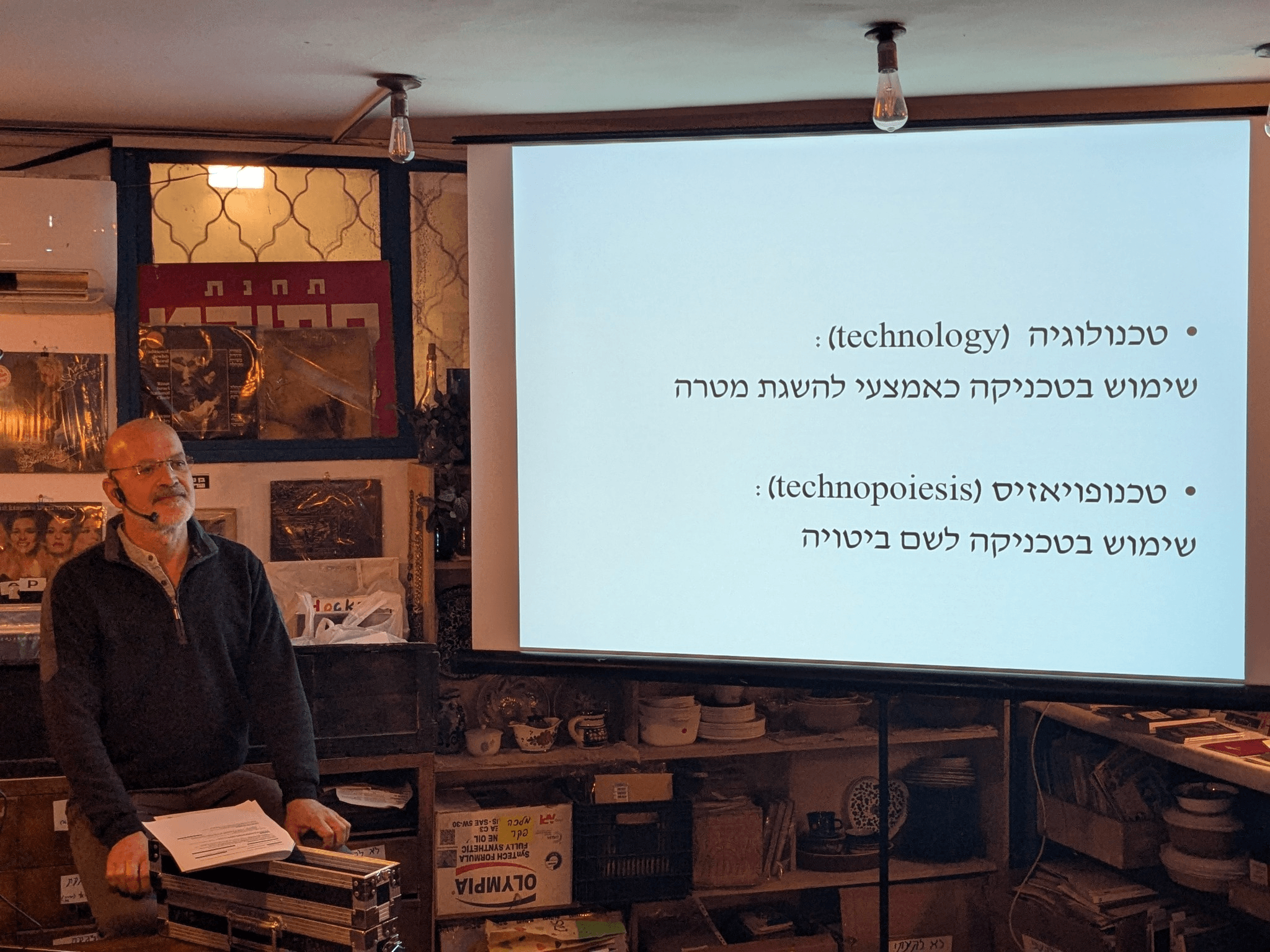
Yesterday marked the sixth and final lecture in the current series of “Temple of Consciousness” talks. The series was a success. It served as a pilot to gauge interest, and the demand and engagement proved it to be both fascinating and mind-blowing. Dr. Amzallag’s lecture on Technopoiesis was a testament to this. The lecture itself was a spiritual elevation.
In the framework of technopoiesis, technological innovations are seen as revelations of cosmic or divine secrets. For instance, in ancient times, the creation of metals like copper or iron was perceived as an act of creation that enabled humans to connect with the gods or cosmic laws. Technopoiesis involves the act of technological creation as an artistic, religious, or cosmic expression, where the act itself becomes a pathway to experiencing deep meaning rather than merely achieving utility.
If until now we regarded plants as entheogens, or even animals and inanimate objects, in technopoiesis, science itself becomes an entheogen.
Amzaleg argues that humans tend to demonstrate technophysis through what he calls a "testimonial artifact." A testimonial artifact is an object created within the framework of technophysis, whose primary purpose is to showcase the power, capabilities, or achievement of the technique rather than serve a practical or utilitarian function. These artifacts are created out of a drive to display the potential of the technique itself and to explore its boundaries, rather than to fulfill a practical need.
For example: jewelry. During the Bronze Age, jewelry was made of bronze to showcase the ability to process these metals. Perhaps it was even meant to metaphorically place these innovations close to our hearts, to always keep the wonder of these advancements in view.
I intentionally mention the eyes and heart. Regarding the fringes (tzitzit), it is said, “And you shall look upon it, and remember all the commandments of the Lord, and do them, and not follow your own heart and your own eyes, which you are inclined to go after.” The fringes are a witness object. The tefillin (phylacteries) are also witness objects: “And it shall be for a sign upon your hand and for frontlets between your eyes, that the law of the Lord may be in your mouth.” The Bible often speaks of signs and symbols, declarations that “the name of the Lord is called upon you.” Circumcision is such a sign, even representing a form of body modification that not only imprints the change upon the person but embeds it in their body, much like a tattoo. Incidentally, tattoos are forbidden because they are signs or, as mentioned in the Book of Revelation, “marks” of a competing god. Revelation 13 speaks of the faithful of the “beast” bearing marks on their foreheads, the “name of the beast,” the number 666—a quintessential witness object.
Cain, according to Dr. Amzallag, symbolizes metallurgy, which at the time was the pinnacle of advanced technology. The name Cain (Kayin) literally refers to molten metal, the smelted copper that takes the shape of its mold. Cain bore a mark on his forehead, a mark that was precisely this kind of witness object. A witness object is a “technological statement.” It exists to showcase the sheer ability to create it, to amaze, to inspire, or to explore, rather than to serve an immediate practical function.
הצטרפו לרשימת התפוצה שלנו
כתיבת תגובה