
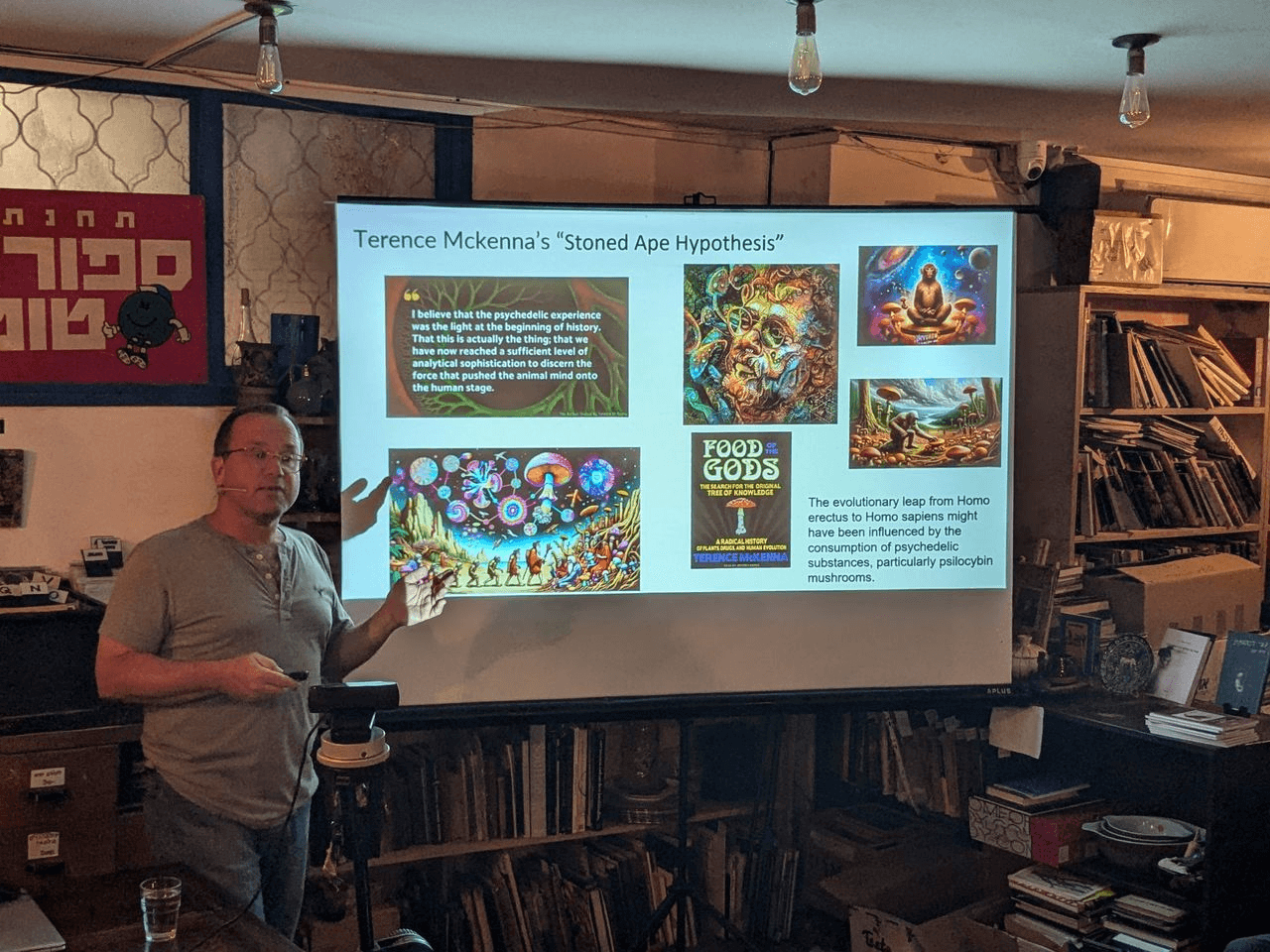
Yesterday, the "Temple of Consciousness" series began with a wonderful lecture by Prof. Ran Barkai from the Department of Archaeology at Tel Aviv University.
The lecture discussed psychedelic experiences during the Paleolithic period, focusing on caves as "doors of perception" or "portals" for communicating with the cosmos and the world beyond. It was suggested that Paleolithic caves served as sites for rituals and ceremonies, where people used consciousness-altering substances to undergo deep and mystical experiences. The paintings and symbols on cave walls, especially in places like Chauvet Cave in France, may be artistic expressions of altered states of consciousness.
The main argument presented was that the disappearance of megafauna (large animals) was one of the key reasons for the cave paintings, particularly in the Upper Paleolithic period. According to this view, the decline of megafauna, meaning the decrease in large animals like mammoths, giant bison, and prehistoric rhinos, created a sense of loss and distress among humans. This might have been traumatic for them, as these large animals were a significant part of their environment, diet, culture, and spiritual connection to the world. The cave paintings are described as a kind of ritualistic process, providing a renewed connection with animals that were no longer accessible as before and serving as a commemoration of those that had vanished. The paintings represented the large animals, and it is possible they were created as part of rituals meant not only to depict reality but also to reconnect humans with the lost history of their world.
Using caves as a ritual space and focusing on animals in the paintings might have evoked psychedelic and spiritual experiences in the participants. Entering the dark caves, along with low oxygen levels or the use of consciousness-altering substances, likely provided an experience that freed them from ordinary reality, allowing them to connect more deeply with the missing creatures and the broader meanings of their changing world. The cave paintings in the Paleolithic era were not created with artistic intentions in the modern sense of the word but rather for ritualistic and spiritual purposes—what Dr. Nissim Amzallag describes as "technopoiesis," creation for experience rather than for purpose. He will elaborate on this in the lecture concluding the series.
Why was megafauna important to humans?
Beyond simply meeting their needs, human diet was actually dependent on it. Large animals provided a rich food source and essential caloric abundance, particularly in harsh winters or during periods of limited vegetation. The meat and fat they provided were crucial for the diet and health of early humans. These animals' fat made the economy less dependent on other food sources, especially in places with a true scarcity of other foods, such as arid regions or areas with harsh climates where vegetation was sparse.
In addition, fat is an efficient energy source. In cold seasons, when the body needs extra energy to stay warm, fat served as a natural fuel, allowing the body to withstand difficult conditions. Fat balanced the high protein intake that was part of the diet of early humans. Protein-only consumption, without fat, can lead to a condition known as "protein hunger," where the body suffers from nutritional deficiencies and has difficulty properly digesting large amounts of protein. Fat allowed for optimal digestion of protein, providing the body with the energy and nutrients needed for proper function. Without megafauna, people would have had to adopt a different, more demanding diet that fundamentally altered their worldview.
In the absence of high mobility capabilities, people did not need to migrate when megafauna was present. Migration only began with the search for megafauna. If it migrated, humans migrated with it. Additionally, as we know, fat acts as a preservative, decaying very slowly. When such an animal was hunted, it could provide food for a very long period. They didn’t need to hunt more than once every six months!
הצטרפו לרשימת התפוצה שלנו
כתיבת תגובה