
Professor Ran Barkai will open the "Temple of Consciousness" lecture series tomorrow with a talk on the psychedelic experience in caves. Professor Barkai is an archaeologist and will likely focus on material findings that suggest entering a cave was a way for ancient people to experience altered states of consciousness. I doubt he will address philosophical or psychological interpretations or any other unprovable explanations. To fill this gap, I turn to Ze'ev Ben-Arieh, who dedicates a significant portion of his book ״The Goddess Culture in Israel״ (2021) to the psychedelic experience in caves.
In the first chapter of his book, Ben-Arieh assumes that, as the primary religion was one of fertility, caves were perceived as the womb of the earth. The inner and outer parts of the cave represented the female reproductive system, and entering the cave was a liminal space that symbolized a "return to the womb". Similar to the Jungian psychological archetype representing a desire to return to an original, fundamental state where a person was protected, worry-free, and fully connected to the source of life, the womb embodies a state of wholeness and unity that existed before separation or birth – when a person was still part of the mother.
Adding to this, in Platonic philosophy, this state is considered a purified condition, seen as the opposite of life, where the soul is exposed to eternal truths. Humanity originates from such a place and aspires to return to it. This concept aligns with the "fall from grace" described in Gnostic myth: a cosmic accident that cast consciousness into a "soiled" state. The world longs to correct itself, and this correction is salvation. Thus, consciousness seeks to elevate itself to its highest purpose, the state of catharsis. This aspiration is called anamnesis, or recollection – the desire to regain lost knowledge and return to that state.
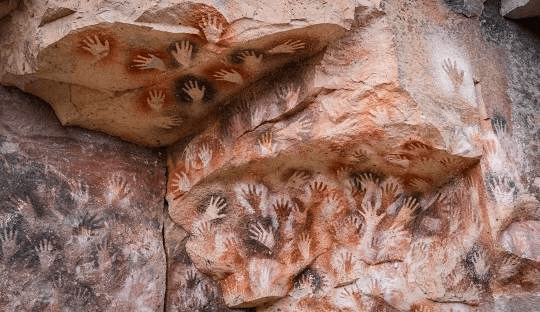
Ben-Arieh quotes Michael Rappengluck, who argues that humanity's interest in astronomy and gemstones is tied to the cave experience. Ancient people believed that stars and the moon, which disappear by morning, actually enter a network of underground caves, completing their cycle beneath the earth. They saw the subterranean world as a mirror image of the outer world. This belief led them to enter caves in synchronization with specific astronomical dates and from very particular angles where outside light penetrates the cave, illuminating a designated area. Their belief was reinforced by the discovery of sparkling crystals deep within the cave, resembling the stars, or the primordial matter. Those who entered the cave were exposed to this material, experienced it, and touched it, which is why we find evidence of people frequently touching the cave walls. The famous handprint murals bear witness to this.
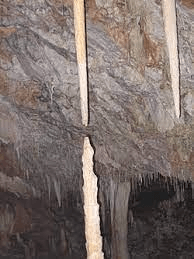
What is this primordial matter? It might be water. Sacred caves often contain a spring or dripping water, usually forming stalactites and stalagmites that symbolized breasts or a phallus. The joining of the stalactite and stalagmite represents the union of the feminine and masculine. The material might also be fire, which creates shadows. When these shadows reflect on cave walls, they evoke a duality of the soul, an "other self" that lives outside us, essentially reflecting us. People were not accustomed to seeing their own reflection, and their image seemed wondrous. A broken and distorted figure, as seen on a cave's irregular walls, was perceived as a portal to another dimension. Professor Barkai is expected to discuss another aspect of fire: how it consumes oxygen in the cave, triggering hypoxia, which induces altered consciousness. Perhaps this also relates to the air element. The earth element, as already noted, is embodied by the unusual and rare minerals found deep within the ground.
Entering a cave essentially fulfilled the archetype of the "World Cave," where entering meant transitioning between universes: from the external universe or upper world to the inner universe or underworld. This transition is a liminal space linking the three levels of the cosmos: the sky above, the earth, and the cave as the nether world. People sought this connection, associating it with birth – whether literal, as women came to caves specifically to give birth, or symbolic, as people entered caves to experience rebirth, initiation, transformation, and transition.
Finally, the cover of Ben-Arieh's book features an image of the entrance to the "Witch's Cave" in the Hilazon Stream, which will be central to Professor Lior Grossman's lecture (in three weeks, on Thursday). He describes the cave's entrance as aligned with a mountain where, between its twin peaks, the sun rises on a special day of the year, illuminating the cave's darkness, symbolizing the fertilization of the earth. The entrance is shaped like a vagina, and when sunlight penetrates, if one stands at the entrance facing outward, he claims it reveals the shape of a woman's head. These elements, in his view, prove the matriarchal worship of the Natufian culture.
הצטרפו לרשימת התפוצה שלנו
כתיבת תגובה