
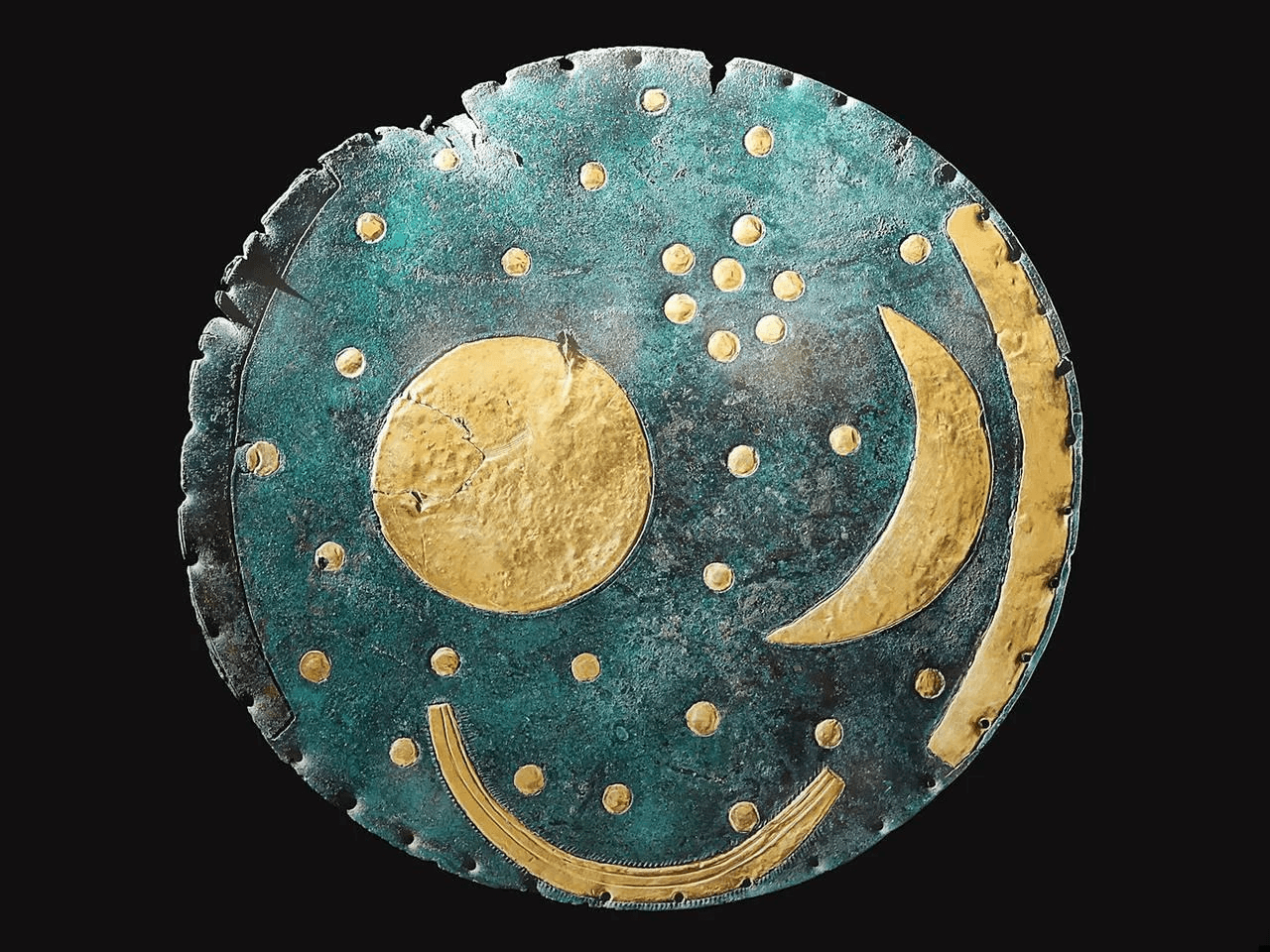
The Nebra Sky Disc is an archaeological artifact from the Early Bronze Age (approximately 3,600 years ago) discovered in Germany. The disc was unearthed in 1999 on Mittelberg Hill near the town of Nebra in Germany, alongside swords, axes, a chisel, and spiral bracelets. Measuring approximately 31 cm in diameter and just a few millimeters thick, the disc is adorned with gold inlays representing celestial bodies such as the sun, moon, and stars, including the cluster known as the Pleiades. The disc represents the earliest recorded depiction of the astronomical sky in human culture, reflecting the advanced astronomical knowledge of the Únětice culture, which flourished in Central Europe during that era.
A recent study published in Scientific Reports traces the manufacturing process of the disc, revealing a level of sophistication in its creation that challenges the notion that this culture was less advanced than the supposedly more “developed” civilizations of the known world at the time. The process involved a combination of casting, forging, and heat treatment—far more complex than the use of simple tools. This indicates exceptional technical expertise and advanced metallurgical knowledge. Unlike the functional artifacts found alongside it, the disc has no practical utility, yet its production required immense effort, suggesting it served cultural or spiritual purposes. The disc also demonstrates astronomical understanding, with some researchers proposing that it was used to create a calendar, while others argue it was a ritualistic object dedicated to celestial worship.
Whether or not the culture was advanced compared to others, the disc provides evidence of metallurgical ritual, implying that its creator was likely a “technological priest,” with the production of such an artifact holding religious significance.
Mythologies worldwide are filled with references to such technological priests. For example, Hephaestus forged Zeus’s thunderbolt and Achilles’ shield. Zeus, the god of the skies and ruler of the cosmic order, was specifically associated with the planet Jupiter. According to the Iliad (lines 18.478-608), the outer circle of Achilles’ shield depicted the heavens, the sea, the earth, the moon, and the stars.
In various ancient cultures, such as Mesopotamia and Egypt, metalworking was often linked to astronomical and astrological rituals. For instance, the seven planets were associated with seven metals: the sun with gold, the moon with silver, Venus with copper, and so forth. This analogy reinforced the sacred and cosmic significance of metallurgy in these societies.
הצטרפו לרשימת התפוצה שלנו
כתיבת תגובה