
Before we get excited about what Benny Shanon claimed regarding the use of the Syrian Rue as a mind-altering plant among the Bedouins in the desert—I want to calm things down a bit. James Mandaville from the University of Arizona published, a few years ago, the first comprehensive ethnobotanical study of plant use among Bedouins in northern Saudi Arabia. And yes, I know it’s a fallacy to draw conclusions between cultures thousands of kilometers apart just because both are Bedouins and both are in “Arabia,” but still, his conclusions cast doubt on the white shrub being a psychoactive plant.
First of all, he claims, “It seems that there are very few wild plants of narcotic or psychotropic reputation in our study area. A Bedouin from the Shammar tribe told me, however, about a plant called Harj, which he claimed is a low shrub with leaves like tobacco, growing in the area of Sakakah in northern Saudi Arabia and reported as a hallucinogen. He said that a man who ate some leaves in the past became insane and spoke like a madman. A woman who ate from the herbs ran around like a locust, riding an imaginary donkey, and shouted that so-and-so had had sex with her.” The Arabic name “Harj” is linked to a root meaning confusion or disorder. He suspects it might be the plant henbane (Hyoscyamus), called in Arabic “sakran” (“drunken”) and known as hallucinogenic.
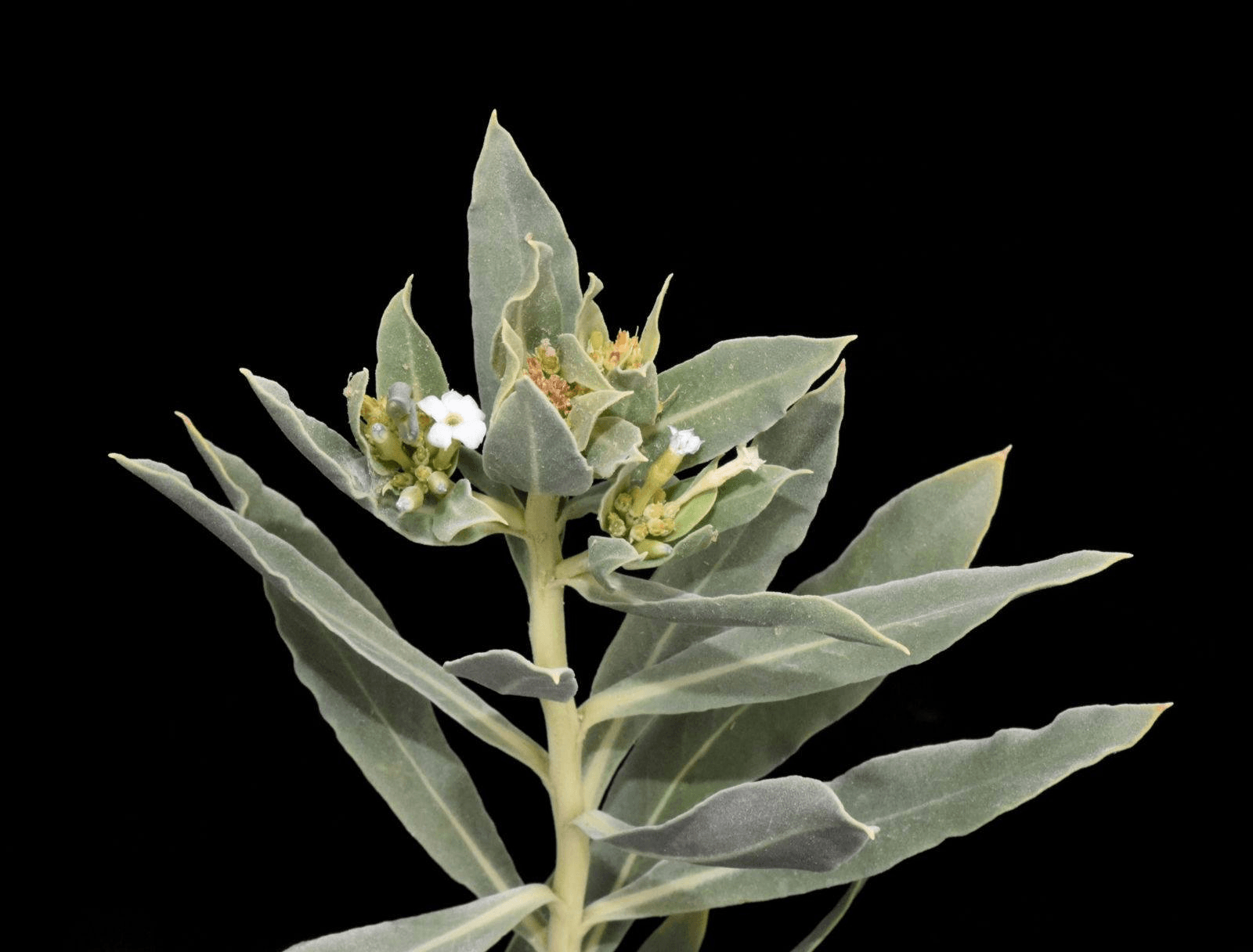
But secondly, and more importantly, it’s not even clear that “harmal” is Peganum harmala. In many places across the Arabian Peninsula, harmal is identified instead with the plant Rhazya stricta. It seems, he thinks, that in the desert the term “harmal” does not serve as a precise botanical identification but is more of an “umbrella term” for plants with similar folkloric uses in traditional medicine, primarily for treating pain and digestive problems. True, some also refer to the peganum as “harmal”, “but it is rare to see it growing in the study area.”
So much for dampening the excitement. And now perhaps I can revive the enthusiasm with the following twist: the etymology of the name harmal comes from Akkadian, where "anamiru" referred to a “medicinal plant used in rituals.” From Akkadian, the name rolled into Greek, becoming “armará” (ἀρμαρά), and later the flowing r sound shifted to an l. From there, the word returned into the Semitic languages, becoming “armal” and later “harmal.”
And we must be precise. Armalā in Aramaic means widow. This reminds us of two Baraitas: the first in Ketubot 65a, where it is told that one must not give too much wine to a woman, because the more intoxicated she gets, the more licentious she becomes. And it specifies, particularly when her husband is not with her—if she is given four cups, “even a donkey she desires in the marketplace and does not restrain herself”—a phrasing that slightly echoes the way the Bedouins described a woman under the influence of a hallucinogen. The second is in Sotah 22a, where it is told that a “wanton widow” causes the world to deteriorate, in the sense that she “changes the social order.” What does “wanton” mean here, and isn’t it clear that it has a negative connotation? Some interpret it as her going to her friends to gossip, but in most cases the sages hint at immodest behavior.
Rashi goes further and denounces her, linking her behavior with witchcraft: wantonness, he claims, means adulterous women and witches who show themselves as righteous so no one will investigate them. Later, he even provides a named example of such a widow-witch, Yohani bat Rativi, about whom Rashi says: “She was a widow and a witch, and when a woman was due to give birth, she would magically ‘close’ her womb. And after the woman suffered greatly, Yohani would say, ‘I will go and seek mercy, perhaps my prayer will be heard,’ and she would go and undo her spell, and the child would be born.”
From all this we can infer a few things: 1. A widow, in the absence of her husband, abstains from sex for too long and is just looking for an opportunity to “let loose.” And if this can be done via intoxicating drinks, then why not? 2. The witches of old were mainly those using medicinal herbs related to pregnancy and childbirth. And indeed, we know harmal in its form as the peganum harmala to be an abortifacient. What this widow, the armalā, did was use a plant called armal. With this poison she manipulated her patients into believing in her powers, and only when she was convinced they had “fallen under her spell” did she provide them with the antidote.
At this stage, I still haven’t decided whether we can trust claims that harmal is psychoactive, since the etymology and folklore hint that it might be, or whether we shouldn’t, because the name doesn’t always refer to a mind-altering substance or even to something used in women’s medicine…
הצטרפו לרשימת התפוצה שלנו
כתיבת תגובה