
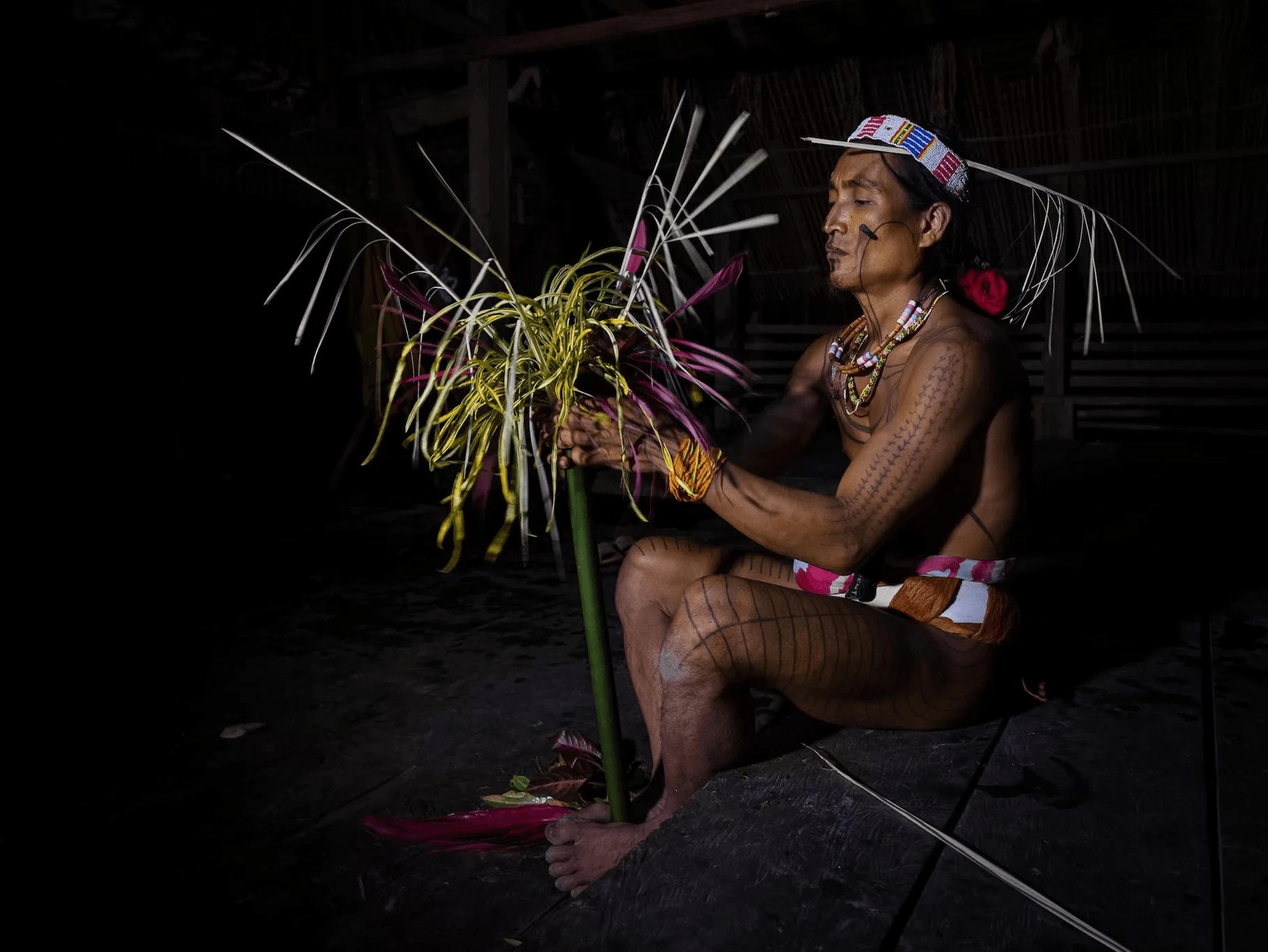
The Mentawai, an indigenous group numbering around 92,000 people, live in the Mentawai Islands, particularly on the island of Siberut off the coast of West Sumatra, Indonesia. For generations, they have practiced a complex belief system known as Arat Sabulungan, the “religion of the leaves.” The name reflects the central role of leaves and plants in rituals and ceremonies, where they serve as bridges between humans and the spirit world. According to Mentawai belief, the world is interwoven with souls (simagere). Every entity contains its own soul, which lives and acts alongside its physical body. These souls exist eternally, even after the body dies, roaming their realm while influencing and being influenced by the material world. The connection between body and soul is expressed in dreams, sensations, and moods, so maintaining a “happy soul” is a core principle of Mentawai life: good food, flowers, decorations, aesthetic appearance, and a relaxed lifestyle are seen as essential.
The world requires spiritual balance, and every action in the physical realm disrupts this equilibrium. Building a new house, hunting, giving birth—all require ongoing reconciliation with the souls to avoid revenge in the form of disease, misfortune, or disaster. Thus, each of these actions needs mediation with the spirits. This mediation is performed by shamans, called sikerei. The sikerei communicate through ritual mediators called gaut, which have special qualities enabling easy and effective contact with the spirit world. When using animals, especially pigs and chickens, the shamans read signs in their entrails. But most of the mediators come from plants—primarily leaves.
Leaves, physically, are the part of the plant responsible for interfacing with the external environment. The Mentawai, of course, could not describe this in botanical terms, but they intuitively understood that something inherent in leaves made them a “communication organ.” As animists, they defined this as a process moving the soul (simagere) and spiritual power (bajau), making the leaves living bridges between heaven and earth—reaching upward toward the sunlight and rain, yet also spreading sideways to cover and protect the ground.
The sikerei tie bundles of leaves, decorate their bodies with them, and prepare amulets, believing the leaf’s soul carries the message. They wear flower crowns, place feathers in their hair, and tie colorful leaves around their waists and heads. Their chests are bare, and tattoos cover much of their bodies—chest, arms, legs, and even their backs. These tattoos consist of complex geometric patterns, curved lines, and plant and animal motifs. They are considered a form of “spiritual armor” to ward off malevolent spirits. The tattoos are created using a traditional technique of needle pricking and plant-based dyes (such as charcoal mixed with oil).
For thousands of years, the sikerei were at the center of Mentawai society. Research suggests that the “religion of the leaves” dates back at least to the Bronze Age (1500–500 BCE). However, during the 20th century, this religion began to fade due to external pressures. Initially, Christian missionaries during the Dutch colonial period played a role, but after the Dutch left, it was the Indonesian authorities who took concrete steps against the indigenous religion. Viewing its traditions as obstacles to the “development” the government sought to promote, West Sumatra’s government outlawed the religion in 1954, giving the Mentawai three months to choose between Islam and Christianity, the only legal religions. The policy included forced relocations, bans on traditional ceremonies, the burning of ritual objects, and even prohibitions against growing long hair—a central symbol of identity. Many succumbed to religious and social pressures, but others fled to the interior forests of Siberut and continued practicing their ancient ceremonies in secret. Government officials avoided confronting these isolated communities, partly because their regions were rife with malaria. These communities survive to this day and are, in some way, attempting to revive their suppressed tradition. But this revival is fraught with difficulties, for the same reasons that countless indigenous cultures struggle to adapt in a world where their preservation remains fragile due to ongoing colonial damage, intergenerational ruptures, and the loss of spiritual environments.
Manvir Singh, an anthropologist from the University of California, Davis, explores this context in his new book Shamanism: The Timeless Religion. The book examines the Mentawai faith as a case study to illustrate what shamanism is, the role of shamans in society, and the place of consciousness-altering rituals within these practices. It also highlights how traditional shamanic societies grapple with modern external pressures: colonialism, competing religions, and especially tourism. Tourism itself complicates the preservation of traditional ceremonies, which are sometimes redesigned to meet foreigners’ expectations, detaching them from their original context—a phenomenon similar to what Bernd Brabec de Mori described among Amazonian tribes and their ayahuasca practices.
One notable aspect Singh describes about the sikerei is their ascetic lifestyle. The Mentawai divide people into two categories: the “uncooked” and the “cooked.” The metaphor refers to food processing. Ordinary people are called simata, because their souls are like raw, unprocessed food—not yet spiritually transformed. The sikerei, by contrast, are “self-cooked.” Their discipline includes strict dietary taboos, and metaphors around what might happen if they violate them often relate to unprocessed food. People who consume raw food risk infections and diseases, which could dull their senses. Similarly, if the sikerei consume forbidden foods, they may become spiritually contaminated, losing their special vision or even dying. Among their forbidden foods are eels, sole fish, certain monkeys, and they also abstain from sexual relations. Singh draws parallels to other indigenous groups with food taboos, like the Jiw in Colombia, the Ulithi in Micronesia, and the Yanomami in Venezuela. This could even offer insight into the strict dietary laws in Judaism, where non-kosher food is viewed as spiritually contaminating.
הצטרפו לרשימת התפוצה שלנו
כתיבת תגובה