
The lecture series by Dr. Uzi Avner, which has just concluded, “The Desert, the Origins of the People of Israel” (on the website meteg.co.il), in addition to defending the maximalist approach [which argues that the biblical narrative contains a historical core, even if it is not accurate and often fuses several historical kernels into one], also examines the various theories concerning the location of the biblical Mount Sinai. There are many approaches, most of them full of gaps. One approach, however, has fewer gaps, and therefore Avner tends to support it: Wadi Feiran, near Jebel Musa, the place where St. Catherine’s Monastery now stands.
The identification of the site is, admittedly, a Christian tradition, according to which Helena, the mother of Constantine the Great—the Roman emperor who made Christianity a state religion—made the identification. Some doubt her identifications, arguing they were accepted mainly due to hype and that they contain many legendary elements, such as the identification of the “True Cross.” And yet, Avner’s analysis makes a strong case for identifying this location specifically with Mount Sinai.
Israel’s Government Naming Committee in the 1950s identified the Wilderness of Paran with a location somewhere in the Arava, but in truth there is reason to believe it refers to Wadi Feiran in southern Sinai. According to surveys, Musa is a local hero of the dominant tribe in the region, and the tribes of the area still preserve traditions associated with him, even if they have undergone certain manipulations (to Christianity or to Islam).
Archaeological evidence from Nabataean churches that preserved pre-Nabataean traditions indicates that the name of God, “Ehyo” (i.e., Yahu/Yahweh), survived there at least until the third century CE. It appears in inscriptions at the site, and indeed across Sinai. It seems he was a regional god of desert tribes, especially the patron of metalworkers who were scattered at various sites in the area. Among these tribes were the “Shasu,” considered desert dwellers similar to today’s Bedouin. The Shasu were not Jews—in the sense of being descendants of the tribe of Judah, if such a tribe even existed—but nomads who, under various circumstances, wandered from place to place, sometimes far from settlements and sometimes near them. In the course of their wanderings, they formed covenants with farming communities on the desert margins, and their political standing brought them influence. This influence was mainly cultic, expressed most significantly in the notion that the deity should not have a figurative representation.
Avner showed in his lecture at “Temple of Consciousness” that representations of the deity were a later, urban development. In general, temples in populated areas that became pilgrimage sites were a late development. At first, they were located in the desert fringes, and people from the settled land would descend (or perhaps ascend) to the desert seasonally. The temples were monuments where fertility rituals were performed—perhaps monuments shaped like “feet” (i.e Regel) which Adam Zertal called “circles” (gilgalim), because they were arranged in the shape of a half-threshing floor or a complete threshing floor. Perhaps because these structures, which symbolized houses, were rounded, people would circle them ritually, perhaps in dances, and thus there is the connection between “feet” (raglayim) and "steps" (pe‘amim. also "times"). They would go up cyclically, from time to time, to perform the “dance of steps”, and each such pilgrimage was called a “pa'am”. Much speculation indeed.
Anyway, the standing stones at these early sanctuaries were non-figurative representations: unhewn stones, reflecting the desert perception that carved statues and images were inauthentic representations of the transcendent God. This conception was embedded in Judahite worship, which turned out to be a hybrid cult of “peasant” tribes on the desert fringe together with nomadic tribes who attached themselves to them. The Bible itself testifies that such tribes lived alongside the Israelites: the Kenites, the Kenizzites, and the Kadmonites.
Why were these treaties formed? Avner did not address this directly. Presumably, it was the result of a long process of desertification in the inner desert zones, which at an earlier stage had allowed habitation, but later forced tribes deeper into the land, leading to inevitable friction with the inhabitants of semi-arid zones where agriculture was possible. This friction sometimes manifested as conflicts between shepherds and farmers—reflected also in the Bible—but ultimately produced a hybrid culture. The nomadic tribes of southern Hebron became an ethnic entity identical with the farming tribes of the Judean hills. Other tribes that did not join this confederation were considered enemies, even if they lived in the same area: the Amalekites, Moabites, Ammonites, Edomites, and so on. Continuous conflicts with these tribes are also described in the Bible.
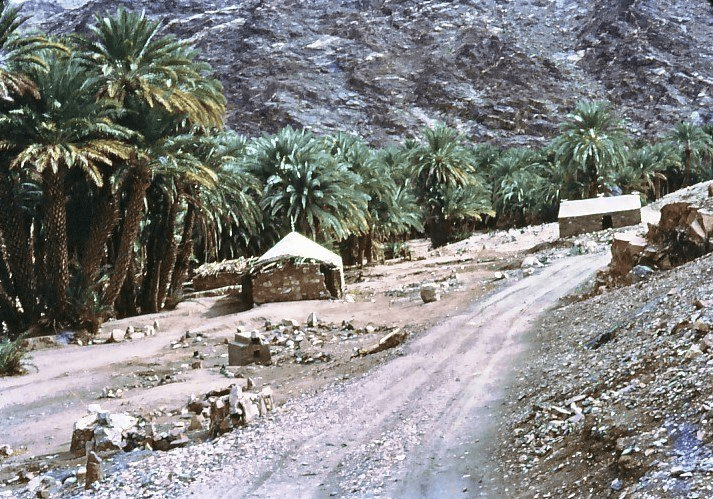
Wadi Feiran itself is an oasis lined with thousands of date palms. The area has numerous water springs, which allowed the existence of the palms, though today, due to over-pumping, little water remains. The course of the wadi leads to Jebel Musa, draining the high mountains of southern Sinai. Part of the local flora includes acacia trees, which were undoubtedly used for building (and also for the Tabernacle). Diodorus Siculus describes the ancient cult practiced there, which was already old in his day, and mentions “inscriptions in an unknown language” (probably Proto-Sinaitic script). The site is often identified with Rephidim, though many Israelite desert stations are described as places of springs and date groves—for example, the Waters of Marah, where they arrived after crossing the Sea of Reeds and not finding water for three days. Immediately after Moses made the bitter water drinkable (however it happened), they came to Elim: a place with twelve springs and seventy palms.
What happened next? Let us skip for a moment the station in the “Wilderness of Sin” where the manna began to fall, and move directly to Rephidim. There too the people lacked water, and there too, as at Marah, Moses performed magic and suddenly water appeared. And then: the Amalekites came to fight them. Why, and for what reason?
To this day, the tribe that lives in the Wadi Feiran region insists on its exclusive right to serve as guides in the area. The region cannot be crossed without a guide, and even if it could, they, as the only ones who know the terrain, demand that whoever passes pay them “protection” in the form of guidance fees. Anyone who tries to challenge this order finds himself fighting them. We know these groups today as the Islamist tribes engaged in drug trafficking, supporting the Sinai branch of ISIS. In reality, these tribes are less interested in Salafi Islam than in money and livelihoods. And in the desert, livelihood means mainly water and pasture—agriculture when possible, but often it is not. Any place where there is some greenery becomes a place to seize, and in the past century, when people speak of “green”, you know exactly what that means (drugs). In any case, the takeover of this oasis by these tribes is part of the story. The place became sacred precisely because it has water sources. The tribe that prevailed would control them and preserve the local traditions—not because those traditions benefited them greatly, but because ownership of a place also implies ownership of its myths. Throughout history we see many examples of this: Greeks who appropriated Indian or Egyptian myths, and so on.
This, then, is the reason the Amalekites fought the Israelites. The Amalekites were a kind of raiding group, and desert wars were primarily about the right to serve as guides for those who needed guidance. The fugitives from Egypt needed guides, and the Amalekites demanded that the payment they carried (recall, they left with much silver, gold, and garments) should go to them. In practice, it was the Kenites, the people of Jethro, who received this payment. The Amalekites did not like it. And in truth, even without the Kenites, the Amalekites regarded the Israelites as trespassers and claimed the right to plunder the property of anyone passing through, unless he paid them protection fees. This practice was called "racket": forcing someone to accept services for payment.
הצטרפו לרשימת התפוצה שלנו
כתיבת תגובה