
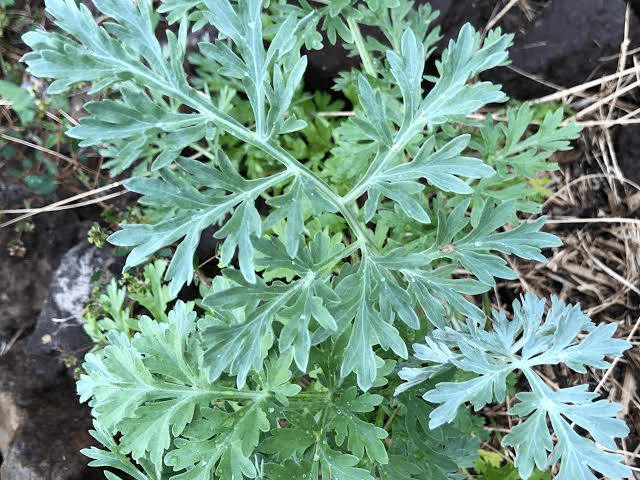
The historical association of wormwood is linked to various gynecological uses in ancient medicine. It was used to treat various menstrual problems such as dysmenorrhea and menstrual irregularities, including the absence of menstruation (amenorrhea), as well as aiding in childbirth and treating inflammations such as endometriosis. Therefore, this is also what gave it its name, artemisia, being a plant that provides medicine to women encountering menstruation for the first time. Artemis was the goddess who protected these women.
The additional association of women and fertility in particular, and of Artemis in general, with childbirth is rebirth. In various fertility rituals, it was customary to drink poison in order to induce intoxication and reach states between life and death, thus being reborn. Certain poisons were known as particularly intoxicating, and as such, wormwood and hemlock served as a nickname for poisonous seasoning herbs (hemlock) and intoxicating ones (wormwood) – according to Chaim Rabin (1976). Because of its bitter taste, and according to Persian, wormwood was called "especially bitter taste," absinthium, ἀψίνθιον. This bitter taste also later gave the wormwood, which is infused in water, the name absinth.
Wormwood contains a poison called thujone. Thujone is a terpenoid with antimicrobial activity that acts on the nervous system. If taken in moderate doses, it stimulates uterine activity as described above. On the other hand, if taken in excessive doses, it acts in an exaggerated manner on the nervous system to the point of abnormalities such as confusion, hallucinations, and of course, intoxication.
Obviously, the ancients did not know what thujone was, but in artemisia trees and specifically in juniper (or thuja) trees, there is a high concentration of thujone. Thujone is Greek for "Disinfection", θυία. During the offering of sacrifices, the Greeks would burn these trees whose smoke had a pleasant smell and is believed to be create a high. In this way, they would purify sanctuaries and drive away spirits. The tree sacred to Artemis is the cypress, the cousin of the juniper, but probably not for that reason. There is no evidence that the Greeks did not know how to distinguish between juniper and cypress, although it is tempting to think so. In Greek mythology, the cypress is associated with death and mourning, and therefore, they would plant it in cemeteries. However, there is a folk tradition that evil spirits dwell in cemeteries, so it is only logical that they would use the tree that drives away spirits. Moreover, the use of juniper and its products is known in Buddhism as a means of exorcising spirits. Juniper is considered a sacred tree in Tibet and is called Lha-shing Shukpa, it is usually planted to be a dwelling place for guardian deities.
Another thing common to juniper and wormwood. In Tibet, juniper is used to create wooden covers of Buddhist manuscripts called Lak-shing. Dioscorides reported that wormwood repels moths, so ink spiced with rue was commonly used to write texts so that moths would not eat the Papyri. In both cases, this material was used for the preservation of manuscripts, perhaps because of a side effect of thujone.
Notes:
"Uninvited Guests: Traditional Insect Repellents in Estonia used Against the Clothes Moth Tineola bisselliella, Human Flea Pulex irritons and Bedbug Cimex lectularius" by Renata Sõukand, Raivo Kalle and Ingvar Svanberg (2010) approves that both the juniper and the wormwood used for repels moths in Estonian folklore.
the tibetian juniper use info was taken from "Ethnobotany of Juniperus polycarpos C. Koch (Cupressaceae) in the Himalayan cold desert of Union Territory of Ladakh, India" by K Dorjeya & A K Mauryab (2019)
הצטרפו לרשימת התפוצה שלנו
כתיבת תגובה