
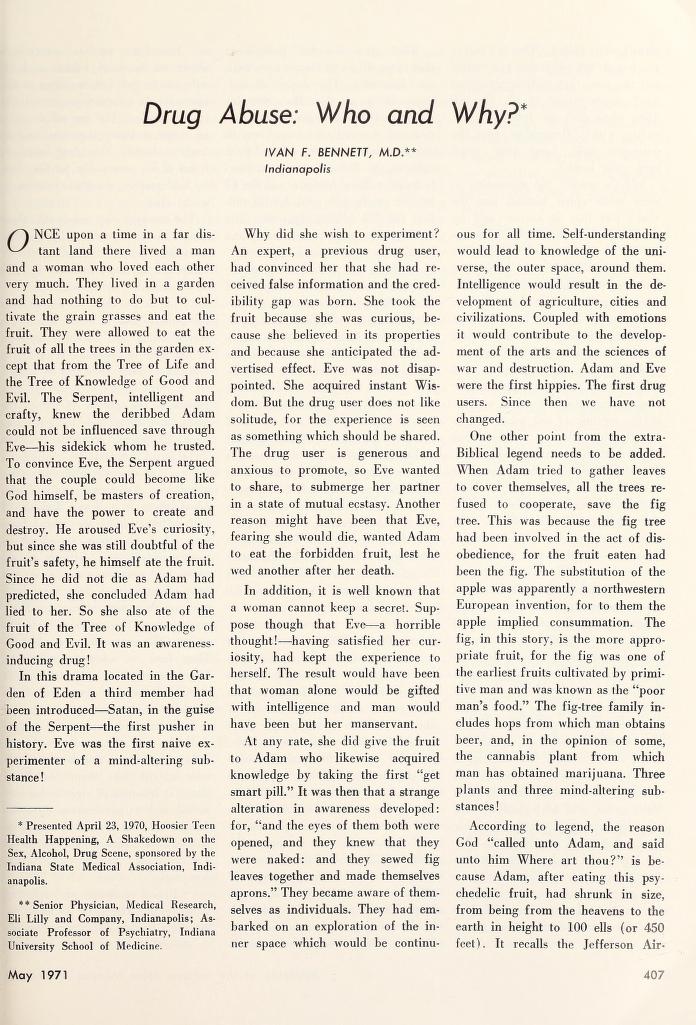
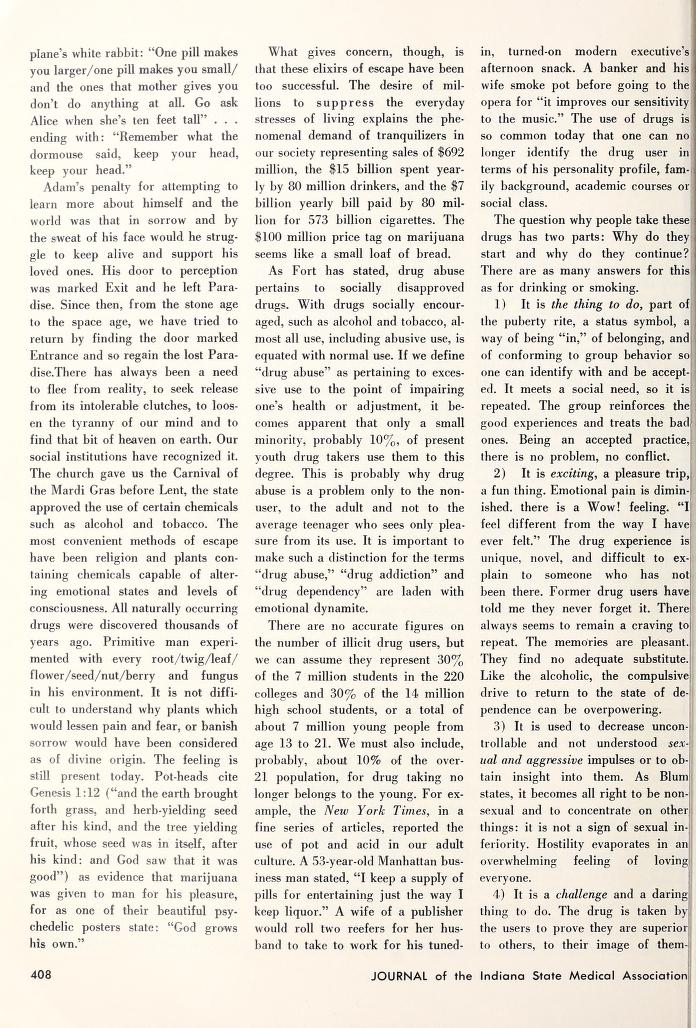
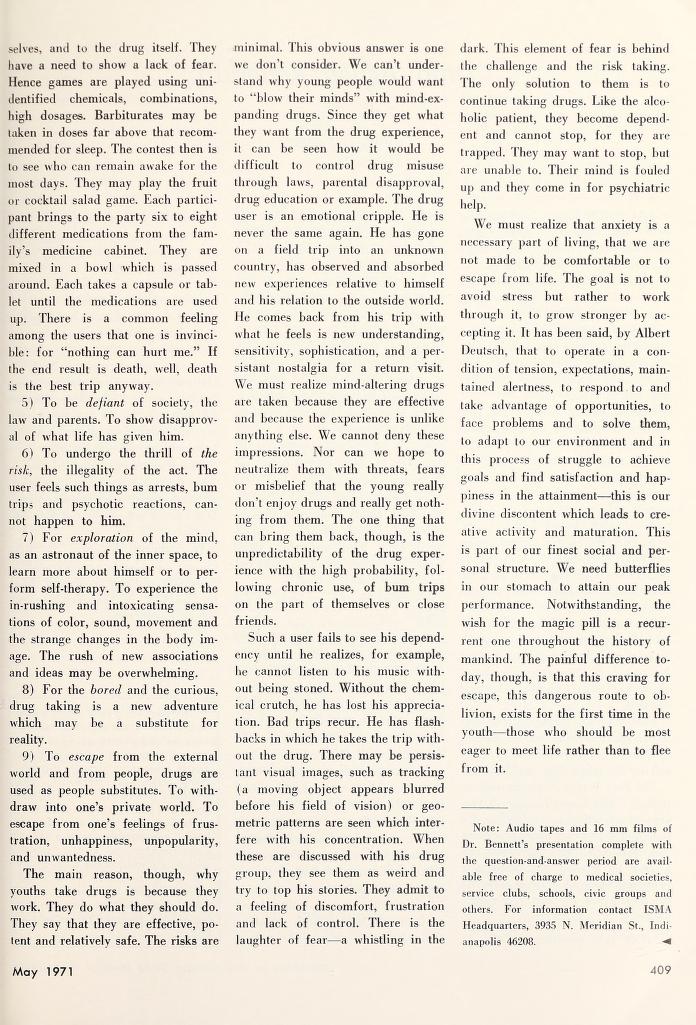
Ivan F. Benet, a physician from Indianapolis, published an article in the 64th issue of the Journal of the Indiana State Medical Association, the first issue of 1971 (between January and June). In this article, perhaps for the first time, he compares the story of original sin to the use of psychedelic drugs. He is not exactly in favor of drug use; rather, he argues that drug users are “emotionally crippled,” succumbing to boredom, curiosity, and their desire to escape the external world and the people around them. “Drugs serve as a substitute for people, allowing users to retreat into their private world and escape feelings of frustration, unhappiness, unpopularity, and rejection.” Users want to “express dissatisfaction with what life has given them” and are unable to set boundaries before their drug use turns into abuse—defined as excessive use to the point of harming one’s health or functioning.
Benet also attempts to downplay or perhaps exaggerate the scope of the issue, presenting statistics—10% of drug use cases lead to abuse. For him, consuming this forbidden fruit equates to original sin, a view typical of the period. However, the reason I came across this article was not because it is anti-drug; rather, the opposite: it is cited as an early source comparing drug use to the sin in the Garden of Eden. It is referenced in the context of the story of Enki and Ninhursag from Sumerian mythology. Scholars see this myth as a source for the story of the Garden of Eden, but in the Sumerian version, the context is broader.
In the Sumerian version, Enki, the god of wisdom, rapes his descendants, who are goddesses of vegetation and fertility. According to Thorkild Jacobsen’s interpretation, there is even a reference to reeds—whether bulrushes or some other kind of reed. Ultimately, the goddess of weaving is born. Raymond C. Van Leeuwen argues that weaving was a ritual act and refers to women’s roles in the temples of fertility goddesses. A similar reference can be found in the Bible. In Exodus 35, it states that “every wise-hearted woman spun with her hands and brought what she had spun.”
In another text, Enki and the World Order, there is a story where Inanna (or more precisely, “Gula”) complains to Ea (Enki) that she has not been given enough powers and responsibilities. She protests that she has been neglected compared to other goddesses. Enki tries to appease her by granting her additional powers and responsibilities, teaching her the secrets of weaving and the healing arts—practical herbalism, or as Jacobsen interprets it, the art of magic. In short: cannabis, which can serve both as fabric and as a medicinal or psychedelic drug. Indeed, Inanna, also known as Ishtar, is said to have had women weaving her kunnabu.
However, that is a separate matter. In the continuation of the story of Enki and Ninhursag, it is described that as a result of the rape of the goddess of weaving, the pains of childbirth were introduced—pains that did not exist before. Consequently, Ninhursag performed an abortion and planted the fetus in the ground, from which eight plants sprouted. Enki, hungry, ate them. Ninhursag became angry and cursed him so that each plant would harm a different part of his body. Enki then suffered in eight parts of his body. The gods sought to reconcile with Ninhursag, and she healed him and removed the curse. As a result, she created an “antidote,” or perhaps she created a healing goddess instead of a curse. Thus, eight different goddesses were born, one of whom is Ninkasi (“Goddess of Potions”), representing the healing related to Enki’s mouth—specifically, healing through the oral ingestion of medicinal herbs, such as beer or another psychedelic drink.
The article that draws the connection between the psychedelic interpretation of the Sumerian Garden of Eden narrative and Bennett’s article is by Ana María Russo from the University of Buenos Aires. It was published in early 2024 in the sixth issue of the journal Qeios.
הצטרפו לרשימת התפוצה שלנו
כתיבת תגובה