
Before I write about what I want to write, about kava/sakau, it is worth noting a confusion we are already aware of but continue to be confused by. In Hebrew, as well as in English, Spanish, and all the Western colonial languages and those that developed by borrowing from them, there is a constant confusion between pepper (Piper) and chili pepper (Capsicum). The reason is that before the discovery of America, Europeans only knew pepper, but once they encountered the chili pepper and saw that it too is pungent and somewhat reminiscent of pepper, and also much easier to import to Europe and market as “pepper,” it simply made sense to call it by the same name. The reason it was easier to import to Europe was of course because there were already working hands expert in cultivating it—the inhabitants of the Americas—and exploiting them was much cheaper than importing pepper the traditional way from Asia. Thus Capsicum, the “pepper” shaped like a box, from the nightshade family and cousin to the tomato and potato, took over European cuisine and replaced the Asian pepper, what we call “black pepper.”
And the story has yet another twist, because as chili peppers became widespread in “Latin” colonial territories, and as the Portuguese later controlled trade routes to India, when the English wanted pepper, they had no way, or it was very expensive. So what did they do? They marketed another pungent spice as “pepper” and called it “allspice” or “English pepper,” even though botanically it is neither one nor the other. In fact, its entire “pepperiness” is in its round shape. Its pungency comes from it being a blend of other spices. So there are three types of “peppers”: pepper (Piper), chili pepper (Capsicum), and a spice mix called allspice. But here we will deal with the true pepper, Piper. And in this case, a specific mutation widespread in the Pacific islands called Piper methysticum—that is, the intoxicating pepper.
One of these islands is called Pohnpei, and there this pepper is called sakau. But it’s important to note that this pepper is also called by other names and also revered in other places or at least used popularly. In Tonga it is called kava, in Fiji yaqona, in Samoa ʻava, and in Hawaii ʻawa. In Kosrae it is called seka, and in Vanuatu it is called malok. It all depends on which geographic area we are dealing with. In Polynesia it is called “kava,” and that is therefore the familiar name, but we will deal with Micronesia—this is the focus of the research I rely on, the sixth chapter in the book Ethnobotany of Pohnpei, edited by Michael Balick, published by the University of Hawaii Press in 2009—a chapter written by Balick himself together with Roberta Lee. The reason the island of Pohnpei is considered a place where the attitude toward sakau is more special than in other islands is, according to them, because on this island it functions as a “cultural keystone species,” a term borrowed from Nancy Turner’s research, taking a concept from ecology and transferring it into the cultural sphere. Instead of a plant having ecological value in a certain place, it has cultural value. That is, plants that are cultural keystones play a role in defining the identity and values of a particular culture. Turner built a “cultural significance index” that examines such plants’ roles: level of use, linguistic richness around them, presence in myths and rituals, stubborn persistence despite cultural changes, role in trade, etc. The plant meets all these criteria.
Speaking of cultural changes, the chapter itself, as well as other studies mentioning the plant, seek to trace how it underwent secularization—or more precisely, how exposure to the West eroded its religious significance. Thus it transformed from a plant used by kings and priests into a consumer item sold in plastic bottles and makeshift bars. Whereas once only men consumed it, now women also drink it, and of course people who do not belong to the traditional structure of the locals, meaning also members of ethnic groups who never traditionally drank sakau. Statistics show that the more urbanized a society is, the more secular the use of sakau becomes—to the point where, in the island’s capital Kolonia, 71% of people have consumed such a drink at least once. This is clearly a severe blow to the traditional fabric, and without entering into the question of whether this is good or not, the fact remains that they took the ritual and reshaped it, thereby proving its centrality in their culture.
Sakau is prepared as a drink by pounding the roots and squeezing them together with the inner bark of the hibiscus tree (Hibiscus tiliaceus). The drink has a slimy texture and a bitter taste. Incidentally, this is why it is called “kava,” since in Polynesian languages this word means “bitter.” In Pacific cultures generally, the plant is considered “a gift from the gods” or from the ancestors, and its consumption is a social ritual. It appears in countless anthropologically significant ceremonies, including weddings, reconciliations, coronations, etc. Its effects are psychotropic in the sense that it contains relaxing substances and is therefore common at events where tension is present, serving to dissipate it. The preparation of the drink itself is a ritual act, with clear rules and a hierarchy of serving, and at some point (along with the drinking) it became a central part of the political and religious life of Pacific culture.
The plant contains active compounds called kavalactones, which have calming, anxiolytic, anticonvulsant, and sedative effects. Its action begins with a tingling sensation in the tongue and lips, then comes general relaxation, inhibition release, good mood, and sociability. Later there is a feeling of deep fatigue, muscle weakness, and sometimes sleep. After locals were exposed to Western drinking culture, they had the option of using alcohol in the “social rituals” of sitting in bars. Yet they still prefer sakau, as it is considered cleaner and also non-intoxicating—at least not in the sense of alcoholic drunkenness, which is perceived as accompanied by a “hangover.” Those who wake up after drinking sakau rise refreshed.
I do not understand enough biochemistry and pharmacology to write knowledgeably about the action of the kavalactones. But generally, there are several actions that cause relaxation: inhibition of norepinephrine reuptake in the nervous system, some action on GABA A receptors reducing anxiety, and effects on sodium and calcium channels causing muscle relaxation. In any case, in traditional societies these mechanisms are meaningless since everything is perceived spiritually—they saw these properties as the transmission of “mana,” the spiritual power residing in the plant.
Sakau grows in the mountainous forests of the island, so harvesting the plant also involved the element of “going to the place of the gods.” Overharvesting caused depletion, and deforestation also damaged it, so today they grow it even outside the mountains, but traditional use was much more ritualistic. They would go to the mountains, harvest the plant mainly for its roots. It is an impressive plant reaching 5 meters tall, with stems up to 10 cm in diameter, and thus also highly developed roots, brown on the outside and yellowish inside. Sakau was not harvested before two or three years of age, and older plants were sometimes preserved for important events such as the coronation of a leader or reconciliation between clans.
When uprooting the plant, care is taken not to damage the roots—the sacred part. Clods of soil are removed using coconut husks, and sometimes the roots are washed in a nearby stream. All stems except one are removed, and the entire plant is brought intact to the ritual house, the nahs. The nahs is a traditional community structure, long and open, built of wood, on stilts, with a high thatched roof and a raised floor. It is located in the village center or at the home of the chief, the Nahnmwarki.
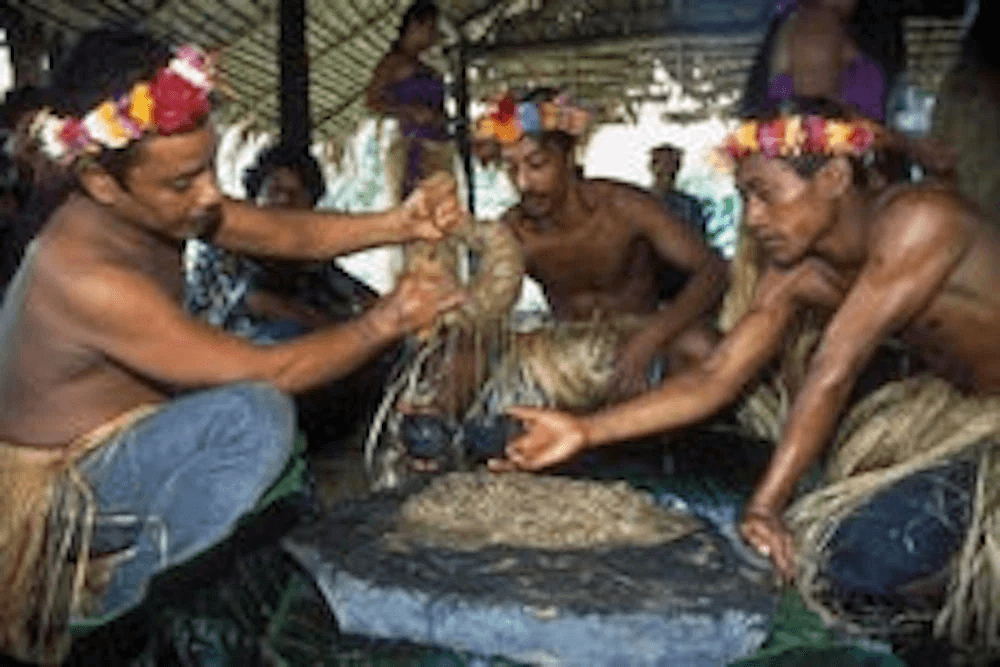
When carrying the plant, no one kneels or bows to the leaders, because sakau is “higher” than them in status. After cleaning, the roots are pounded on a flat basalt stone (peitehl) handed down from generation to generation, considered a being in itself—by the unique sound it produces during pounding, its qualities can be recognized. The basalt is covered with broad leaves of Alocasia macrorrhizos and placed on a base of coconut husks (today tires are sometimes used for this). This is the mortar; the pestle is a smaller stone called ketia or moahl. Striking it creates a distinctive sound, and all who hear it are invited to come participate in the ritual. The work is accompanied by the calls of the menindei (the ritual leader), who dictates the pounding rhythm and the order of serving cups. The end of the pounding is marked by the cry “Sokamah!”
After crushing, the mixture is squeezed using strips of inner hibiscus bark (Hibiscus tiliaceus) called keleu, adding a unique slimy texture to the drink. The squeezing is done with bare hands, in forward and backward twisting motions, over a coconut shell serving as a cup. The thick, dark brown, slimy liquid drips slowly—each drop considered sacred. Speaking of “mana”: not only the plant and its roots contain it, but all objects used in the ritual, including the hibiscus, the pounding stone, and of course the coconut shell cup from which the drink is sipped.
The first cup is offered to the Nahnmwarki or the highest-ranking figure in the nahs. The offering is made with the right hand, the other hand supporting underneath and the eyes lowered; the recipient holds the cup with both hands, closes their eyes, and sips slowly. Gradually, the noise around quiets, both ritually and because all are already becoming drowsy. Those who fall asleep remain to sleep inside the nahs.
In Pohnpei folklore there are several versions of the sakau’s origin, all emphasizing it as a gift from the heavens or a divine invention. The myths were passed down orally for generations and only recorded in writing in the 20th century, including in The Book of Luelen by Luelen Bernart, the first Micronesian native to write such accounts.
One version tells of an old blind man named Wideningahr. Wideningahr devoted his life to prayers to Loh, the tribal god Loh. When the old man became too weak to walk, the god descended from the heavens and extended his hand. At his touch, Wideningahr regained his strength and sight. The god took him on a journey across the island: they paddled in a canoe made from a banana leaf, stopped at various places, and at one, the god gave a piece of skin from Wideningahr’s heel to a local woman and instructed her to plant it in the earth. From that skin grew sakau. The woman learned that the drink made from it caused a floating sensation and altered state of consciousness. Later, other gods from the heavens stole a part of the plant and planted it in the “heavenly paradise,” but a root node fell to the earth in Pohnpei and the plant began to spread there. In another version, the journey was by means of a storm that carried Wideningahr (Loh is a thunder god), not before cleansing him from the mud that covered him.
Another story describes how the people of Pohnpei celebrated the “harvest festival” with sakau, adorned with traditional decorations, offering the divine fruit to their ancestors. The gods in the heavens, seeing the joy of the people, envied their right to use sakau and punished them: they caused sakau roots to fly into the air and scatter to other islands—Hawaii, Fiji, Vanuatu—thus explaining the plant’s spread throughout the Pacific. Later, a woman from Pohnpei visiting Kosrae managed to smuggle the plant back. While pounding sakau root, a small piece fell onto her body, and she concealed it on her return to the island. After planting the root in Pohnpei, it grew again, but retained a “scar” in the form of spots on the stems—a trait distinguishing the local variety.
As noted, all these practices were widespread before Christian colonialism. Since then, they have been adapted and changed, and it is worth viewing them within the framework of different expressions of intercultural encounter, including cargo cults. The encounter between the Micronesians’ religion and Christianity is also connected to sakau. In confession rituals and ceremonies where the community reconciles with God at Christmas and Easter, they use sakau, thus expressing local syncretism with the new form of their culture—another proof of the plant’s centrality and its being a “cultural keystone.” Its place was so central and strong that because the Church failed to prohibit sakau use, it synchronized it with its own rituals, just as pagan rituals were incorporated into Celtic and Germanic Christianity.
הצטרפו לרשימת התפוצה שלנו
כתיבת תגובה