
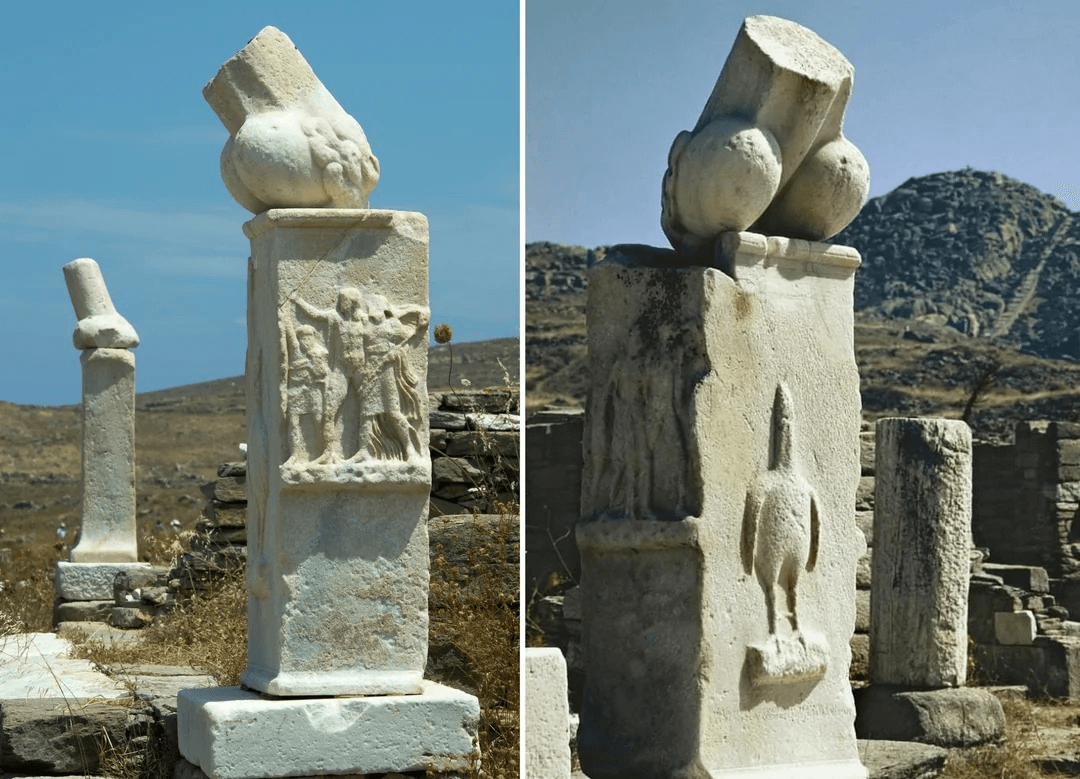
The Stoibedeion is an ancient monument on the island of Delos in Greece, dedicated to the fertility god Dionysus. The Stoibedeion consists of a rectangular platform on which stood a statue of Dionysus, flanked by two figures portraying the Papposilenoi—representations of Silenus, the mentor and tutor of Dionysus (Pappos = like "papa," father). Silenus is characterized as an old, hairy, bald figure with a large belly, flat nose, and donkey ears. Each of the Silenus figures holds a giant phallus, a male symbol of fertility carved in stone. The southern column features a central scene with a relief of a rooster, whose upper portion is elongated and also shaped like a phallus. On either side of the rooster-phallus are figures representing Dionysus and his divine entourage: a maenad, one of his frenzied female followers, and Pan, a half-human, half-goat satyr. An inscription on the southern column mentions the name Carystios, who around 300 BCE donated the column as a tribute to Dionysus and the ecstatic festivals in his honor. So, why is Dionysus associated with both fertility and intoxication? The answer likely lies in the fact that the substances used for intoxication were also used as aphrodisiacs. One of them, of course, is wine. Another example of an intoxicating aphrodisiac can be found in the Song of Songs, where the mandrakes (dudaim) are mentioned.
הצטרפו לרשימת התפוצה שלנו
כתיבת תגובה