
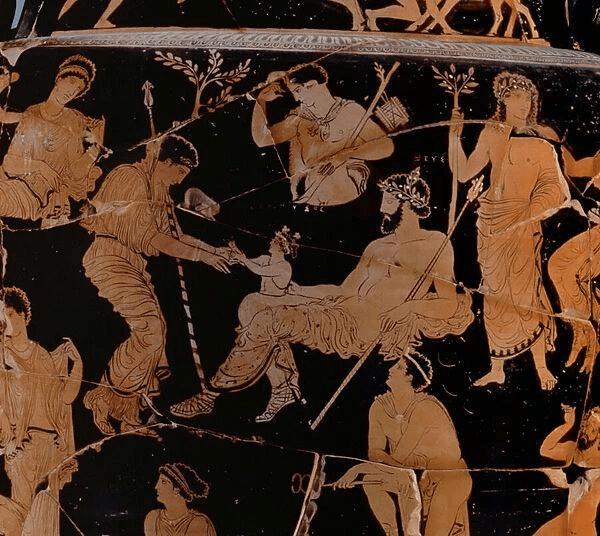
The meaning of the name Dionysus is the god from "Nysa". Erroneous etymologies associate the name Dionysus with "the twice-born", as well as with "limp of Zeus", to allude to the story of the birth of Dionysus.
The story goes like this: Zeus and Hera were married, but Zeus fell in love with all kinds of other women, and Hera who was jealous of him hated them and cursed them, or put obstacles in their way that ended up eliminating the threat from them, usually they died. This was also the case with the mother of Dionysus, Semele, daughter of the king of Thebes. Zeus fell in love with her and she got pregnant. Hera made Semele wishing to see Zeus in the form of lightning, in all his glory. This means death, and indeed a Semele died. Zeus managed to save her baby by uprooting him from her womb and putting it in his thigh.
Some time later Dionysus was born from the thigh of Zeus and therefore his name: "Dio Genissos" (δύο γέννησόσ), the one who was born twice, when the G is not pronounced. Nonus of Panopolis, a Christian Greek poet of the fifth century, wrote the work "Dionysica", in which he claims that in the Syracuse language "Nisus" is a limp on the thigh, a symbol of Zeus' limp while carrying Dionysus on his thigh, due to his weight.
What is Nissa? It is not clear. The philosopher Pherecydes of Syros claimed that this is an archaic Greek word for tree (nũsa), but the popular opinion was that it was a nymph of that name in whose hands Zeus entrusted the raising of his son and she raised him on a diet of honey in a place called Nysa, where he invented wine. A multitude of cities therefore claimed to be the birthplace of God, as was the city of Beit Shean in the Land of Israel. Coins were also found there in which the figure of Dionysus leaps from the right thigh of Zeus, similar to Eve born from the Adam rib. Pliny the Elder also says that Scythopolis, the name of Beit Shean at that time, was formerly Nysa and was named after the nurse of Dionysus, as she was buried there. The city was indeed a center of worship for Dionysus.
In the book "Land of Wine" by Oded Feingarsh and David Eitam (1988) it is stated that the city of Rafah was at the time another city where there was a center for the worship of Dionysus. Although the etymology of Rafah is unknown, it is of Egyptian origin. However, it is claimed in the book, and it should be noted that I did not find a reference for this on the Internet, that the etymology of the city is Greek. Rhaphe in Greek is a seam (ῥαφή), a connection between two parts of an organ or skin tissue, and the city is named after the seam that Zeus made in his thigh after putting Dionysus within it. The city of Rafah was called in Greek Ῥαφία and therefore in Latin Rhaphía.
Through these myths about Dionysus one can see a considerable similarity to the story of the creation of Eve in Genesis 2. The fact that the myth mentions a limp and a thigh, alludes both to the unclear "rib" that God took from Adam "and closed flesh under it", after all, this is the seam under the missing rib, and to Jacob's struggle with the angel, during which the angel touched his thigh and it was broken, and thus Jacob became "limp on his thigh", the same "Jacob's thigh" that his sons went down to Egypt from (Exodus 1). Thigh, by the way, is a clean word for the genital organ in the Bible, so there is a reasonable chance that when it is said that someone came out of someone else's thigh, it is simply a poetic way to say that it is his son. And then… Dionysus is the son of God. The next time you talk about the analogy between Christ and Dionysus, remember this.
PS It is not clear if the fact that Rebecca's nurse was called Deborah (i.e a bee) is related to the honey diet that Nysa gave to Dionysus. But the fact is that the Bible bothers to mention her burial immediately after entering the Land.
הצטרפו לרשימת התפוצה שלנו
כתיבת תגובה