
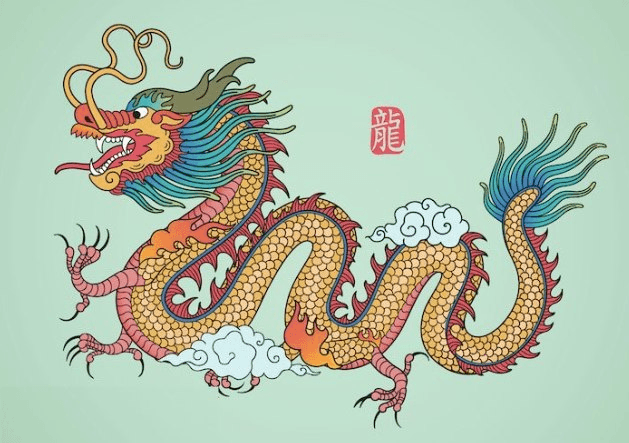
In my opinion, the origin of the myth about the war against the seven-headed dragon is the encounter between the Indo-Europeans and the Chinese, and the question of who is worthy of using psychedelics and what the appropriate result of using them is. The victory over the dragon and the war against it is, as mentioned, a description of the inner struggle within a person while using aids given to him by the gods to become like them. The question is whether it is worthy to become like them, to what extent is it worthy, and how much should one strive for it, who is capable, for what purpose, and when.
In "Western" cultures (meaning Indo-European and Semitic), in most cases, the one who fights the dragon-snake is ultimately the one who rises above all the gods, and for this victory, he sits on his throne. In most cases, it involves a miraculous weapon that he used, sometimes it's lightning, as he is a storm god, in other cases, it's a bow and arrow or another weapon unique to the war hero (or war god). The victory over the snake-dragon ultimately brings about cosmic order and removes the threat to its stability.
The snake symbolizes wisdom. The river also symbolizes knowledge and wisdom that came directly from the gods. The gods sit at the top of the mountain, on the snowy peaks. The snow melts and becomes the river's stream. Alternatively, the gods sit deep within the earth and spring fountains that, in turn, become lakes. The snakes sit at the mountain tops and guard the rivers, or alternatively, they sit deep in caves and guard the tree roots or those same springs that emerge from the earth's depths. In both cases, these are waters that threaten to flood the world, and what the snakes do is prevent them from doing so. They serve as the dam; they are essentially plugging the hole through which the stream passes, so the protection they provide is actually something positive. But on the other hand, it's also something negative because they block the person. This is probably the explanation for the attitude difference towards the dragon between the East (China, for example) and the West (Indo-Europeans). In the East, the dragon is a symbol of protection and luck.
The gods sit at the top of the mountain. Every culture has its mountain. Seven rivers flow from the mountain into seven seas that surround seven continents. The number seven repeats, as mentioned, because it symbolizes cosmology and astrology, spirituality, and the power of life in humans, in the chakras, and in the seven circles of consciousness. We will soon reach the point where, when talking about divine wisdom and abundance, we're essentially talking about consciousness. Usually, these guardians have many heads, likely because the head symbolizes authority and wisdom, which are essentially the same things; to lead, you need to be wise, and the head is the seat of thought. The guardians don't have to be snakes but rather monstrous, like Cerberus, who is a hound dog. You can liken the guardian's role to a door, which only those who have the key to it can pass through and approach eternity. The key is a magic spell or password, which is usually some mantra or just a eureka that breaks the thought pattern (in a positive sense). Whoever attains it manages to touch eternity. Eternity is where the gods reside, immortality. In other words, all this talk about rivers, snakes, and battling snakes is essentially a metaphor for an inner struggle in the human soul when consuming the elixir of immortality that can also kill him or drive him mad. We've already talked about this here several times.
Since we started with images from the Eastern world, let's illustrate this with Hindu myths. In India, there are two races of gods: the Devas and the Asuras. Among the Asuras exists a race of snakes called Nagas. A snake named Vasuki, who is the king of the Nagas, is said to have been used by the gods as a rope to churn the sea of milk and produce the Amrita, the elixir of immortality. During the churning, Vasuki emitted a strong poison that threatened the world, but Shiva drank the poison and saved the world, thus earning his famous blue neck. This is nothing but a chain around Shiva's neck. Shiva sits in a meditative pose at the river sources in the mountains, preventing them from flooding the world, using his hair as a dam. He allows only one stream of water to pass his body, the Ganges River. This dam also appears in another myth, in the Rig Veda. There, a snake named Vritra sits and blocks the river waters. Only Indra's victory over the snake, using his lightning weapon, saved the world and restored its vitality. Before Indra embarked on his mission, he drank Soma. Amrita (अमृत) is considered one of the synonyms for Soma, which is also made from milk. In one of the Hindu scriptures, the Vishnu Purana, the struggle between the Asuras (of whom the Nagas were part) and the Devas (of whom Indra was part) is described, regarding the right to use this elixir of immortality.
The question is who is worthy of possessing this power and what are the limitations of the power it grants to its holder. As mentioned, Indra's victory and appropriation of the Soma constitute the argument that man is worthy of adhering to the gods and using the tools given to him (or rather created for themselves, and he heroically managed to obtain them) to draw closer to them and become them. This idea that man should engage in spiritual work to become a god himself has seeped into all religions. If we define man's attempt to adhere to his deity and become endowed with divine qualities as a "Promethean effort," Western religions can be characterized as "Promethean". Prometheus was a figure who took the risk of bringing fire from the gods to man, representing man's effort to acquire divine knowledge and power. Eastern religions cannot be described in this way. In these religions, you do not aspire to become a "divine" person but rather strive to be a "human" person. Everything belongs to the domain defined for it; man must act according to his role and place. Therefore, the "dragon" is indeed worthy of admiration, but its role is mainly to guard the world against chaos, not to embody chaos itself when provoked.
By the way, the story of the river that flows out of Eden and splits into four heads in Genesis 2 is actually another version of the multi-headed serpent. A river is shaped like a serpent, and river branches sometimes look like a serpent's tongue. Although there are only four heads in the Bible, in Hinduism, there are seven rivers that flow from the mountains, bringing divine abundance and flowing into seven seas. Because of this, serpents are considered water monsters.
הצטרפו לרשימת התפוצה שלנו
כתיבת תגובה