
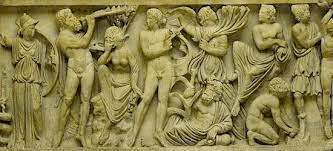
In the Mysteries of Eleusis there were actually two ceremonies: a great mystery in the fall and a small mystery in the spring. The Small Mystery was considered a preparation for the Great Mystery. In the Small Mystery they sowed the wheat field, and in the Great Mysteria they gathered the barley that grew there and brought them to Eleusis. Anyone could participate in the mystery, and the only requirement from the participants, beyond knowledge of the Greek language, was the price of the sacrifice (pig) and a salary for the guides plus the expenses of the stay in Athens. The great mystery was actually a pilgrimage to Eleusis, a 14km long procession along the holy road that leaves Athens and crosses a narrow and swampy land bridge. Usually on the banks of the marsh they were awaited by masked men (gephyrismoi, Γεφυρισμός) who stood and ritually mocked them. This bottleneck, passing through a narrow and swampy place in the atmosphere of humiliation, is considered symbolically as an entrance to a siege and a straitness and deliverance from them.
Months of learning and rituals preceded the revelation on the night of mystery, with every action planned in great detail. The process included study, ritual bathing in the sea, refraining from forbidden foods and various drinks, sacrificing pigs, and finally the march which included the dangerous crossing of the last part of the water before reaching the gates of Eleusis. At this point there was a big celebration that included dancing, theater shows, etc. Later there was another day of preparation that included purification and a fast that was only broken by drinking the kikaon in a hall called "Telesterion". Not much is known about this non-public part of the mystery, it appears that it was an ergot beer, but it is not relevant to our case what it was beyond the fact that it was considered a once in a lifetime experience, and a kind of rebirth.
In summary, the elements we find in the Mysteries are:
1. Long preparation that includes purification and fasting
2. Pilgrimage.
3. Offering sacrifices.
4. Crossing a source of water (or a water ritual)
5. A procession ending in a festival
6. A long and difficult road that ends in success and relief
7. The end is commemorated in a moment of spiritual and ritual climax
In Judaism:
In the Torah there are two holidays called Atzeret (assembly). The first is Shavuot, the second is Shmini Atzeret. The first closes the cycle of Pesach (7*7), the second closes the cycle of Sukkot (1*7). The symmetry between the holidays is also related to the fact that both have food taboos, sacrifice and rejoicing related to water. On the Sukkot holiday it is about Yom Kippur which is a kind of preparation for the Holy Week which is an event that marks the sacrifice of 70 bulls, during which there is the rejoicing of Beit Hashoevah and at the end of it "Atzeret", a celebration that lasts the whole eighth day. Shavuot is about not eating chametz on Pesach and the offering of a sacrifice, the Exodus from Egypt and the tearing of the Red Sea (which is observed on the seventh of Pesach) and ultimately the "congregation" which in itself is limited to the "three days of restriction" and at the end a celebration related to a large procession to the city of Jerusalem and the bringing of the first fruits.
We also see this series of events in the Exodus. Immediately after the exodus, the Israelites crossed the Red Sea, starved for food, and God gave them manna while forbidding them to gather it on Shabbat and ultimately commanding them to limit themselves 3 days before they receive the Torah on Shavuot. Also in the description of Joshua's entry into the land (which is based on the same literary structure of the Exodus and Mount Sinai) we see that at the same time as the Passover celebration, the Israelites passed through a dangerous water crossing (the Jordan), and immediately ate the grain of the land while the manna from the sky ceased.
Is this just a case?
Well, I'm teeding up. For those who have read the late Dan Merkur's book "The Mystery of the Manna". Also in Eleusis and according to Merkur also in Pesach, the worship was based on ergot
הצטרפו לרשימת התפוצה שלנו
כתיבת תגובה