
Linear A is the earliest known syllabic script, used in Minoan Crete. Linear B, which is composed of similar but phonetically different signs, was deciphered in the 1950s. However, Linear A has not yet been fully deciphered, partly because it was not written in any known language. While Linear B represents a language close to Greek—known as "Mycenaean"—Linear A was written in a language whose family is still unclear. Some scholars argue it was a Semitic language, perhaps a variation of Phoenician; others suggest it was Anatolian, that is, Indo-European.
In any case, what has been clear—based on numerical signs—is that the texts found so far were administrative records: inventories of goods, shipments, land ownership, offerings to gods, names of officials and settlements. Not religious texts. Or so it was believed—until now.
This month, the journal Ariadne, published by the University of Crete, featured an article claiming to have identified the longest Linear A inscription discovered to date, and also the first to represent a clearly ceremonial or ritual text from the golden age of Minoan civilization.
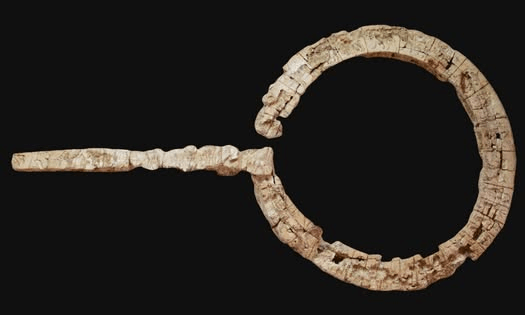
The inscription appears on an ivory ring with a handle, dated to the Neopalatial period (1700–1450 BCE), bearing a text of 119 signs that include depictions of animals, vessels, textiles, and hides—but no numbers. In contrast to most Linear A inscriptions, typically written on clay tablets for accounting purposes and containing numerals, the absence of numbers here suggests that this is not an administrative inscription but a ceremonial or religious text.
However, caution is advised, as it seems there are actually two inscriptions: one on the handle of the object appears to be a different text, including elements reminiscent of Cretan hieroglyphic script, and it does include some numbers. This could indicate that the scepter had dual usage, or perhaps was repurposed at some point. It may have originally served as an administrative tool, and only later been used in religious rituals—or vice versa.
Two facts suggest a later religious usage:
- The object was found in a location known as the "Ivory Deposit", where other ritual items, offerings, and bronze artifacts were also discovered.
- The quality of the engraving, recognized as "religious" in character, is especially refined, and the unique visual symbols are arranged within metopes (μετόπη, metope)—rectangular compartments that serve as discrete graphic units.
הצטרפו לרשימת התפוצה שלנו
כתיבת תגובה