
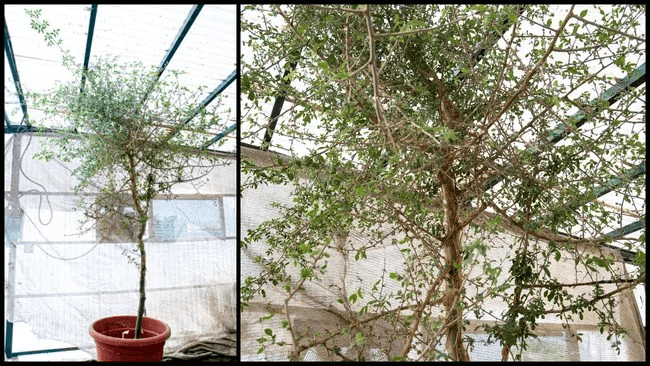
Israeli and international researchers successfully germinated a seed from the Commiphora species, found in a cave in the Judean Desert and dated between 993 and 1202 CE. They believe that the plant may be related to species mentioned in the Bible, likely the "tsori" or "Balm of Gilead," a resin historically used for medicinal purposes.
The Commiphora tree is closely related to frankincense and myrrh, from the family Burseraceae, which is known for its aromatic resins and ethnobotanical uses. The seed was discovered in a cave, and the researchers hypothesize that it may have been brought there by animals such as rodents or birds, or perhaps deliberately stored by humans. It is unclear whether the species was native to the region or imported from elsewhere. The researchers suggest it may have been locally traded or brought from afar in an attempt to renew the trade of valuable resin.
The researchers named the germinated plant "Sheba," a name they created for this particular specimen, though it is uncertain what it was called in the past. There is speculation that it could be connected to the biblical "tsori".
Dr. Sarah Sallon, who leads the research, is the director of the Louis Borick Natural Medicine Research Center at Hadassah Hospital. She is also part of a project to preserve natural plants in the Middle East, in collaboration with the Palestinian Authority and Jordan. She worked alongside Dr. Elaine Solowey, director of the Center for Sustainable Agriculture at the Arava Institute for Environmental Studies at Kibbutz Ketura. Solowey specializes in cultivating crops under challenging conditions and has worked on reviving other historically and agriculturally important plants in the region, such as the "Methuselah tree," a date palm germinated from a 2,000-year-old seed found at Masada in the 1970s.
הצטרפו לרשימת התפוצה שלנו
כתיבת תגובה