
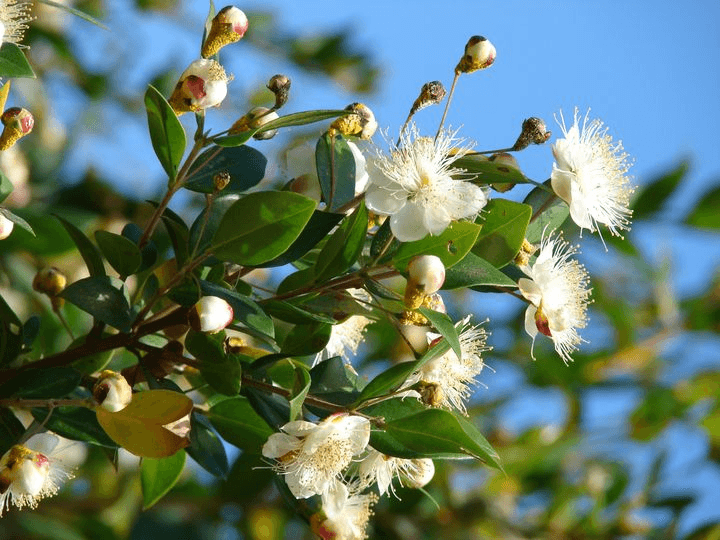
Purim Special: about the origins of the name Esther and the Persian connection, from the book "The Book of Esther Unmasked" by the Iranian linguist Dr. Thamar Eilam Gindin.
Esther is also called Hadassah (myrtle), or rather according to the boo of Esther 2:7 her original name was Hadassah, and her secondary name is Esther "Hadassa is Esther". In ancient Persian culture, smell had a special importance. According to Herodotus, when the news reached Susa that Xerxes had conquered Athens, the Persians were so happy that they filled the streets of the city with myrtle branches, burned incense, and of course held ceremonial feasts. Myrtle has a fine aroma due to the myrtle oil found in it. Even in the Sukkot's four species, the myrtle is considered a species that has no taste but has a smell. In the "second translation" of the Book of Esther, it is explained that Esther's name was Hadassah: "is symbols with the myrtle whose scent perfumes the world".
The flower itself was used in all cultures of the ancient world in rituals of life and death, and also after death: starting with a blessing on the myrtle at circumcision ritual and ending with placing the myrtle on the grave. The Jewish Sages claimed that the strong smell of the myrtle drives away the stench of hell (a very Iranian thought!), and in Yalkuy Shimoni it is written that "when a righteous person comes to heaven, they clothe him with eight garments of clouds of honor … and put eight myrtle in his hand … and put him in a place of water, surrounded by eight hundred kinds of roses and myrtle" (Genesis Rabah, paragraph 20). Isaiah 55:13 promises: "Under the nettle will grow a myrtle", and in tractate Megillah 10b they interpret: "Under the nettle – under Vashti. .. a myrtle will grow – this is Esther the righteous, called Hadassah".
The myrtle was associated with the goddesses of love and fertility. The statues of Venus were decorated with myrtle wreaths, and the women who worshiped her also flaunted with myrtle. The connection to fertility is also preserved in Judaism and the Babylonian Talmud, Shabbat 110a, It is said that "they used to bring myrtle and palm branches to rejoice the bride and groom". And of course Esther herself is named after the goddess of love and fertility. Babylonian indeed, but surprisingly Ishtar's name is strictly Persian. The E in the name Esther is a prosthetic Aleph, meaning an E that was added so that there would not be a bunch of consonants at the beginning of the word (invalid in hebrew). When it is ommited, a "ster" or "star" is left, in Old Persian stāra. This is a word common to all Indo-European languages, with r-l alternating among them: astro-, êtoile, stella, star, and in the Hittites language ḫaster.
הצטרפו לרשימת התפוצה שלנו
כתיבת תגובה