
Last week we read the portion of Teruma, one of the most entheogenic passages in the Bible due to the many mentions of the shittim trees and the shesh moshzar. The shittim trees are considered (by Benny Shanon & Co.) to be trees containing DMT, and the shesh moshzar is considered by John Kitto to be cannabis, according to the resemblance with the egyptian SMSMT.
It is important to note that the identification with the tree that we call acacia is only according to the Septuagint translation, and the Peshitta identifies the tree with the Buxus tree. The Gemara identifies it with the pine tree as one of the types of cedar trees, i.e. the coniferous trees. The midrash also identifies the trees that were used to build the tabernacle as "cedar" wood, and this is also what makes the temple one that was built from those trees. It should be noted as well that according to the verse "The beams of our houses are cedars, we furnished them with Brotim", the Buxus tree known as Barti (aramaic), is indeed a "cedar" tree, so cedar was as a generic name for the conifers. So that in fact it was only given with the translation of the Septuagint whose botanical reliability has already been proven several times to be questionable.
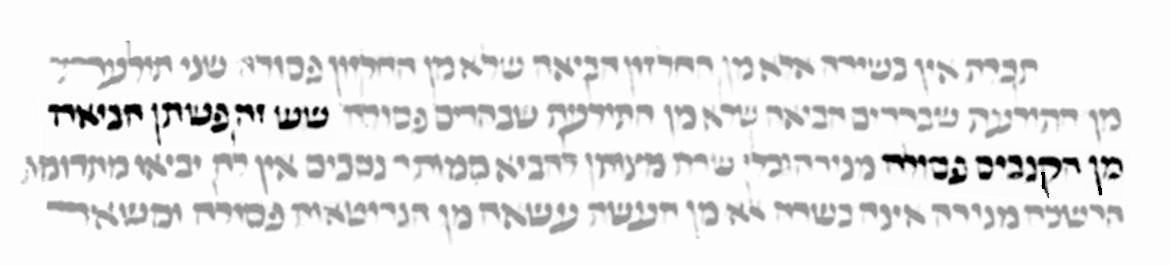
As for shesh moshzar, there is no clear answer. It is possible to contrast John Kitto's (very plausible) statement with the Tosefta in Menachot Tractate. In the more common edition of the Tosefta, in chapter 9 of Halachah 7, it is written "shesh is flax, and if you brought it from the 'nekevot' (females), that is forbidden". However, it turns out that in a Vienna manuscript from the 14th century it was written "shesh is flax, and if you brought from the cannabis, that is forbidden" (i.e the word is not "nekevot" but "cannnabis"), so supposedly already in the third century there was a tradition that the shesh was not cannabis, even though the sages clearly knew "canabus".
הצטרפו לרשימת התפוצה שלנו
כתיבת תגובה