
Technopheisis, as Dr. Nissim Amzallag discussed, I once defined as the way of using science as an entheogen, as a generator of religious experience, and essentially as a tool for spiritual elevation. But there is a very specific type of technology that demonstrates this technopheisis perfectly—the technology of language—and the way in which it is refined is through poetry. One of the strategies of poetry, which Dr. Amzallag claims was used as a true entheogen, is what he calls “The Song of the Enlightened” ("Maskil"). That is, the spiritual practice of the ancient poets to elevate themselves was to perform wordplay and compose poetry. Through this technological demonstration of language or through the linguistic innovations that emerge, the worship was expressed. This is what is called “Sing to the Lord a new song”. Language is essentially “a word”, "a logos", and through the word, God created the world. When refining the word, one employs the technique of creation, effectively entering the grand circle of “the creators”, becoming participants in creation. This act is equivalent to a sacrifice or prayer. Prayer is essentially a word spoken with enthusiasm, the very experience achieved through the art of the word.
The Song of the Enlightened is essentially a term for a specific type of song, which can be read in multiple ways: both in a synchronous manner and in a “transformed” manner. This involves applying a certain transformation to some of the lines—typically a shift of several verses, symmetry, or structural tricks—and as a result, the song gains an additional layer of meaning beyond its original. This layer often enriches the song but may sometimes even provide a deeper interpretation of it. Amzallag presents this technique of poetry as a mystical tool for serving God, as frequently described in the Bible in terms of song and melody. This is also the title of his book in which he argues these points, “Zamru Maskil” ("sing the song of the enlightment").
The reason it is called Maskil is, as mentioned, because it performs a “switch” (sikul), which Amzallag interprets as “a tying or connecting of things in a way incomprehensible to it”. It might be understood as “rearrange” or “swap”, but the idea is primarily that this process is simultaneously cumbersome and elegant. Through the awkwardness, an elegant and innovative solution emerges—a metaphor for death (awkwardness) and rebirth, which is also an upgrade and refinement of the previous version of life.
The elegant form of resolving the awkwardness is wisdom, and this essentially explains the etymology of the word “Sechel” (wisdom). A delightful wordplay is that by changing just one letter, the word reverses its meaning, and it’s not even a full letter—just a slight nuance. Sechel in its positive sense means wisdom, while Sachal in its negative sense means foolness.
And not only this “switching” of the word but also when swapping letters: Sechel implies a positive result, while Keshel implies a negative result. Alternatively, when the tongue shifts slightly forward from the Sin (i.e a light Shin) to the teeth, it forms Tikhl (associated with failure/Keshel or bereavement/Shchol). In both cases, the minor shift changes the meaning entirely.
The reason I mention the word Tikhl is twofold. Ultimately, I want to connect it to the Psalm Maskil in Psalm 74, which includes the verses: “You shattered the sea with Your might; You broke the heads of the sea monsters in the waters”, which I believe references the myth of the primordial war between the god and the sea monsters, and the act of crushing snail shells in the production of the tyrian purple and blue dyes. This is particularly because “Porarta” (crushed) is a homograph and homophone of the word “Porphyry”, meaning purple. According to Michael Astour, parur means cauldron, referring to a dark color between red and black, as in the verse, “Before Him nations writhe, all faces turn red”—their faces “redden”. Red, in ancient language, was one of the terms for the color purple. In my view, this is the interpretation of the word techelet, from the word tikhl. But I wish to discuss this in another post.
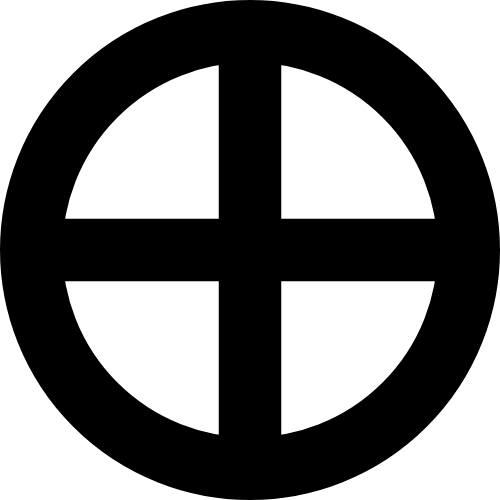
For now, I want to focus on what is called “the solar cross”, and primarily on the symbol of the cross, which in ancient Hebrew script, and even in its earliest form, the Proto-Sinaitic script, symbolized the letter Tav. It is often explained that the “sign” (Tav) described in the New Testament is a cross marked on the forehead, similar to the way slaves were branded in ancient times. That is, this cross is simply a “mark” or “sign”. But just as the other letters represent the first motion of the word they symbolize, it can be said that this cross representing the letter Tav is the first letter in the word Tikhl or Sechel. In other words, the meaning of the letter is this switching, the blending of things, the awkwardness that culminates in wisdom. That is, the last letter in the script system, symbolizing the end—literally—is like the “Omega Point”, a kind of goal to be reached: wisdom. This is the meaning of the solar cross in Gnosticism. The Gnostic cross serves in Gnostic sects as a symbol of secret knowledge.
In the story of the Tower of Babel, God says, “Let us go down and confuse their language, so that they will not understand one another’s speech”. Through the confusion of language, God, ostensibly, caused people not to understand each other’s language. The question is whether the sole meaning of this is that He made them unable to understand one another’s language—or perhaps the intent was to encrypt the language, and the misunderstanding was, in fact, a form of foolishness. Specifically, those who manage to bring order to words are the ones who understand. Poets achieve this through the mixing of words. It is precisely through this blending that they achieve the opposite effect: the antidote to confusion. Poets are the revivers of language because they use “The Song of the Enlightened”.
Particularly fascinating are the letter rearrangements and wordplays used in the story of the Tower of Babel. What the people say to one another is, “Come, let us make bricks and bake them thoroughly”, using the words "Nilbena levenim", The bricks become a substitute for stones ("Levena le'aven"), and the clay serves as mortar. What God does to them is confuse their language using the verb “Navlah” (“confuse”). Here, we see a rearrangement of letters, where changing the order of the letters transforms the meaning of the word. Lavan (white) refers to the color of light, while the burning in fire, through “whitening with light” ("Libun", "Nilbena") results in blackness. Naval, at least according to the Book of Proverbs, refers to a fool—“A foolish child is a grief to his father, and a foolish man does not rejoice his parent”, while proverbs is using the hebrew word of "Naval" and "Ksil". Its opposite is therefore the enlightened "Maskil", the righteous, the wise, who hold onto light ("Or"while fire is "Ur"). As Proverbs states: “The light of the righteous rejoices, but the lamp of the wicked will be extinguished. Pride breeds quarrels, but wisdom is found in those who take advice.” The righteous hold onto light and offer wise counsel, while the wicked’s light dims because they offer malicious counsel.
The process of transmitting knowledge, discovering it, and holding onto it are all etymologically linked to the root “or” (light). Knowledge itself is called “Torah” (instruction), its transmission is called “hora’ah” (teaching), and its possession and use are called “or” (light). As stated in the verse: “For the law ('torah') will go out from me, my justice will be a light ('or') to the nations”, and “The commandment is a lamp, the Torah is light, and reproofs of discipline are the way to life”.
In religious thought, the sun symbolizes the source of life, creation, and wisdom. Immediate examples include Ra in Egyptian mythology and Apollo in Greek mythology, who specifically was both a musician and a prophet. Apollo led the Muses, who were patrons of music, poetry, and dance. As we see in the Bible, too, the sun is a source of wisdom.
The sun brings two energies: light and heat, both of which are associated with wisdom. Amzallag attempts to channel this fact by pointing out that through heating with fire, also called “ur” (light), metals can be inflated and forged. He attributes the wisdom of metalworking to the Edomites, among whom we find the names Korach and Zerah—musicians (the Levites, sons of Korach) and poets (the descendants of Zerah) in the Temple. At the center of the Temple stood the fire altar, with its eternal flame, and the menorah, with its perpetual light. The altar was made of metal (bronze), and the menorah was made of metal (gold). There is also a golden altar. The differences between the metals depend on their placement in the Temple.

Regarding light: refracted light is characterized by a sparkle that appears in perpendicular rays. This depends on the surface shape of the material, the angle of observation, and, of course, exposure to light. Specifically, metallic materials have a natural shine and light reflection, so when light strikes them, it refracts and appears like the shape of a solar cross. This is another reason why this symbol of breaking the order is associated with light and the sun.
The menorah is essentially a “small sun” as it is a source of light. The Bible as a whole is a metaphor for acquiring Gnostic knowledge, a sort of “myth of wisdom” that tries to explain metaphorically that the entire world is a blurred image. To understand what is truly seen, one needs “special glasses,” or that the world is a dark room that requires a special lamp to navigate. Therefore, it was important to provide the target audience of the Scriptures, those who read them and use them for elevation (an entheogen in itself, especially when in poetic form), with imagery of light.
In biblical poetry (and prose), there are psalms constructed with artistic structures. In some cases, there are chiastic parallels. In others, there is a symmetrical structure with seven verses: three pairs of parallel verses surrounding a central verse, known as a “menorah” structure. Sometimes these pairs themselves are chiastic, creating perfect symmetry. Sometimes this menorah structure consists not of seven verses but a multiple of seven—such as 15 (7 + 7 + 1). The important point is that we see numerological and symmetrical structures around the number 7, combining poetry, linguistic tricks, and specific contexts tied to the myth I describe. It aligns with the idea that extensive parts of this mythic narrative are organized in what is called “menorah structure”, including the creation of man, the sin with the Tree of Knowledge, the story of building the Temple in the Book of Kings, and so on. The Book of Psalms itself includes several “Maskil” psalms constructed as menorahs, which were likely used in their chanted reading, as call and response, accompanied by music and dance as a technique for spiritual elevation.
At this point, I return to the wordplay appearing in the context of the Tower of Babel. The poetry was accompanied by music played on an instrument called the "nevel", which rested on the “kislayim”, meaning on their hips and waists. Thus, the wordplay extends to the scenery of the entheogenic scenario of poetry—not only within the poetry itself or its essence.
As a side note regarding the “Sun Cross” symbol and its connection to wisdom through practical technology—specifically metallurgy in ancient times—one might mention Robert Graves’ theory that the Cyclopes were a guild of Bronze Age smiths. According to Graves, their defining feature was a tattoo of a ring or circle on their foreheads, and they worshiped the sun as the source of life energy.
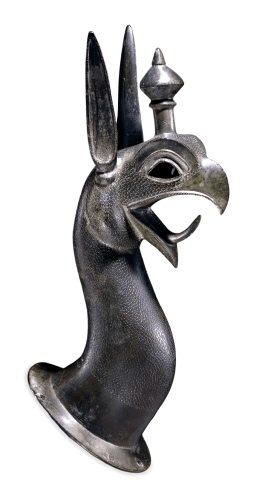
In Nissim Amzallag’s book The Copper Revolution, there is a reference to Claude Frédéric Armand Schaeffer’s work Ugaritica II. Schaeffer, who led the excavation team at Ugarit, describes a depiction of a smith with a symbol resembling the Sun Cross on his head. Unfortunately, I have not been able to access the book myself, but Amzallag claims this depiction exists. Amzallag further suggests that the “Mark of Cain” was essentially a tattoo of the Sun Cross. He also asserts that a protome of a griffin adorned with a copper sphere on its forehead, displayed in the British Museum, inspired the practices of the Telchines of Rhodes. The Telchines, according to him, were another guild of smiths identified by a copper ball strapped to their heads with bands. Does this remind you of tefillin?
In the Egyptian context, we have the Eye of Horus, the Wedjat, considered a symbol of wisdom and protection (similar to the Mark of Cain, and in a different way, tefillin or the High Priest’s frontlet—a form of apotropaic symbolism). The Eye was associated with the Sun God and depicted as a symbol with a curved adornment beneath it, said to represent a falcon’s feather. Why a falcon? Because birds of prey possess extraordinary long-distance vision, and some are nocturnal predators capable of seeing in the dark. Hence, the owl became the symbol of Athena, patron of smiths. Similarly, Amzallag argues that the Edomite deity (whose nature as a deity remains uncertain) was called Kos, a name linked to the owl, the bird also associated with Athena.
Although the owl has a round pupil, its nocturnal vision captured the ancients’ imagination. This ability allowed such creatures to utilize the property of sunlight—vision—even in the absence of the sun. Animals with night vision often have uniquely shaped pupils, like the slit-shaped pupils of felines and, interestingly, snakes—an animal with clear metallurgical associations.
Thus, one could draw a parallel between the Sun Cross and this distinctive pupil shape, functioning as an aperture or diaphragm.
הצטרפו לרשימת התפוצה שלנו
כתיבת תגובה