
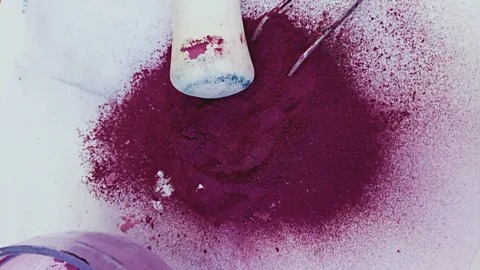
Tyrian Purple is an ancient and unique dye derived from the secretion of snail glands. The production of this dye, which symbolized wealth and high status in the ancient world, involves a series of delicate chemical processes that require great timing and precision. If not done correctly, the desired product may not be obtained. In modern terms, one could say that the producers of the pigment must be experts in organic chemistry, but the ancients did not know what that was; they approached the production process with religious awe, as that was their understanding. And it is likely that if this process had side effects, originating from "poisonings" or absorption of byproducts released during the process, they would have attributed them to spirits and demons or divine punishments.
The question is twofold: First of all, of course, this is what we, as natural psychonauts, are looking for—the thing that can go awry or occur by accident, and be interpreted as the work of hidden spiritual forces. And of course, what might cause such a disruption. I apologize in advance for this being speculative, for the simple reason that industrial production of this substance has not existed for over 1,400 years, and generally, since this dye was "banned" and allowed for royal use only, the professional knowledge became secretive. In any case, no one would really tell what happened during the continuous production of the substance and what happens to the people working with it for years. So, one can only speculate and come up with fantastic hypotheses, which stem solely from common sense or chemical ignorance.
The answer is bromine. During the dye's production process, when the mollusks are crushed and their secretion, from which the substance can be produced, is extracted, a chemical substance containing bromine is obtained. In fact, the difference between plant-based indigo (the purple dye) and its animal counterpart is bromine, and it may also be the component that makes the produced dye so durable. During oxidation, reduction, dissolving, heating, and all the other chemical processes involved in the production of the dye, there is a risk that bromine will be released into the air or found in liquids. Exposure to bromine, especially in its acidic or oxidative form, can be dangerous and lead to bromine poisoning.
Bromine poisoning, or "bromism," is primarily caused by prolonged consumption of bromide compounds or exposure to high doses of bromine. Bromine can be absorbed through inhalation, causing severe respiratory problems, but also through contact—whether direct or through vapors. Exposure to bromine can lead to various neurological symptoms, including psychotropic effects and even psychoactive effects. In other words, it can cause not only confusion and loss of coordination or mood disturbances but also psychosis and hallucinations—altered perceptions of reality.
Again, it should be noted that this is speculative, but possible. Bromine can primarily enter through the respiratory system, but absorption through the skin is not excluded, and direct contact with bromine compounds can lead to signs of poisoning. All of this raises the question of whether the dye, the production of which involves working with dangerous substances, was considered sacred specifically because of the bromine poisoning risk involved in its production. Did bromine also pass through contact after the dye was made, and did those who wore Tyrian Purple garments risk poisoning if they wore them over time? Did the ancient testers intentionally risk themselves to induce psychotropic effects, which they thought would only be positive? If we assume they did this with heavy metals like lead and mercury, why not with other substances that, in some way, they discovered had mental effects?
A material for further investigation.
הצטרפו לרשימת התפוצה שלנו
כתיבת תגובה