
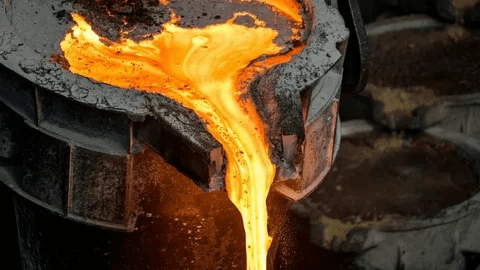
I am currently reading the book "The Copper Revolution" by Nissim Amzallag. It's one of the best and most mind-blowing books I've read. In short, the book argues that the origins of religion lie in humanity's amazement at natural phenomena of heat and wind. Through this form of observation, ancient chemistry was born, enabling humans to exploit natural resources, essentially earth and rock, to extract materials for toolmaking and building. Thus, the art of blacksmithing, forging, and smelting was discovered—the idea that a certain process can change the material and its form, mostly through heat, but not exclusively. The essence that constitutes the material without form or form without the material was defined as God, and the methods to achieve, extract, and interact with it were considered divine experiences.
The professional terminology of these arts became the etymological foundation of all things related to religion—from Cain (קין), in the sense of the art of smelting, giving rise to words like acquisition (קניין), zeal (קנאות), and violin (כינור). Through the word Melech (מלך), meaning the remains of melted material left at the bottom of the furnace (Amzallag calls this "furnace residue", derived from the round shape formed upon collision with the floor), which gave rise to words like monarchy (מלוכה), angel (מלאך) in the sense of a messenger, and craft (מלאכה). And finally, nesekh (נסך), meaning the smelting and casting of metal, gave rise to words like prince (נסיך), miracle (נס), and snake (נחש). A snake, for example, is the trail of molten metal solidifying in its free path. Moses' staff was supposedly a shapeless copper ingot when it touched the hot coals, turning into a snake when the molten metal moved slightly away from the fire.
As part of the explanation of the spread of religions through the idea of metallurgy, an explanation is provided on the Indian religion, which developed from a supposed conflict between the Indo-European Aryans and the local culture known from Sumerian sources as Meluhha, a supplier of copper and tin. It seems that entities described in the Mahabharata epic (whose names also signify words for snake and copper, such as नाग, Naga, hybrid serpent-like creatures, with one of their kings called नहुष Nahusha, son of Ayus, the Indo-European word for metal—compare Aes in Latin) reflect this conflict, which likely wasn't a physical war, as there are no archaeological evidences of a violent and sudden disappearance of the Indus Valley culture, but rather a change in the nature and purpose of soma. Here lies the great surprise: the method of preparing soma and its essence, Amzallag argues, is a symbolic resemblance to the copper extraction process. Starting from its pressing, done as metal is pressed in forging, through the fact that the preparation process resembles the metal purification process in Indian alchemy, and concluding with the plant extraction by crushing, transitioning from solid to liquid state, mimicking the creation of molten metal in the smith’s furnace, allowing shape transformation and essentially making the metal eternal (permanently recyclable).
הצטרפו לרשימת התפוצה שלנו
כתיבת תגובה