
In Hindu mythology, there is a central myth describing the search for the nectar of immortality, Amrita. This nectar is what the gods seek and rely upon for sustenance. By drinking it, they gain access to supreme knowledge. Following a curse placed upon Indra, the king of the gods, the Devas (the benevolent beings) lost their power and needed the production of Amrita to regain it. With no other choice, the god Vishnu advised them to collaborate with their enemies, the Asuras (the malevolent beings), in a joint effort to produce the nectar. The raw materials came from the cosmic ocean, particularly a part of it known as the Ocean of Milk. To produce Amrita, the milk needed to be churned, a process akin to shaking the milk forcefully to separate the fatty layer from the liquid, symbolizing an earthquake-like event.
The cosmic ocean is Vishnu’s dwelling place. From this cosmic ocean, the Ganges River descends; it is said that the Ganges originates from Vishnu’s sweat. Vishnu lies on the serpent Shesha in a Yoga Nidra pose, dreaming of the world. The world, as described, is Vishnu’s dream. Shesha has multiple heads that form a canopy over Vishnu. Above this canopy lies the world itself. Shesha exists in a state of apneic existence—a state where he practices Pranayama (breath control) and does not breathe. By mastering this, he controls his soul, life energy, and Prana. Those who succeed in not breathing achieve liberation from the body and spiritual release. Vishnu is considered a master of Pranayama, and with every breath he takes, he creates the world. Since we live in a single existence, it is understood as if the world was created only once, and thus Vishnu is perceived as not breathing. When Shesha loses his yogic balance and breathes, the world shakes. Here again, we see the metaphor of an earthquake.
Incidentally, anyone who observes snakes closely will notice their ability to hold their breath for extended periods, particularly when conserving energy during rest or waiting for prey. Snakes are so skilled at breathing that they can continue to do so even while consuming their prey—a process that can take a long time. They achieve this by extending their trachea forward during swallowing. Some snakes can also dive underwater, holding their breath for significant periods. Some can even breathe through alternative methods, such as cutaneous respiration (breathing through the skin).
The earthquake metaphor is a necessity since one cannot avoid breathing altogether. Chaos, therefore, is inevitable. The role of the snake is to balance this chaos. Similarly, Vishnu’s role is to balance order and chaos, maintaining existence. Order symbolizes the cessation of breathing and spiritual liberation, while chaos symbolizes breathing and lack of spiritual release. When practicing Pranayama, the cycle between inhalation and exhalation represents rhythm and cyclicality. Snakes, as a general symbol, represent cycles and renewal—they shed their skin, reflecting transformation.
Thus, snakes served as cosmic beings. In Hinduism, they are called Nagas, and Shesha is one such Naga. The leader of the Nagas is called Vasuki. Here, we return to the story of the churning of the ocean. As noted, Vishnu advised producing Amrita from the Ocean of Milk. To achieve this, he incarnated as a tortoise, stabilizing the churn and supporting the churning pole. The pole itself was Mount Mandara, believed to exist in the Indian state of Bihar near the Ganges. Vasuki volunteered to serve as the rope used to rotate the churn. The serpent coiled around the mountain, and the two factions—the Asuras and the Devas—competed in a tug-of-war. Each time one side overpowered the other, the mountain rotated, churning the ocean. Again, the earthquake metaphor emerges.
During the churning of the ocean, several mishaps occurred, threatening to destroy the world, prompting the gods to intervene. The second and less significant mishap occurred after the Amrita was ready—the Asuras coveted it. Vishnu disguised himself as a beautiful woman named Mohini and seduced the Asuras into giving her the Amrita. She then gave it only to the Devas. However, an Asura named Rahu disguised himself as a Deva and attempted to drink the Amrita. To prevent the nectar from reaching the Asura, Mohini—Vishnu in disguise—decapitated him.
The more critical mishap occurred during the preparation of the Amrita (and the extraction of 14 treasures from it). A toxic liquid called Halahala, a lethal poison, was released, threatening to destroy creation. The poison emitted deadly fumes, and both groups—the Devas and the Asuras—almost suffocated. The poison likely alludes to snake venom, symbolizing the dark side of existence, the bitterness of death, and the shadowy aspects of altered consciousness and madness. It posed a dire threat to the world, and only Shiva’s intervention saved the day. Shiva consumed the poison, saving creation. As a result, his throat turned blue, earning him the name Neelakantha (“The Blue-Throated One”).
It is worth noting that in some sacred texts, the Soma itself is referred to as Amrita. Thus, although it is not explicitly stated, the nectar of immortality and the drink of the gods are associated with altered states of consciousness. While the exact preparation of Soma remains unknown, it is clear that the process involved crushing a certain plant, extracting juice from the resulting pulp, mixing it with water, and adding milk and clarified butter (ghee). Ghee is highly concentrated and does not require refrigeration due to its high-fat content. Its preparation involves extensive processing: first, regular butter is made, then melted, with the foam skimmed off before re-solidifying it—a meticulous and lengthy process.
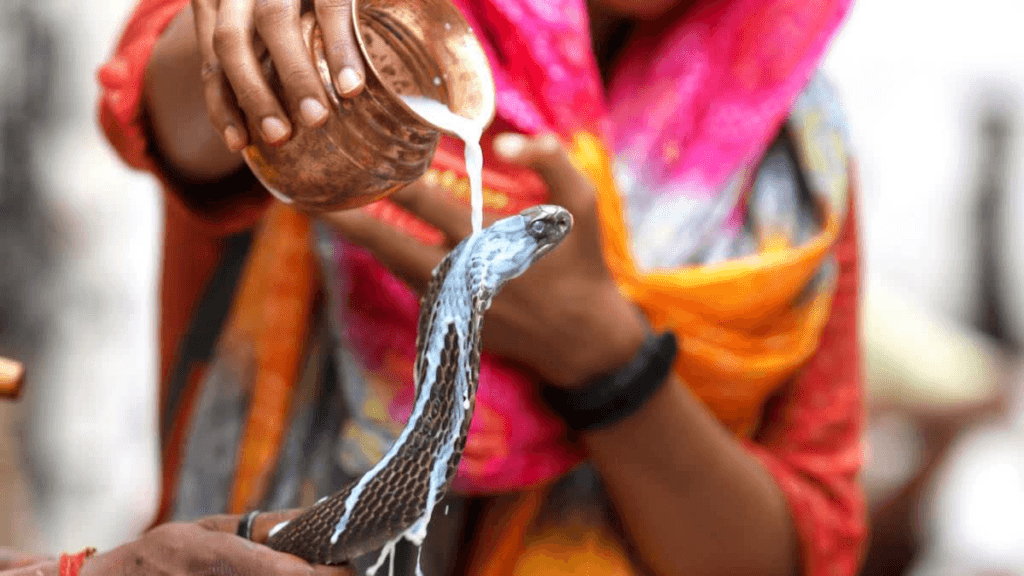
Interestingly, in central India, within Telugu culture, an annual festival called Nagula Chavithi is celebrated. During this festival, women fast and worship the serpent god through rituals involving offerings of milk and dried fruits to snakes. The festival spans several days, with one specific day dedicated to a special Naga, Ashtanga, an eight-headed cobra. It is said that this specific day coincides with the day Shiva drank the Halahala to save the universe.
Animal rights activists disapprove of this practice. Firstly, snakes cannot digest milk. The snakes involved are often starved until they are willing to drink the milk. Snake charmers typically break the snakes’ fangs, sew their mouths shut, and leave only a small hole at the front for the snakes to breathe. Additionally, milk is a product of an industry that exploits cows, which are considered sacred in Hinduism.
הצטרפו לרשימת התפוצה שלנו
כתיבת תגובה