
Chaac is the rain god of the Mayans and was at the center of their worship, probably due to the fact that he rains water from the sky and the Mayans had an issue with water. The Mayans lived in the Yucatan Peninsula. The Yucatan Peninsula is a geological phenomenon. The peninsula consists almost entirely of a karst block, that is, of limestone that penetrates the water, and the meaning is that essentially all the rain that falls is absorbed by the infiltrated soil. As a result, there are almost no water reservoirs or streams in the area, and therefore an area without running water does not allow living conditions.
The Maya's dependence on rain was for a simple reason, it is the only source of water available to them, and it also maintained the only natural sources of water they could find. Geologically, rain that falls on the ground will behave according to the structure of the ground. If the structure is permeable, the water seeps through. Of course, there are also times when the rate of infiltration does not catch up with the permeability of the soil, and then floods occur. Over time, the only water left on the ground will be swamp water, which is non-potable water. So from this point of view the Mayans did not benefit from the rain, but from another point of view it made the rain particularly attractive.
When the percolating water meets with concentrations of carbon dioxide in the soil, an acid is formed that dissolves the limestone and creates underground cavities, which are called karst caves or simply "stalactite caves". Sometimes the layer of soil above these spaces is too heavy, then the soil simply collapses and sinkholes are formed. As the groundwater rises, these sinkholes fill with water. Sometimes to reach this water you have to crawl inside the sinkholes but sometimes the water is visible. These sinkholes are called "cenote", which is a corruption of a word in the Mayan language that means "well". This is how the Mayans saw the only place that could actually be a source of potable water for them. Therefore these places also became holy. Cities were built around cenotes. Temples were built in the cities. One of the well-known temples built around Cenote is Chichén Itzá, which was originally the center of the Mayan culture.
In the Mayan language, as mentioned, the Yucatan Peninsula is described as a place where the water is not abundant, which is called Ma'yaan Ja in their language. However, they would call these wells "the place where the water is", Máay Já. Indeed we see that the origin of the name of the Mayans is related to water. The ancient name of the Yucatan Peninsula was shortened by the Mayans to Mayab, there is a claim that the meaning of the name is "few", "not many" – and refers to not much water. As mentioned, the Mayans depended on the rain. The rain filled these wells, allowing the Mayans to have access to drinking water. But when they were in droughts, the wells dried up or rather their level dropped. This thing symbolized in their eyes a violation of the cosmic balance, and required a special form of worship from them.
To understand worship we must understand Mayan cosmology. Chaac was associated with the four sky gods called the "Four Chaacs" or the "Bacabs". Chaac probably symbolized the "fifth cardinal direction" which is the center of gravity between the four cardinal directions, the Axis Mundi. Each of these gods symbolized a different cardinal direction, and each of them had a different color – the east is red, the west is black, the south is yellow and the north is white. In the myth of the creation of the world in Popol Vuh, these four gods created the world after it was destroyed by the war of the 9 gods of the underworld against the 13 gods of heaven. Each one created a tree of its own color in its own cardinal direction, the Ceiba tree. The trees were called Yaxche. A fifth tree was planted in the center, symbolized by green. This tree connected the three worlds, and symbolized the harmony and balance between them. The top of the tall tree connected the earth with the 13 sections of heaven, and its prominent roots connected the earth with the 9 sections of the underworld. Every time the world went out of balance these gods had to be pleased, and therefore they used the tree as a direct channel to connect with them.
In the aforementioned drought, the balance was broken. The balance between the sky, which was considered the source of the rain, and the depths of the earth, which were considered the karst caves buried under the cenote wells. In years past, the Mayans held the C'ha Cháak ceremony. A festival in which four boys were chosen to represent each of them a different Chaac, who would croak like frogs and hold a service to please God. However, at the time of the drought, it would seem that the gods were not satisfied and therefore messengers should be sent to them in order for them to plead for mercy on man. For this purpose, volunteers were chosen who agreed to be human sacrifices, and these human sacrifices would be thrown into the cenote after their death. The cenote was considered the entrance to the underworld, and therefore a person who sinks into it, his soul is sent directly to the angry gods.
The victims would be dyed with a special pigment that is now called "Maya blue" (in Spanish: azul maya). The pigment is created by blending the indigo dye produced from the anil plant (Indigofera suffruticosa), and a heated Palygorskite clay soil. This clay was abundant in the soil, and especially in the walls of the cenotes (as scientists discovered in the 1960s). The Mayans also used this clay as a medicine, and generally considered it sacred to the god Chaac. In fact, this light blue color symbolized in their eyes the clear water, and whoever was painted with it was actually expressing submission to God.
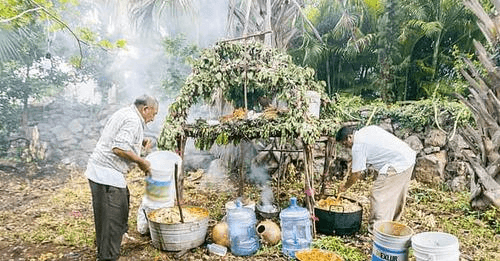
Today, of course, there are no more human sacrifices. The Spaniards saw this custom as something obscene, and forcibly converted the locals to the Catholic Christianity. But it turns out that this ceremony is still held today, in a quasi-Catholic edition. Instead of praying to the god of rain, they pray to Christian saints, they use crosses, and their prayers are accompanied by Christian concepts and biblical verses. The article in the link describes such a ceremony
הצטרפו לרשימת התפוצה שלנו
כתיבת תגובה