
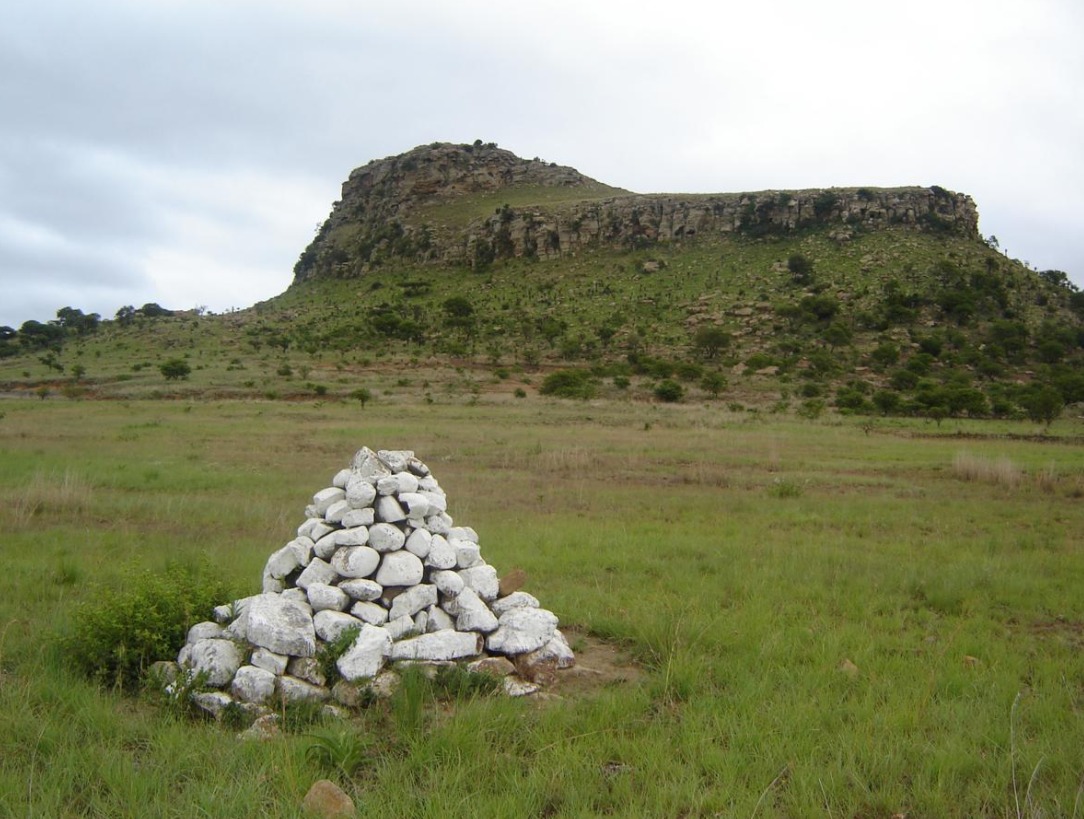
Crossroads in Ancient Greece were considered dangerous and unstable spaces, where boundaries became blurred and humans were exposed to supernatural forces. These were liminal spaces, and the Greeks believed that daimons — elusive, local spirits, sometimes hostile — dwelled there. The fear and sense of danger associated with them are evident in rituals performed at crossroads, especially in the form of secretive or apotropaic offerings, made at night, with averted faces, as was done for the goddess Hecate.
To ward off the danger posed by the daimons of the crossroads, stone cairns were often erected, sometimes featuring a tall central stone pillar. These stones also served as way markers, especially in areas lacking paved roads, but primarily as ritual sites, since it was believed that the daimon resided within the stone itself. Initially seen as the dwelling of the daimon, the stone eventually became its representation — gradually a human head was added, though it never fully transformed into a human figure. This gave rise to the figure of the herm — a protective boundary stone originating from apotropaic magic.
Hermes developed from a roadside daimon associated with a stone heap. His name derives from the Greek term for “stone cairn” (hermaion). Thus, he became a guardian of the roads and a guide through liminal places, and was indeed referred to as “Soter”, the savior god who protects people from dangers along the way.
As noted, Hekate was also such a guardian of paths, sometimes identified with Artemis, who was known as the “Lady of Animals” (Potnia Theron), and thus the patron of wilderness and untamed places — zones of danger inhabited by daimons. This is according to Martin Nilsson in his book A History of Greek Religion.
Both Hekate and Artemis were considered saving deities. According to Theodora Suk Fong Jim, they, along with Hermes, were called “Propylaios” (“Before the Gate”) — a title denoting the god’s physical location, as a protective agent at the entrance, in the transition between outer and inner spaces. Their statues were placed at the entrances to settlements: thus Artemis Propylaios in Eleusis, Hermes Propylaios at the entrance to the Acropolis in Athens, Hecate in an inscription from Miletus, and so on.
There are two stages in the association of these deities with altered states of consciousness:
These stone cairns were often used as graves, and it was also believed that daimons were buried there. For this reason, Hermes became a guide of souls to the afterlife, which is itself a liminal realm. Hecate, too, was a connector between worlds in this way.
Intellectually, when one reaches the land of the unknown, one becomes lost and needs breadcrumbs to mark the way back home—or to the witch’s house. Thus, Hermes and Hecate both became guides for the perplexed.
In both cases, from the image of being lost on a physical path, the two became mentors on the journey toward spiritual salvation.
הצטרפו לרשימת התפוצה שלנו
כתיבת תגובה