
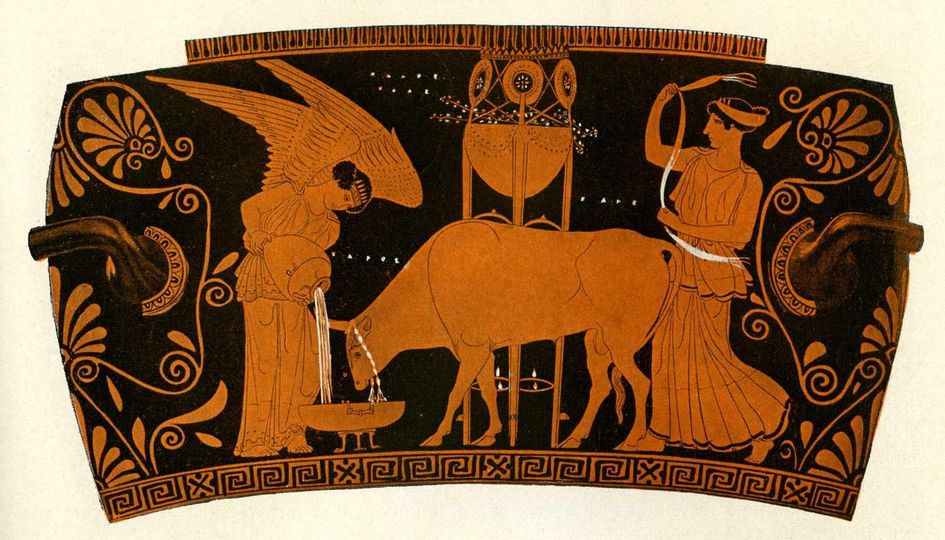
This week's Torah portion "Vayikrah" deals with sacrifices. The sacrifices and especially the blood sacrifices formed the center of the two religions of the ancient world, the Greek religion and the Jewish religion. There is a similarity and of course there is a difference between the two religions. The difference is clear, the nature of the slaughter which is supposed to be "kosher" only for the Jews and the specific animals they sacrifice. The similarity is evidenced (albeit at a much later stage, and from a polemical approach) by the emperor Julian the Apostate, when he writes "The customs of the Jews are similar to the pagans, except that they recognize only one god. This thing is unique to them and foreign to us. But we share the rest of the things – halls, temples, altars, drivers of purity, and certain laws in which there is no difference between us – and if so, only in marginal details".
Among the Greeks, the sacrifice offered was usually something called "thusia" (θυσία), a ceremony that included partial burning of the sacrifice, after separating the parts that can be "read" (i.e: liver for divination) and the parts that are eaten in a festive manner. Something similar to the Jewish "shelamim" sacrifice ceremony (Leviticus 3). This ceremony was mainly aimed at the worship of "Olympian" gods and was done during the day.
Among the Greeks, there was also something that paralleled the "olah" sacrifice (Leviticus 1), in which the whole animal is completely burned. This thing is called sphagia (Σφαγία), after the sphagion, a vessel designed to collect blood. Something perhaps similar to the "sprinkling bowl" ("mazrek") described in the Sacrifice of the "shelamim". The mazrek is so called because it was used to collect the blood that the priests threw (that is, sprinkled, "zarak") on the horns of the altar, but in both cases it is a receptacle. The princes of Israel are told in the book of Numbers that they donated silver "mazrek" or "mizrak" (that is, bowls). In Solomon's temple it is said that there were copper and gold "mizrakot". The reason they had to collect the blood is because there was a special emphasis on cutting the main artery, what is called in Judaism "the tube and the esophagus". The Greeks would pierce them and the squirt would pour directly into the vessel.
Sphagia was usually sacrificed before going to war. This Greek sacrifice is called Holokautein (ὁλοκαυτεῖν), which means "holo" from the word "whole", and "kaustos" from the word "burnt". In Latin "holocaustum" and later in English "holocaust". This sacrifice is of Chthonic origin, and was usually sacrificed to these gods, such as for example the gods of the underworld. It is therefore understandable why it is said that in archaic times a human being was sacrificed, but because of the reluctance to sacrifice human sacrifices it was changed to an animal. In this there may be a parallel to the worship of the Moloch (as described in 2 Kings 3), and this was abominable in the eyes of the "civilized" nations. Among the Jews, we also see the conversion of the human sacrifice into an animal, in the story of Binding of Isaac where Abraham took the knife ("Maachelet"), a word that was supposedly also taken from the Greek, where the knife with which the sacrifice was slaughtered was called "machaira" (μαχαιρα). This is how it was with the Greeks, the conversion of a human sacrifice into an animal.
Following the destruction of the Temple, the Jews stopped sacrificing because there was obviously nowhere to and how to, and converted their sacrifices with prayers. But did they do it under practical circumstances, or simply because they were influenced by the Neoplatons who, at exactly the same time, began to despise blood sacrifices?
We see Porphyry, a vegetarian Neoplatonist, abhors blood sacrifices and explains the logic of this approach in his essay On Abstinence from Eating Animals". Porphyry bases his theory on Theophrastus in his book "Peri Eusebeias" ("On Piety"). He claims that the true priest to the supreme God is none other than the philosopher, who worships his God, above all, with the moderation of his spirit (σωφροσύνη) that allows him to approach God with a pure body and a fresh soul. "The mind of the wise man is the true temple" The wise man turns his heart into an altar, on which stands the true statue of God, his intellect. Vegetarianism is also a tool that allows the philosopher to detach himself from the masses participating in the sacrifice of the polis. Whoever eats meat, will participate in the blood sacrifice ceremony. Those who are vegetarian will give it up.
Porphyry, following Theophrastus, distinguishes, however, between the animal sacrifice among the Jews and the sacrifice among the Greeks, and he obviously means "thusia". And I am quoting from Guy G. Stroumsa's book "La fin du sacrifice : Mutations religieuses de l'antiquité tardive": The sacrifices of the Jews are not at all similar to those of the Greeks, because the Jews do not eat the meat they sacrifice to their God, but burn the animal entirely. But the Greeks are careful not to imitate them in this! Because the Jews are a "race" of philosophers: their sacrifices are opportunities to connect with the divine, "and they dedicate the night to observing and reading the stars, and calling to God in their prayers". Although the Jews offered blood sacrifices, they did not do so because of their lust for flesh, like other gentiles, but because they had no choice. The famine, writes Porphyry following Theophrastus, pushed humans to cannibalism which became human sacrifice, while the original sacrifice of mankind were only from the plant. Blood sacrifices represent a later stage than human sacrifices.
What is the purpose of the victims? "We must unite with God, become like Him and offer Him as a holy sacrifice our ascension, since it is the service of our soul and its redemption. This sacrifice is embodied in the equanimity of the soul and in the contemplation of God," writes Porphyry. Iamblichus, another Neoplatonic philosopher, although he disagrees with Porphyry about vegetarianism, still agrees that superior beings do not need sacrifices at all. In his book "On the Mysteries of Egypt" he claims that only the lower gods, the material, require sacrifices. The blood sacrifices represent the material aspect of the worship, alongside the spiritual aspect that exists in it; the dual composition of man, both material and spiritual, is the reason for this ritual duality. Along with the blood sacrifices there is another type of sacrifice, more spiritual. Spiritual sacrifices These are the ones sacrificed by the philosophers, who ascend to the One, above and beyond the multiplicity of divinities: a small elite that exists beyond any law. Blood sacrifices, on the other hand, are committed to the "hoi polloi", the people of the polis who need a lawgiver (chapter 22).
Towards the end of the fifth book, Iamblichus discusses the prayer that accompanies the sacrifice (chapter 26). The purpose of prayer is to bring us closer to the gods, to establish contact with the divine. The sacrifice and the prayer complement each other. Union with the gods is also at the center of a small treatise, "On the Gods and the World", which presents the main beliefs of later paganism and was written by Sallustius. For Sallustius, temples are nothing but exact replicas of the heavens, reflecting unattainable heavenly powers. Despite this, in these temples there is no use for the gods (and what use can they have?), but for us, since there we can unite with them. Blood sacrifices represent our lives, which we sacrifice symbolically. Prayers that are not accompanied by sacrifices are empty words without any value, while when they are said during the sacrifice they become "living words". The soul of the sacrificed animal ascends in some way to heaven, together with the words of the prayer in which we seek to unite with the gods (chapter 16).
הצטרפו לרשימת התפוצה שלנו
כתיבת תגובה