
While in the modern world, disability is often viewed as a state of physical or mental weakness, in many ancient cultures, those with disabilities were not perceived this way at all. On the contrary, they were empowered, respected, and even attributed with special spiritual abilities.
In the indigenous cultures of Central and South America, people with physical disabilities were not considered weak. The opposite is true. In small ceramic figurines found at the Michael C. Carlos Museum at Emory University, we see figures with unusual physiognomies—some with completely white eyes, others with protrusions from the chest and back, and in some cases, a combination of male and female genitalia on a single body. In many cases, these figures are adorned with luxurious clothing, jewelry, and depicted in meditation poses or fertility symbols—all signs of honor and spiritual roles. Shamans in these cultures were considered intermediaries between the physical world and the spiritual world, and they were attributed with healing powers and communication with spirits because of their ability to survive harsh physical challenges. In other words, their struggle with illness or disability was seen as a sign of spiritual strength, not weakness.
The attribution of shamans with disabilities to spiritual powers stems, in part, from the idea that the shaman is a figure who exists "in between"—between life and death, between male and female, between the visible and the unseen. In many cultures, especially in ancient America, shamans were seen as those who could traverse worlds and cross the boundary between the physical and the spiritual.
Disability or illness, which can be interpreted as being close to death or the unknown, was considered a sign that the shaman had undergone a physical or mental challenge that granted them access to other realms. For example, in one of the figurines documented in the Carlos Museum, a person with their face ravaged by leishmaniasis, a cruel disease that eats away the flesh around the nose and mouth, is depicted. The figurine does not present the person as a victim but rather as a spiritual figure of great power who survived a harsh disease and gained healing powers and spiritual communication.
Additionally, in the article "Empowered, Not Disabled" by Professor Rebecca Stone from Emory University, attached here, I can add a few things relevant to the upcoming lectures in the "Temple of Consciousness" series next month.
The first point is that it turns out that even in the Bible, various prophets, particularly the earlier ones, are depicted as having disabilities. Perhaps we haven't noticed this, and what is the interest in mentioning their disabilities? Moses was "slow of speech and tongue", Elisha was grotesquely bald, thus having physical differences, Jacob was limping, Job was afflicted with boils and suffering, and Jeremiah frequently describes how he suffered both from afflictions and negative reactions to his nature, and so on. Is this a coincidence, or were the prophets really a kind of shamans?
In mythology, there are many examples of disabled or unusual figures, who were sometimes elevated intellectually or spiritually precisely because of their conditions. For example, Hephaestus, the god of blacksmithing and fire, was disabled and deformed, but he was the one who forged the weapons of the gods. Metallurgy in the ancient world was almost considered a spiritual craft, as Dr. Nissim Amzallag will demonstrate in his upcoming lecture on December 18th. In Norse mythology, there are several disabled gods, such as Tyr, the god of war, who lost his hand when trying to save the world from the fearsome wolf Fenrir. War is the primary use of metal, and thus it is significant that this god is depicted as disabled. Odin is also described as having sacrificed his eye to gain knowledge and supernatural powers, a theme that recurs in many traditions.
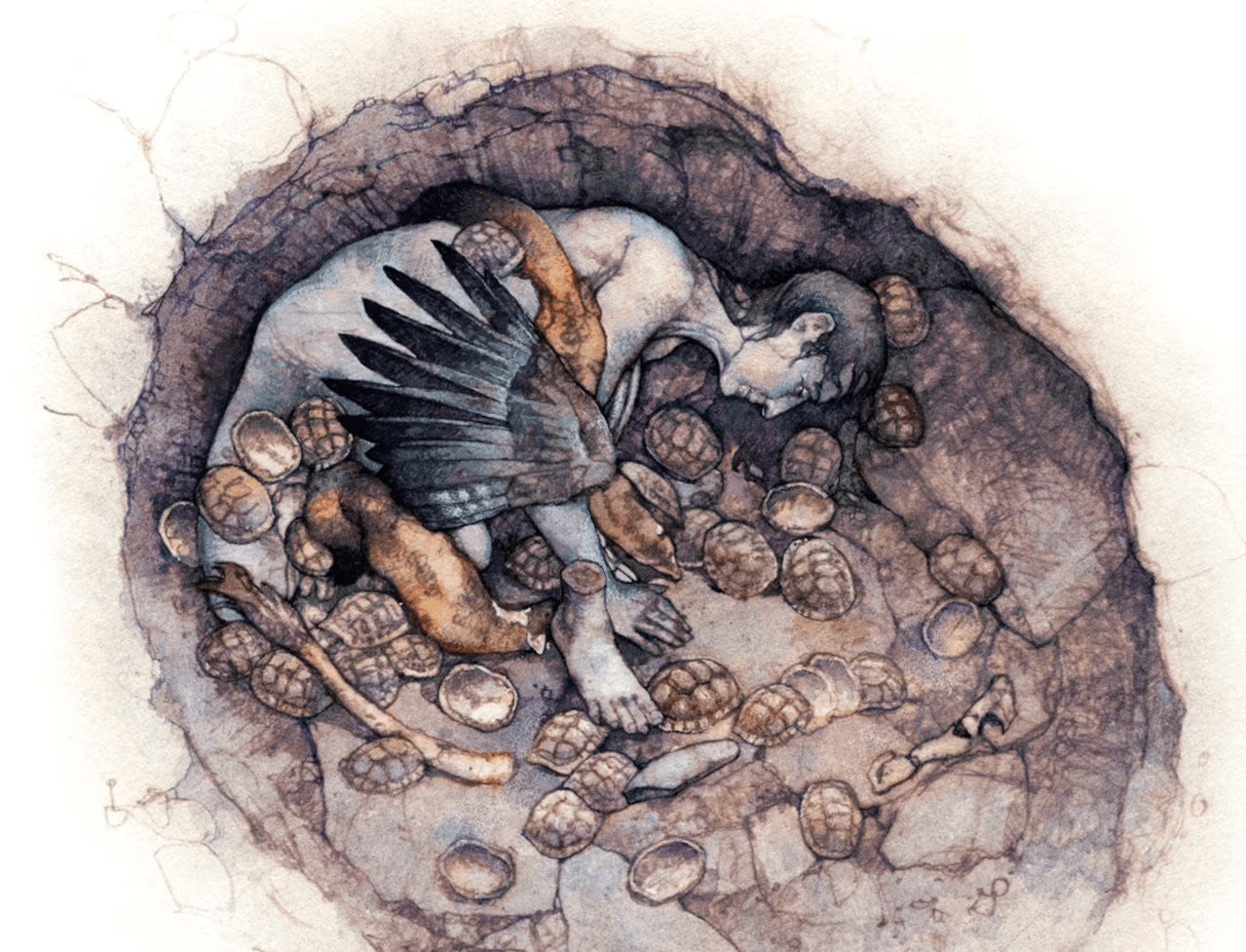
The second and more important point is that in the Hilazon Tachtit Cave, the Natufian shaman found there was disabled. Nevertheless, she was buried with honor, not only in the preparation of the grave but also with the offerings found with her. This indicated her high spiritual status. This subject will also be discussed by Professor Leore Grossman in her lecture on November 28th. However, Professor Grossman wanted to emphasize that she is an archaeologist, not an anthropologist, so the issue of disability will likely not be the central focus of her lecture, beyond a fun fact that strengthens the anthropological theories as Professor Stone suggested. In the attached image, an illustration of the shaman woman and the offerings found beside her, including a portion of a human leg… (Imagination can answer the question of why—perhaps it relates to her type of disability).
הצטרפו לרשימת התפוצה שלנו
כתיבת תגובה