
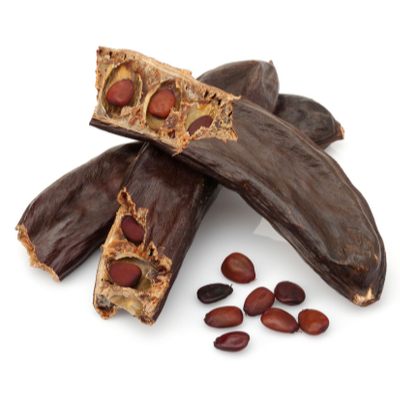
The carob appears in quite a few Chazal (i.e jewish sages) legends in the context of destruction and redemption. I believe that the source of the adoration for the carob comes from the Hellenistic culture.
Two legends are known: the first is about the Khoni Hame'agel (John the circle maker) falling asleep for 70 years, which is a time when the carob bears first fruits – 70 years are also the years of destruction, and another version of the legend tells that the time when the Khoni Hame'agel fell asleep was actually the time of exile, he fell asleep when the first temple was built was built and woke up when the second temple was already built. In the meantime, the temple was destructed.
A second legend tells of Rabbi Shimon bar Yochai (aka Rashbi) who hid in a cave for 13 years, feeding only on carobs. After Rashbi came out of the cave, he cleansed Tiberias of the impurity of the dead.
What connects these two legends is an ancient legend that originally comes from the Minoan culture in Crete. Epimenides, who is considered the prophet of Zeus, fell asleep in a cave, which is also known as the Cave of Zeus, for 57 years. After leaving, he cleansed Athens of a plague that broke out in it. Zeus himself hid in this cave (where Epimenides fell asleep, and Pythagoras was also initiated there) in his childhood during the time when he feared the wrath of his father who wanted to kill all his children, because one of his children was supposed to kill him according to the prophecy. During all this time he was fed on honey, which according to some interpretations was none other than carob honey of which identify ambrosia with carob honey.
Epimenides is considered to be the one who, according to the legend, founded the Orphic cult, and who had a special section with the "near death", meaning something that is between a mystical experience, death and resurrection. Reaching this state, which has been a shamanic practice since time immemorial, also made the Orphs a sect that worships this state of life after death. Or more correctly to the meeting point between them, between life and death, what is called "immortality". From there it seeped into Judaism.
A state of destruction was considered a state of death, a state of the building of the Temple was considered a state of life, and this moment when the world went from state A to state B, was considered the moment when the order of the world changed, or as the Gemara calls it, "in these days, the world has changed". Meaning, as soon as the temple was destructed, something "x" happened and as soon as the Messiah comes and builds the temple, something "x inverse" happens.
Well, what is this "x" thing? The Gemara in the Sotah tractate speaks of the fact that from the time the Temple was destroyed "there is not a day without a curse, and the taste of the fruits has gone and some say even the fat of the fruits." What do you mean? Rabbi Yochanan says, "When a child ate carob, a thread of honey is drawn on both his hands". That is to say, the thing that symbolizes that "threshold" is the carob. The one who eats carobs is the one who is able to reach such a state, and the one who lives on carobs diet is the one who was in such a state of platonic ideal perfection.
It is not said what the diet of the Orphs or the Pythagoreans. It is said that they were vegetarians, it is not said what vegetarianism is. This vegetarianism, I suggest, was the same diet of the Rashbi, which also turns out to be the diet of John the Baptist – carob honey, according to the verse in Isaiah "If you desire and hear, you shall eat the good of the land,; and if you won't desire to do it, you shall be eaten by the sword (or: eat the sword)" – and as the Midrash Rabba says sword is actually carob (same letters in hebrew חרב).
P.S In the book "Paralipomena of Jeremiah" or "4 Baruch" there is a similar story about "Abimelech the Ethiopian", aka "Ebed-melech the Kushi", who fell asleep for 66 years while gathering "figs dripping with milk". Rivka Nir (of the Israeli open university) explains that the book is an adaptation of the midrash about the Khoni Hame'agel, which underwent a Christian metamorphosis and the fruit became a fig in order to link it to Jesus' prophecy about the flowering of the fig as an eschatological sign (Mark 13). The purpose of this book is similar, to tap the transition between destruction and redemption, dream sleep and awakening, and the non-destructed situation as a situation where the fruits have a its juicy taste.
הצטרפו לרשימת התפוצה שלנו
כתיבת תגובה