
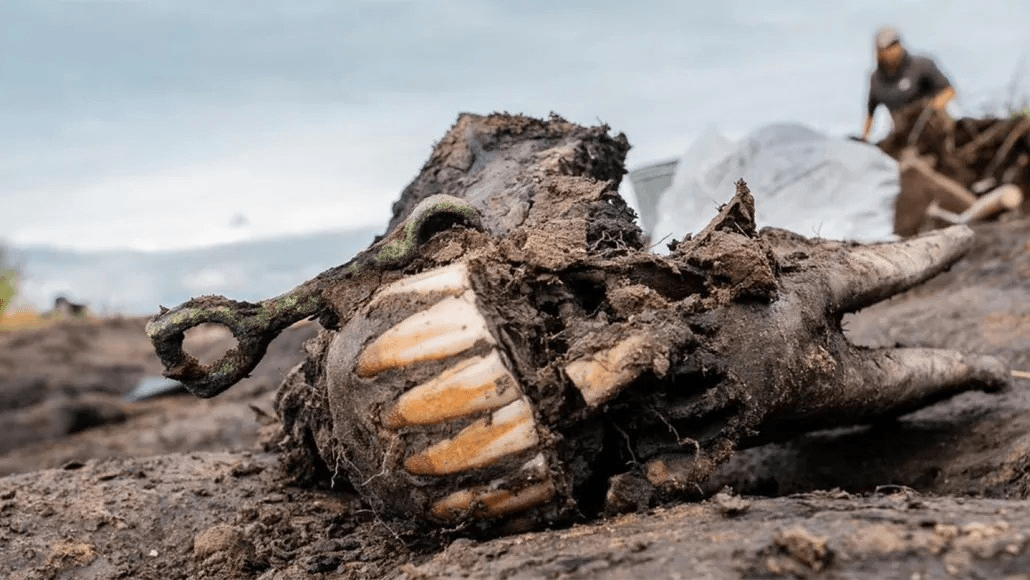
At Tunnug 1, a royal tomb in Tuva, southern Siberia, the remains of at least 18 horses and one human were found, sacrificed as part of a burial ritual that appears similar to the horse-sacrifice ceremonies described in Scythian burial practices. Additionally, items such as horse tack, bronze belt fittings adorned with animal motifs, and weaponry were discovered, along with carbon-14 dating indicating the Early Iron Age—specifically, the late 9th or early 8th century BCE.
The findings align with the descriptions of Herodotus, the Greek historian, who described the burial of Scythian kings, in which servants and horses were sacrificed as part of the ritual. Furthermore, the use of birch stakes corresponds to the concept of "spectral riders" mentioned by Herodotus as unique Scythian burial practices.
The findings at Tunnug 1 indicate a cultural connection between the horse-herding cultures of southern Siberia and the Scythian culture, suggesting cultural continuity and a trend of spreading burial and riding traditions from east to west across the Eurasian steppes. The tradition that began in Siberia in the 9th century BCE likely spread westward and became an essential part of the known Scythian culture. These findings point to cultural interactions between Siberian populations and the Scythians in the west earlier than previously thought.
The "spectral rider" burial described by Herodotus is part of an additional ritual performed at "the turn of the year" (4.72). Herodotus details the royal burial rites as involving the transportation of the body from tribe to tribe, with each tribe performing unique mourning ceremonies that include self-inflicted injuries as a sign of respect. After the journey ends, the body is taken to a designated burial site.
The body is wrapped in wax, and the abdominal cavity is cleansed and filled with spices and medicinal herbs. Following this, the body is transported in wagons to the tribes under Scythian rule. At the designated burial site, various items are placed alongside the king, such as spears, mats, servants, horses, and an array of other items, including gold bowls, though silver or copper is not used. The grave is covered by a large mound.
At the end of the year, an additional ritual is conducted in which fifty servants and fifty horses are selected for sacrifice. Each body is filled with chaff, and the sacrificed horses and attendants are arranged in a circle around the tomb on half-wheels and logs supporting the bodies, giving the appearance that the horses are mounted, with legs hanging in the air, supported by stakes that pierce the horse to maintain stability.
The burial of commoners is also described: they are transported by relatives to visit friends for forty days before burial. After burial, a unique Scythian purification ritual is performed, which involves heating stones and boiling water in dedicated tents. This ritual includes heating cannabis seeds on heated stones to create thick, hot smoke, inducing perspiration. It serves both for cleanliness and a refreshing sensation in place of water bathing, and in this context, it is performed for purification purposes.
Afterwards, when the year comes round again, they do as follows:—they take the most capable of the remaining servants,—and these are native Scythians, for those serve him whom the king himself commands to do so, and his servants are not bought for money,—of these attendants then they strangle fifty and also fifty of the finest horses; and when they have taken out their bowels and cleansed the belly, they fill it with chaff and sew it together again. Then they set the half of a wheel upon two stakes with the hollow side upwards, and the other half of the wheel upon other two stakes, and in this manner they fix a number of these; and after this they run thick stakes through the length of the horses as far as the necks, and they mount them upon the wheels; and the front pieces of wheel support the shoulders of the horses, while those behind bear up their bellies, going by the side of the thighs; and both front and hind legs hang in the air. On the horses they put bridles and bits, and stretch the bridles tight in front of them and then tie them up to pegs: and of the fifty young men who have been strangled they mount each one upon his horse, having first run a straight stake through each body along by the spine up to the neck; and a part of this stake projects below, which they fasten into a socket made in the other stake that runs through the horse. Having set horsemen such as I have described in a circle round the tomb, they then ride away.
הצטרפו לרשימת התפוצה שלנו
כתיבת תגובה